
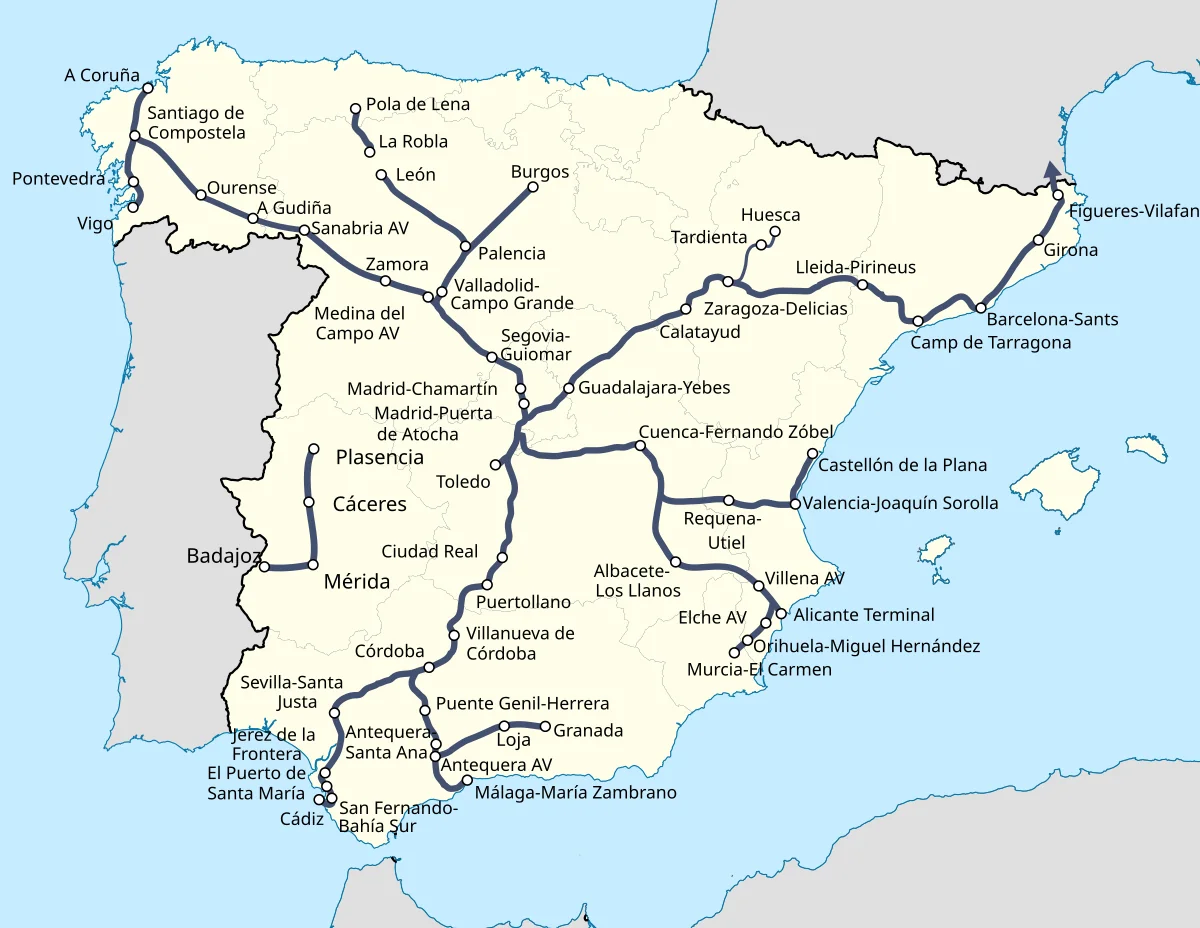
Spain high speed rail is the second longest high speed rail network in the world after China. It consists of roughly 4,000 kilometers (about 2,500 miles) of dedicated high speed lines, mostly radiating from Madrid, and connects most major Spanish cities with trains that regularly run at 250 to 300 km/h. Built largely since 1992, it has become the most extensive high speed rail network in Europe and continues to expand.
What surprises many people is not just the size of Spain high speed rail, but how much it has changed daily life. In a few decades, Spain went from slow, decrepit long distance trains to a system where trips such as Madrid to Barcelona or Seville are so fast and affordable that flying or driving often makes less sense. For many routes, high speed rail is now the default choice for commuting, tourism and business travel.
What is Spain high speed rail and how big is the network?
Spain high speed rail is a nationwide system of passenger rail lines designed for speeds of at least 250 km/h on dedicated track. Branded mainly as AVE (Alta Velocidad Española), with newer low cost and competing brands such as Avlo, Ouigo España and Iryo, it links Madrid with most major regional capitals and several important secondary cities. According to reporting in 2023, the network spans roughly 4,000 km of high speed lines, making it the longest in Europe and second in the world after China, which has more than 40,000 km of high speed track.1
The backbone is a radial layout from Madrid: high speed lines run to Barcelona, Seville, Malaga, Valencia, Alicante, Valladolid, León and other cities, with more under construction toward the north and northwest. This layout means that, from Madrid, you can reach most major cities in under three hours. Some corridors, especially Madrid to Barcelona and Madrid to Seville, see dozens of trains per day operated by several companies that share the infrastructure.
By track length, Spain is the high speed rail leader in Europe, ahead of France, and ranks second globally only to China in total kilometers of dedicated high speed lines.
Despite this impressive length, the network is still incomplete as a mesh. Commenters in Spain often point out the lack of direct high speed links along the northern coast or between certain coastal cities, which still forces many journeys to route through Madrid or to rely on buses and conventional trains. Even so, the existing system already allows many long distance trips of 400 to 600 km to be completed in just a few hours.
How did Spain build such a large high speed rail system?
Several ingredients allowed Spain to build a very extensive high speed rail network relatively quickly. The first is timing and political consensus. Spain opened its first AVE line between Madrid and Seville in 1992, ahead of the Barcelona Olympics and Expo 92 in Seville. Since then, governments from both left and right have consistently backed high speed rail expansion. According to journalist María Ramírez, no major Spanish party now dares to oppose high speed rail because the service is so popular with voters.1
Second, European Union structural and cohesion funds played a major role. Spain spent an estimated 57 billion euros to build its high speed network, with roughly one in four euros coming from EU sources.1 These funds were not unique to Spain, but Spanish governments proved particularly adept at channeling them into transport infrastructure rather than dispersing them across many smaller projects.
Analyses of international construction costs find that Spain builds high speed rail at some of the lowest per kilometer costs in the developed world, often below 25 million euros per km, with only France comparable in Europe.
Third, Spain is unusually efficient at actually building infrastructure once decisions are made. Work by the Transit Costs Project at New York University, summarized in Spanish media, shows that Spain has some of the lowest costs per kilometer for underground metro lines and high speed rail among rich countries, far below the United Kingdom, Germany or the United States.2 An opinion piece in Vozpópuli highlights that Spain builds metro tunnels at about 97 million dollars per km on average, compared with more than 500 million in the UK, and notes that high speed rail costs are also unusually low.
Experts attribute this to strong in-house engineering capacity in public works ministries, detailed planning before contracts are awarded, and experienced construction firms. Spain has exported this expertise: Spanish companies have helped build or manage rail projects abroad, including in the UK and the Middle East.
How does Spain high speed rail work in practice for travelers?
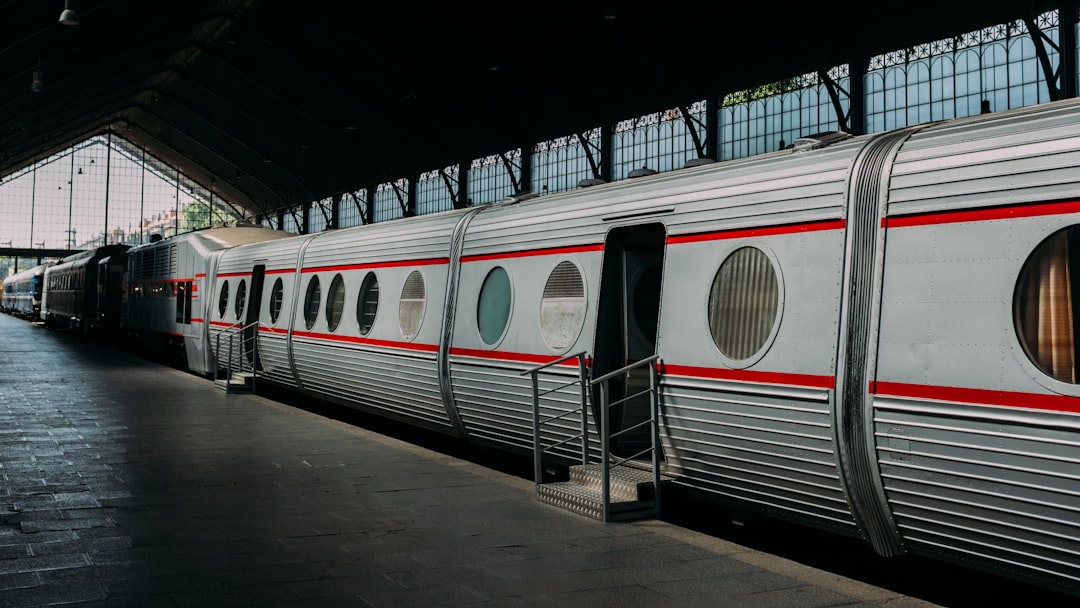
For passengers, Spain high speed rail has become a routine part of daily life, especially for intercity travel over distances of around 200 to 700 km. High speed trains between Madrid and Barcelona cover about 620 km in 2.5 to 3 hours. On the Madrid to Seville and Madrid to Valencia routes, trips are often around 2.5 hours or less. Compared with driving, these journeys can cut travel time in half; compared with flying, they are competitive or faster once airport transfers and security are included.
A notable feature of the system is reliability and passenger rights. On Renfe operated AVE services, if a high speed train arrives more than 15 minutes late, passengers are entitled to a 50 percent refund; more than 30 minutes late, they get a full refund.1 This strong punctuality guarantee has helped build public trust. At the same time, the liberalization of the rail market since 2021 has brought new operators that compete on price and service quality, particularly on the busiest corridors.
- Speed and frequency: Trains routinely operate at 250 to 300 km/h, with dozens of departures per day on trunk routes.
- Comfort: Modern rolling stock, quiet cabins, air conditioning, reserved seating and on board services make long journeys comfortable enough for work or rest.
- Pricing: Competition and yield management produce a wide range of fares. Promotional tickets between Madrid and Barcelona can be as low as 20 euros, sometimes cheaper than a taxi across the same city.
- Integration: High speed stations are usually close to city centers, unlike many airports.
In everyday terms, this means that someone living in a medium sized city within 200 to 300 km of Madrid can realistically commute to the capital in about an hour. As one Spanish resident quoted in media noted, commuting by high speed train can take less time than crossing a big city by car or metro. Weekend trips for leisure have also become common, with trains often full of tourists and short break travelers.
What impact has high speed rail had on Spain’s economy and cities?
Measuring the precise economic impact of high speed rail is complex, but case studies inside Spain point to significant local effects. Cities that gained high speed rail connections have seen growth in tourism, commuting and business links. León, a northern city of about 120,000 people with an aging population and a post industrial economy, is often cited as an example. Before the high speed line opened in 2015, the train trip from Madrid to León took nearly five hours; now it takes less than two, and tourism has surged as day trips from Madrid have become easy.1
In many Spanish cities, high speed rail appears to have created demand as much as it has met existing demand, attracting new residents, tourists and businesses once travel times drop dramatically.
Economists point to several channels through which high speed rail can influence growth:
- Wider labor markets: Faster travel effectively enlarges the area from which workers can commute, which can reduce unemployment frictions and allow people to live in cheaper locations while accessing higher paying jobs.
- Tourism and services: Easier access encourages short visits to smaller cities that were previously too far for day trips, boosting local hospitality and retail sectors.
- Business connectivity: High speed rail supports frequent face to face meetings between firms in different cities, especially where travel time drops below about three hours, the range in which rail can outcompete air travel.
- Regional balance: In theory, improved links can help spread growth beyond the capital, though critics in Spain argue that the heavily radial network also reinforces Madrid’s central role.
Official assessments by Spain’s infrastructure ministry and independent researchers have found positive, though uneven, impacts. Some routes that serve smaller or less dynamic regions are used far less and are sometimes criticized as politically motivated. At the same time, heavily traveled corridors such as Madrid to Barcelona have broken passenger records in recent years, especially after new entrants increased capacity and lowered fares.1
Beyond economics, high speed rail has environmental and social effects. It shifts travel from cars and short haul flights to trains, which have much lower emissions per passenger kilometer when powered by a largely decarbonized electricity mix. It also changes how Spaniards conceptualize distance: trips that once required planning and overnight stays are now everyday possibilities.
What are the limitations and controversies around Spain high speed rail?

Despite its successes, Spain high speed rail is not without problems and criticism. One issue is network design. The system is strongly centralized around Madrid, reflecting both geography and political decisions. Coastal and cross country links, especially in the north and between some major Mediterranean cities, remain incomplete. For example, a continuous high speed corridor along the northern coast from A Coruña through Oviedo and Bilbao to San Sebastián has been slow and expensive to build because of mountainous terrain.
The most notorious case is the high speed connection to Asturias. Planning for the final 50 km section from León began around 2003, and it only entered service roughly two decades later. The cost ballooned to about 4 billion euros, five times the Spanish average per kilometer, due to long tunnels, difficult geology and engineering challenges. The works also caused local environmental impacts, such as water management issues, which drew public criticism and legal scrutiny.1
Another limitation is the contrast with local and regional rail. While high speed trains are fast and usually punctual, many suburban and regional lines in Spain are underfunded and unreliable. Regions like Extremadura, on the western border with Portugal, have long complained of outdated conventional services even as high speed lines open elsewhere. In metropolitan areas, particularly around Madrid and Barcelona, expanding commuter rail capacity has lagged behind suburban sprawl.
Spain excels at executing big construction projects, but analysts argue that deciding where and when to build is often more political than economic, which can lead to underused lines.
Finally, there is an ongoing debate about cost effectiveness. Studies highlighted in Spanish commentary note that Spain’s state machinery is extremely efficient at spending money on tangible projects like railways, clinics and roads, but less effective at designing the legal and economic frameworks that determine which projects are truly needed.2 As a result, Spain may have built more high speed track than is strictly justified by demand in some corridors. Yet because construction costs are low by international standards, many of these lines still look relatively inexpensive compared with similar projects in the UK or US.
What lessons does Spain high speed rail offer other countries?
Spain’s experience offers several lessons for countries considering high speed rail, especially medium density nations with multiple mid sized cities. First, a long term political consensus, spanning parties and regions, is crucial. In Spain, governments from different ideologies continued to expand the network rather than restarting debates about whether high speed rail should exist at all. This stability made it easier to plan corridors and attract EU co funding.
Second, institutional capacity and cost control matter as much as funding levels. Spain’s public works ministries and state rail infrastructure manager, Adif, invested in internal technical expertise, careful preconstruction studies, and robust oversight of contractors. International comparisons suggest that these practices help keep per kilometer costs low relative to peers.2 Countries where each big project is treated as a one off with limited in house engineering knowledge often see much higher costs.
Third, high speed rail can change travel behavior more than simple models predict. In Spain, once lines opened and travel times fell dramatically, trains often created new demand: commuters started living farther from their workplaces, tourists began visiting previously overlooked cities, and people reconsidered whether they needed to fly. That suggests that demand forecasts based on previous travel patterns may underestimate the long term impact of high speed rail.
For North America in particular, commentators note that regions like the US Northeast Corridor or the Toronto Montreal Quebec City corridor in Canada have population densities and intercity distances comparable to Spain. Yet they lack similarly extensive or fast rail systems. Spain’s network shows that medium sized countries, not only ultra dense ones like Japan, can build and operate large high speed rail systems when policy, institutions and funding align.
At the same time, Spain also serves as a cautionary case about overbuilding and regional politics. The challenge is not only to build quickly and cheaply, but to choose corridors and complementary local transport investments that maximize social and economic benefits over decades.