
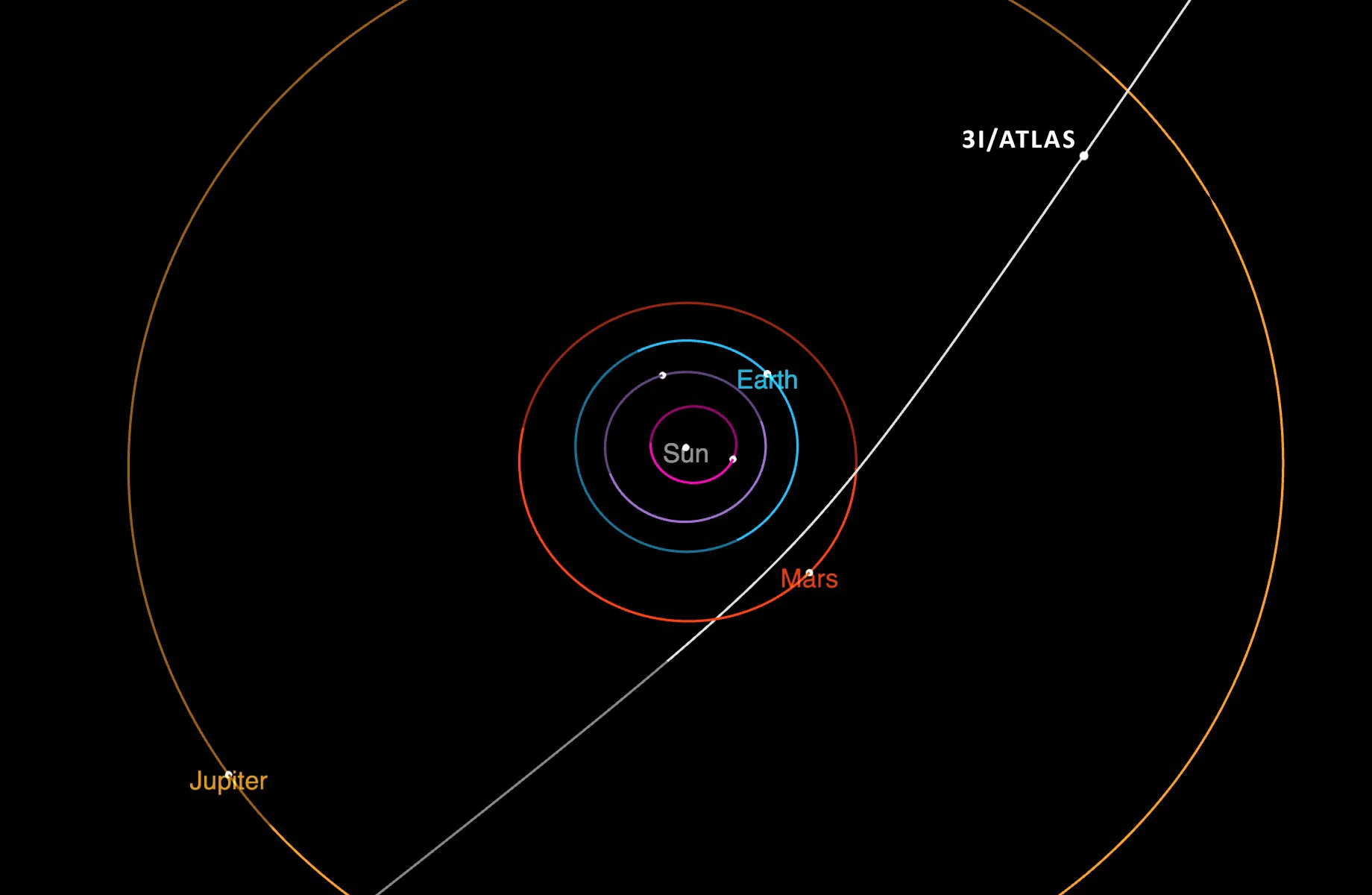
A dirty snowball from another star system is cruising past at nearly twice Earth-Sun distance, and about twenty different teams are staring at it with everything from heliophysics probes to James Webb. Those 3I/ATLAS observations are not just “cool comet pics”, they’re the dress rehearsal for turning interstellar debris into a routine experiment.
Look, the key shift is this: 3I/ATLAS is the moment interstellar objects switch from rare miracles to scheduled lab work. We stopped asking “will we ever see another one?” and started planning “which instruments get time on the next five?”
That sounds subtle, but it completely changes how we study planet formation beyond the Sun.
TL;DR
- 3I/ATLAS looks like a “normal” comet with a very not‑normal, hyperbolic orbit, clear proof it’s interstellar.
- Coordinated 3I/ATLAS observations (JWST, SPHEREx, spacecraft, big ground scopes) turned it into a controlled experiment on extrasolar ices and organics.
- Rubin‑class surveys plus missions like Comet Interceptor mean these visitors are about to become repeatable labs for comparative planetology, not one‑off curiosities.
What Is Comet 3I/ATLAS? A 40-60 word answer
Comet 3I/ATLAS is the third confirmed interstellar object, an active comet on a clearly hyperbolic orbit, discovered in 2025 and passing safely at ~170 million miles from Earth. Its speed and trajectory show it’s not bound to the Sun, so its ices and dust are raw material from another planetary system.
For more background details, see our Comet 3I/ATLAS archive.
What the 3I/ATLAS observations actually found
OK, so imagine you’re handed a snow cone from a stranger and told, “This came from another country. Tell me what their water and air are like.” That’s basically what 3I/ATLAS is for astronomers.
We’re sampling another system’s leftovers, but at a distance.
NASA lined up an absurd amount of hardware for this: heliophysics missions like STEREO watched its dust and gas tail from space, Mars‑orbiters shot images from another vantage point, and big ground telescopes tracked its brightness and activity. On top of that, infrared specialists, JWST and the upcoming SPHEREx mission, went after its chemical fingerprints.
SPHEREx already reported infrared detections of organic molecules as the comet brightened. That means carbon‑bearing compounds, the same broad class of stuff we worry about in prebiotic chemistry, survive the million‑year sandblasting of interstellar space.
Webb’s role is spectroscopy: splitting the comet’s light into colors so you can see which molecules are present. In practice, that means:
- Volatiles like water, carbon monoxide, carbon dioxide
- More complex organics that leave distinct lines in the infrared
- The relative ratios of those ices, which encode how and where the comet formed
The striking thing so far is not that 3I/ATLAS is bizarre. It’s that, as NASA’s scientists keep stressing, it looks like a really normal comet that just happens to be from somewhere else. Activity ramps up when it gets sunlit. The coma and tail behave as expected. The ice mix is familiar.
If ʻOumuamua was the weird cousin and 2I/Borisov was the first “OK, that’s basically a regular comet,” then 3I/ATLAS is your second and third and fourth data point rolled together, the one that lets you start drawing a trend line.
Why 3I/ATLAS observations matter: interstellar visitors as repeatable labs
Here’s the thing: the fun part isn’t that 3I/ATLAS exists. It’s that we’re finally set up to do the same experiment over and over on objects like it.
For ʻOumuamua, we had telescopes scrambling in panic. For 2I/Borisov, we had a plan, but only a handful of big instruments got a shot. For 3I/ATLAS, NASA talks about “nearly 20 science missions and research teams” tracking it in a coordinated way.
That progression is the story.
Think of each interstellar comet as a test tube. You can measure:
- Ice composition (water vs CO vs CO₂ vs exotic stuff)
- Organic molecules and their complexity
- Dust grain sizes and mineralogy
- How easily it “turns on”, when does it start outgassing?
Now imagine lining up dozens of those test tubes from dozens of star systems.
If 3I/ATLAS looks chemically boring, similar ice ratios, similar organics to solar‑system comets, that’s actually a huge result. It says the processes making icy planetesimals around other stars converge on something a lot like ours. Planet formation may be more universal than we feared.
If, as we add more objects, we start to see clear “families”, some comets that are CO‑rich and water‑poor, some with weird organic signatures, that’s even better. You can start asking, “Do these correspond to different kinds of protoplanetary disks? To different stellar metallicities? To stars that form planets in different ways?”
That’s comparative planetology, but sideways in time and space. Instead of just comparing Mars vs Earth vs Jupiter’s moons, you’re comparing our leftovers to their leftovers.
And 3I/ATLAS is the inflection point where that stopped being a science‑fiction idea and turned into a survey strategy.
Rubin Observatory: from miracles to statistics
All of this hinges on one thing: you can’t do statistics with three objects.
Enter the Vera C. Rubin Observatory.
Rubin’s LSST camera will scan the entire southern sky every few nights with a 3.2‑gigapixel imager. The Space.com analysis points out that in just 10 hours of early commissioning, Rubin pulled out 2,104 new asteroids. Its specialty is catching fast, faint, moving things, exactly what interstellar objects are.
Right now, 3I/ATLAS feels special because it’s “the third one ever.” In a Rubin world, that framing flips. You get:
- Automated difference imaging that flags anything moving weirdly fast
- An alert stream with millions of events per night
- Filtering pipelines tuned specifically to hyperbolic, high‑velocity candidates
Suddenly “third interstellar object” becomes “the third this year.”
The non‑obvious implication is this: the bottleneck moves from discovery to follow‑up. Rubin’s not the scarce resource; telescope time on JWST, SPHEREx, big ground‑based spectrographs, and opportunistic spacecraft is.
So 3I/ATLAS won’t be the last heroic, all‑hands campaign. It’s the prototype for a playbook:
- Rubin (and other surveys) flag a likely interstellar interloper.
- Automatic alerts reserve JWST/ground‑based time within days.
- Heliophysics and planetary missions check whether it crosses their fields of view.
- We run the same “chemical panel” on each one and drop the results into a growing catalog.
At that point, “interstellar comet science” is less about any single object and more about building an atlas, appropriately enough, of how other star systems build icy debris.
What comes next: missions, chases, and eventual sample returns
This leads to the obvious sci‑fi question Reddit users asked in the AMA: can we actually chase one of these, land, and bring material back?
Today, for 3I/ATLAS itself, the answer is basically no. They move fast, we find them late, and our current rockets can’t instantly pivot and catch up.
But notice how ESA’s Comet Interceptor mission is designed: launch it in 2028/29, “park” it near the Sun-Earth L2 point, and wait. When a promising long‑period comet or interstellar object shows up, the spacecraft sprints out, splits into three pieces, and does a 3D flyby.
That’s the correct mental model: think of Comet Interceptor as a goalie waiting in front of the net, not a player sprinting from the locker room after the puck is already moving.
As detection gets earlier (thanks to Rubin) and targeting gets more flexible, you can imagine a stack of “standby” assets:
- One or more interceptor spacecraft loitering at L2
- A roster of pre‑approved observation programs on Webb and its successors, triggered by an ISO alert
- Eventually, specialized sample‑return missions for the very rare cases where geometry and speed line up
Is a true interstellar sample return realistic? Not in the next decade. But the infrastructure we’re building for 3I/ATLAS‑style campaigns, wide surveys, agile interceptors, standardized spectroscopy, is exactly the scaffold you’d need.
And here’s the beautiful part: even without boots‑on‑comet, remote spectra plus statistics already let us falsify planet‑formation models. If your theory predicts that disks around low‑metallicity stars produce CO‑rich comets, and Rubin+Webb find that all the CO‑rich interstellar comets have trajectories pointing back to such stars, that’s an empirical win.
3I/ATLAS is the first time we’re doing that kind of thinking with a realistic path to N=50.
Key Takeaways
- 3I/ATLAS observations show a chemically familiar but orbitally exotic comet, strong evidence that “our” comet recipe isn’t unique to the solar system.
- The big shift is organizational, not just scientific: nearly 20 missions coordinated on 3I/ATLAS, turning a one‑off visitor into a planned experiment.
- Rubin Observatory will flood us with interstellar comet candidates, making follow‑up capacity, Webb, SPHEREx, spacecraft, the limiting factor.
- ESA’s Comet Interceptor and future “parked” spacecraft make proactive flybys of interstellar objects plausible; true sample returns are a longer‑term but logical next step.
- 3I/ATLAS marks the pivot from “we got lucky three times” to “we now have a pipeline to use extrasolar snowballs as routine tests of how planets form around other stars.”
Further Reading
- Comet 3I/ATLAS, NASA Science, Central NASA hub for 3I/ATLAS facts, orbit details, and mission coordination updates.
- Comet 3I/ATLAS Archives, NASA Science Blogs, Ongoing blog posts, including SPHEREx infrared detections of organics and spacecraft observations.
- The Vera Rubin Observatory could find dozens of interstellar objects, Space.com, How Rubin/LSST will radically increase interstellar object discovery rates.
- James Webb Space Telescope, NASA Science, Overview of JWST’s capabilities, including infrared spectroscopy used on comets and small bodies.
- Comet Interceptor, ESA, ESA’s mission concept to “wait in space” and intercept a pristine comet or interstellar object.
In a decade, 3I/ATLAS will probably look quaint, the early case study everyone cites from the era before interstellar comets got their own databases, standard observing scripts, and maybe even dedicated interceptors. The important part isn’t this one snow cone; it’s realizing the freezer it came from is now officially open for repeat orders.