
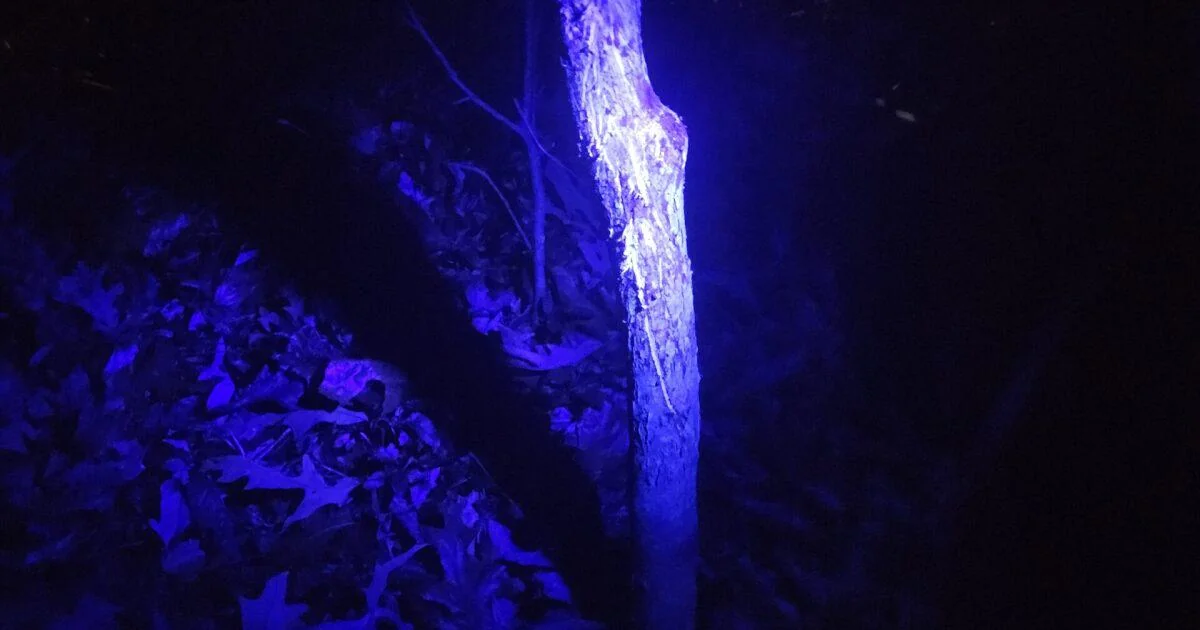
New research on photoluminescent deer signposts, ultraviolet sensitivity, and what it means for deer vision and behavior
Yes. Deer can see UV light to a limited extent because their eyes transmit more ultraviolet and are most sensitive to short blue and green wavelengths. A new peer‑reviewed study reports that deer signposts in forests photoluminesce under ultraviolet excitation and emit light at wavelengths deer can detect, making those markings stand out at dawn and dusk. The study does not prove that deer use this glow to communicate, but it shows a plausible visual cue they are capable of seeing.
Can deer see UV light?
Deer are dichromats with two cone types tuned to short and medium wavelengths, giving them strong sensitivity in the blue and green part of the spectrum and relatively poor sensitivity to red. Unlike humans, many mammals, including deer, lack a strong UV‑blocking filter in the eye’s lens, which allows more near‑ultraviolet to reach the retina. Experimental measurements of mammalian ocular media support widespread ultraviolet sensitivity across species (Douglas and Jeffery, Proc. R. Soc. B, 2014).
Deer vision peaks near 450–460 nanometers (blue) and around 537 nanometers (green), with the eye transmitting more UV than a human eye, so short‑wavelength cues are relatively conspicuous to deer.
Deer are most active at dawn and dusk. During these times the sky contains proportionally more short wavelengths due to scattering, and low light favors visual systems like a deer’s that emphasize blue‑green sensitivity and a reflective tapetum lucidum that boosts night vision.
What did the new study find about UV glow on deer signposts?
A study published in Ecology and Evolution surveyed white‑tailed deer (Odocoileus virginianus) activity sites across roughly 800 acres of Whitehall Forest in Georgia, mapping active signposts and measuring their optical properties under UV excitation (DOI:10.1002/ece3.72618). Researchers analyzed 109 antler rubs, 37 scrapes, and 20 urination spots. When illuminated with ultraviolet, these features emitted light that contrasted with surrounding bark, soil, and litter. Emission peaks occurred near 450–460 nm and around 537 nm, aligning with known deer spectral sensitivity.
Rubs expose lighter “underbark,” which fluoresced more than intact outer bark. Scrapes, which concentrate scent from interdigital glands and often urine, also glowed, likely due to photoluminescent compounds. The team noted brighter emission during the breeding season, consistent with increased rubbing and scraping activity. An external ecologist quoted in a media summary praised the field imaging as an informative first look but urged caution about inferring communication function (New Atlas summary).
Key finding: white‑tailed deer signposts emit UV‑excited light that falls within deer vision, making them visually distinct from their surroundings under UV illumination in the field.
How would UV‑glowing signposts work in practice?
Photoluminescence is when a material absorbs short‑wavelength light and re‑emits it at a longer wavelength. In forests, several signpost components can photoluminesce:
- Antler rubs: Removing dark outer bark reveals lighter inner tissues that fluoresce more under UV, creating bright vertical streaks on trunks.
- Scrapes: Soil disturbed by hooves is coated with secretions from interdigital glands. Many biological secretions contain aromatic compounds that fluoresce under UV.
- Urine: Common at scrape sites, urine can fluoresce due to porphyrins and related metabolites, a principle widely used in forensic alternate‑light searches (NIJ: Alternate Light Sources).
Photoluminescence makes deer signposts optically brighter in short wavelengths, potentially increasing detectability to deer during low‑light, short‑wavelength‑rich periods such as dawn and dusk.
Taken together, the optical contrast of rubs and scrapes under UV, the spectral match to deer vision, and crepuscular activity patterns present a plausible mechanism by which visual cues could complement the primary chemical information at these sites.
What are the limitations and open questions?
- Function is unproven: The study demonstrates conspicuous UV‑excited emission from white‑tailed deer signposts but does not show that deer behaviorally use the glow to find or interpret signposts. Controlled choice tests and field manipulations are needed.
- Photoluminescence can be incidental: As noted by external experts, many natural materials fluoresce. Brightness alone does not establish a communication function.
- Environmental variability: UV availability changes with canopy cover, weather, season, and substrate moisture. How far and how reliably these cues travel in real forest light fields remains to be quantified.
- Temporal dynamics: Emission can fade as surfaces weather or as biochemical residues degrade. Persistence over days or weeks has not been established.
Why does this matter for ecology and management?
- Sensory ecology: Integrating chemical and visual signaling would expand how researchers think about ungulate communication and habitat use.
- Monitoring and research: UV imaging could help biologists locate active signposts more efficiently for population studies, disease surveillance, or behavioral research.
- Human visibility: Some fabrics and detergents contain UV brighteners that fluoresce. Given deer ultraviolet sensitivity, managers and practitioners may reconsider materials used near study sites to avoid confounds.