
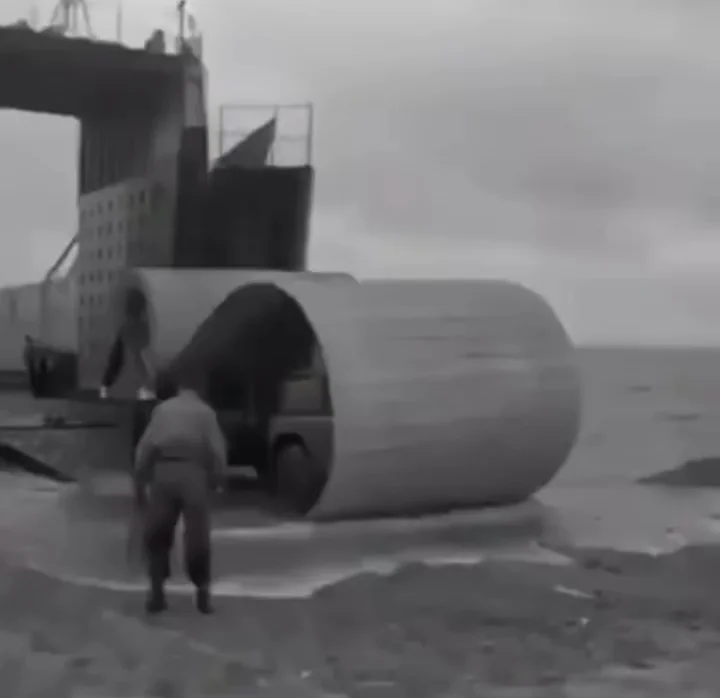
A bobbin tank is a combat engineering vehicle that carries a large reel of reinforced matting and unrolls it to create an instant roadway over soft sand, mud, or shingle. It works by paying out the mat in front of the vehicle as it drives, spreading the load so the deploying vehicle and following traffic do not bog down. The concept originated in World War II and later appeared on postwar vehicles, including bobbin-equipped trucks.
What is a bobbin tank?
The term refers to a tank, typically a Churchill AVRE in World War II, fitted with a cylindrical bobbin of roadway material mounted at the front. As the vehicle advanced off a landing craft and onto a soft beach, the bobbin unfurled to make a firm path for itself and for other vehicles behind it.
“Bobbin: A reel of 10-foot wide canvas cloth reinforced with steel poles carried in front of the tank and unrolled onto the ground to form a ‘path’, so that following vehicles (and the deploying vehicle itself) would not sink into the soft ground of the beaches.” Hobart’s Funnies
This device was one of the British Army’s specialised engineering conversions known as Hobart’s Funnies, developed by the 79th Armoured Division under Major General Percy Hobart to solve practical problems expected during the Normandy landings.
How does a bobbin tank work?
The mechanism is simple and rugged, designed for surf and sand:
- Front-mounted reel carries a wide mat, historically canvas reinforced with battens or poles.
- Drive-forward deployment: as the tank moves, the reel turns and the mat feeds under the bow, laying a strip roughly the width of a lane.
- Load spreading: the mat increases contact area, lowering ground pressure so tracks and tires stay on top of soft ground.
- Immediate use: the deploying vehicle uses the mat as it is laid, then follow-on vehicles stay on the strip.
- Limited run: when the reel empties, the mat ends; additional reels or other engineering assets take over.
Variants of the mat and feed hardware existed, but the goal was consistent: create a temporary, quickly placed pathway that turned a boggy approach into a drivable surface for the critical first minutes of a landing.
Why was the bobbin tank developed?
Allied planners learned from the failed 1942 Dieppe Raid that landing forces could not rely on capturing intact deep-water ports. For 1944’s Operation Overlord, they needed ways to cross mines, obstacles, seawalls, and soft beaches. Hobart’s team fielded a suite of vehicles to meet those needs, including flail-equipped Sherman Crab mine clearers, swimming Duplex Drive (DD) tanks, Churchill Crocodile flamethrowers, and the AVRE with its bobbin roadway, fascines, assault bridges, and demolition tools (Hobart’s Funnies).
What vehicles used bobbins, and were trucks involved?
On D-Day, the Churchill AVRE was the primary bobbin carrier. Its engineering crew could select among attachments, including the bobbin, depending on the task and terrain. Postwar, the same roadway-laying idea was adapted to wheeled platforms; archival demonstrations from the 1950s show British service trucks such as the Bedford RL fitted with bobbin reels to lay mats rapidly on beaches and soft ground. The broader lineage of combat engineering vehicles continued after the war with specialised platforms like the Titan and Trojan, which took over bridging and breach roles for later British armour (source).
What are the limitations of bobbin tanks?
- Finite length: a reel carries only so much mat, so coverage is short relative to a full beachhead.
- Single-lane width: the laid strip suits one vehicle lane; traffic management is required.
- Exposure: the deploying vehicle leads the approach and can be vulnerable to enemy fire, surf, or mines unless other assets clear threats.
- Sea state and slope: heavy surf, strong currents, or steep gradients can shift or damage the mat.
- Driver visibility: front-mounted reels can restrict forward view during deployment, requiring careful coordination and guides.
How did bobbins fit into D-Day logistics?
Bobbin paths were one element in a much larger engineering plan that also included portable Mulberry harbours to offload ships offshore while major ports were seized and repaired.
The Mulberry B harbour at Arromanches operated for about ten months, enabling the landing of over two million men, four million tons of supplies, and half a million vehicles (Mulberry harbours).
Together, bobbin-laid roadways, mine-clearing, bridging, and temporary ports turned difficult surf zones and soft beaches into workable supply routes at the decisive moment of entry.
Your browser does not support the video tag.