
The Eins Catalogue was a paper listing of every possible way the German word eins could be encrypted on a naval Enigma machine, for a given daily key. It worked by precomputing the encipherment of the word “eins” at all 17,576 rotor starting positions, then using this list to match patterns in intercepted messages and recover the exact rotor setting for that day. Once codebreakers at Bletchley Park found a match and confirmed it produced readable German, they could decrypt all traffic that used the same key.
What makes the Eins Catalogue remarkable is how simple the core idea was: exploit the fact that German operators had to spell out numbers, so the word “eins” appeared in the vast majority of naval messages. According to historical accounts of Bletchley Park’s Hut 8, “eins” occurred in about 90 percent of genuine German Navy signals, making it an ideal anchor for this large, hand built lookup table.[source]
What was the Eins Catalogue in Enigma cryptanalysis?
The Eins Catalogue was a specialized cryptanalytic aid created early in the Second World War to attack the German Navy’s three rotor Enigma system. It was essentially an alphabetically sorted table of all 17,576 ways the four letter word EINS could be enciphered, assuming that the wheel order, ring settings, and plugboard connections for that day were already known.[source] The only unknown remaining in that situation was the rotor starting position for each individual message.
Because each rotor has 26 possible starting positions, and naval Enigma used three rotors at a time, there are 26³, or 17,576, different starting combinations. For each of these, the codebreakers calculated how the machine would encipher EINS. They then listed the resulting four letter ciphertext groups in alphabetical order, with the corresponding rotor positions next to each entry. This master list was the Eins Catalogue.
In the Bletchley Park Cryptographic Dictionary, “EINS CATALOGUE” is defined as an alphabetic list of all the 17,576 ways in which “eins” can be enciphered with known wheel order, ring setting, and plugboard, used to set further messages on the same day.
The catalogue was particularly important against German Naval Enigma traffic, which was considered the hardest Enigma variant to break. Historian Michael Smith and others note that once the British knew the daily ground key, “EINS ing” procedures using the catalogue became a standard method in Hut 8 for recovering per message rotor positions and for building up the bigram tables used in naval indicator systems.[source]
Why did codebreakers choose the word “eins”?
The Eins Catalogue depended on the fact that the word “eins” was extremely common in German naval messages. Enigma could only handle the 26 letters of the alphabet, not numerals. As a result, operators were instructed to spell out all numbers in words instead of using digits. A captured German radio operator confirmed this practice under interrogation, prompting codebreakers to review decrypted traffic and quantify how often different number words appeared.[source]
They found that eins, the word for “one”, appeared in roughly 90 percent of genuine Kriegsmarine messages. This makes sense once you consider how many operational details involve the digit 1: times like 13:10, grid references, bearings, quantities of ships or aircraft, and so on. Every time a 1 appeared in these data, it had to be written as EINS before being encrypted.
Alan Turing and his colleagues recognized that this consistent linguistic habit created a powerful crib, a piece of presumed plaintext they could search for inside ciphertext. Rather than looking for generic words like “wetter” (weather) or predictable sign-offs such as “Heil Hitler”, they realized that searching systematically for the enciphered forms of EINS would give them more hits across a wide variety of messages. That insight is what made it worthwhile to invest effort in building a dedicated catalogue instead of relying only on ad hoc crib dragging.
In the Bletchley Park dictionary, “EINS” itself is defined as a verb: to drag the word “eins” through a German cipher message by any feasible method, a sign of how central this tactic became.
How did the Eins Catalogue work in practice?
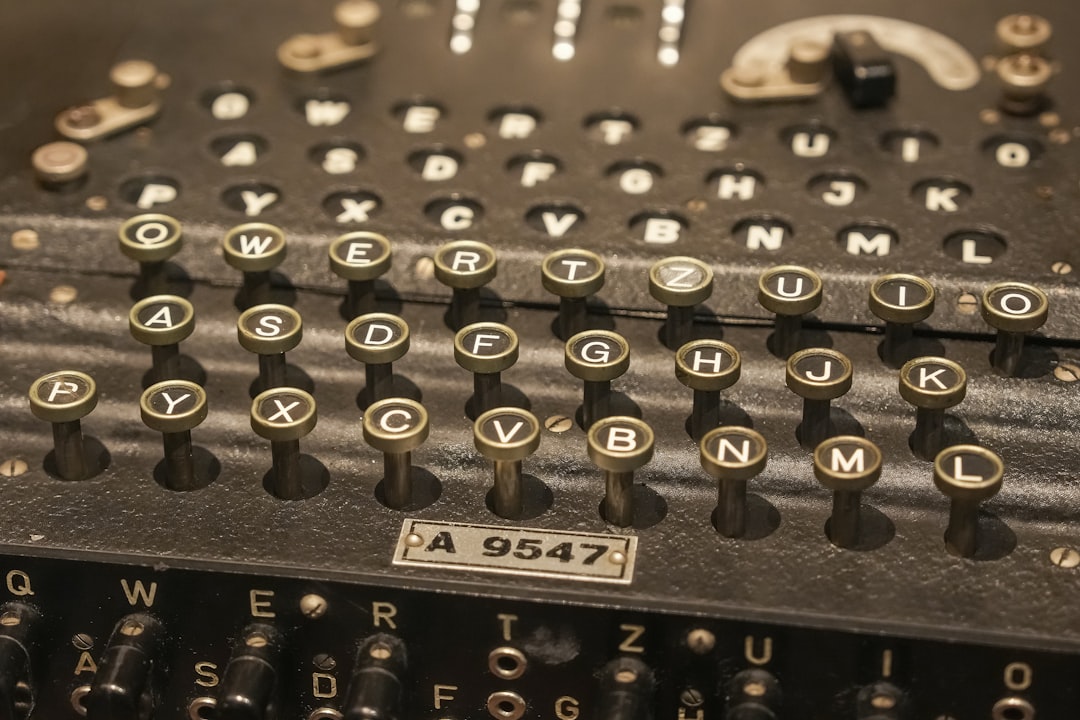
The Eins Catalogue was used only after the British had already recovered three of the four essential daily key components for a particular naval network: which three rotors were in use and in what order (wheel order), the ring settings, and the plugboard connections. These might have been deduced from earlier breaks, captured material, or other crib based methods. The remaining unknown for each message was the rotor starting position, which could be any one of the 17,576 possibilities.
To create the catalogue, Bletchley Park used a special machine nicknamed “The Baby”, which automatically ran the Enigma simulation through all starting positions and recorded how EINS was enciphered in each case.[source] For starting position AAA the output might be one four letter group, for AAB another, and so on up to ZZZ. These 17,576 groups were then sorted alphabetically and printed with their corresponding rotor settings.
When a new batch of German naval traffic arrived that used the same daily key, cryptanalysts would scan a given message and pick positions where the presence of the number “one” was plausible, for example in a time, a coordinate, or an order quantity. At each suspected position they would note the four letter ciphertext group that could plausibly be EINS.
They then looked up that four letter group in the Eins Catalogue. If it did not appear at all, that position could not be EINS, and they moved on. If it did appear, they took the listed rotor starting position and set up a replica Enigma or a British Typex machine wired like the German machine to those settings. They would then decrypt not just those four letters but the subsequent text as well.
If the deciphered output after EINS turned into nonsense, this was a false hit: the same four letter ciphertext group could sometimes result from enciphering different plaintexts because of the complex rotor stepping. But if the result produced plausible German, the cryptanalyst had found the correct rotor starting position for that message. From there, they could decrypt the entire signal and, by repeating the procedure, gradually solve more of the keying system.
How did the Eins Catalogue fit into wider Enigma codebreaking?
The Eins Catalogue was one of several structured approaches to exploiting regularities in German messages. It complemented other techniques such as the use of weather report cribs, stereotyped phrases like “Heil Hitler”, and statistical methods for reconstructing bigram substitution tables used in naval indicators.[source]
For the German Navy 3 rotor Enigma, historians describe the first wartime breaks occurring in late 1939 and early 1940, when Bletchley Park began to understand that numerals were always spelt out. Once they knew this, compiling an EINS catalogue for a known daily ground key allowed them to speed up attack on many messages at once, rather than treating each signal as an isolated puzzle.[source]
Over time, more powerful tools, especially the bombe machines designed by Alan Turing and improved by Gordon Welchman, automated much of the crib searching process for general Enigma keys. Even then, the conceptual idea behind the Eins Catalogue, precomputing the behavior of the machine for common plaintext fragments and using them as lookups, remained influential. It represented an early form of what cryptanalysts today might call a specialized “table” attack.
The catalogue also illustrates a broader lesson in cryptanalysis: the strength of a cipher system is not just in its mathematics or hardware but in how people use it. German insistence on writing out numbers, combined with rigid message formats and repeated phrases, created enough predictable structure for analysts at Bletchley Park to chip away at Enigma’s vast keyspace.
Why is the Eins Catalogue historically important?
The Eins Catalogue matters for several reasons. First, it was a practical workaround created before Bletchley Park had enough electromechanical bombes to search the Enigma keyspace efficiently. It allowed a small team in Hut 8 to extract more value from each known key and to bring additional messages under decryption using largely manual methods.
Second, the catalogue is a clear example of how deep understanding of an adversary’s language and procedures can be as important as raw computing power. The idea did not require exotic mathematics. Instead, it depended on recognizing that a short, common word, “eins”, tied to operational data like times and coordinates, could serve as a stable anchor across very different messages.
Finally, the Eins Catalogue is an early historical echo of techniques that are now standard in modern cryptanalysis and computer security. Precomputed lookup structures, such as rainbow tables used to attack hashed passwords, exploit the same tradeoff: invest time and resources up front to generate a large table, then use it to make individual lookups fast. In that sense, the Eins Catalogue was a World War II precursor to ideas that underpin many contemporary attacks on weak or poorly used cryptographic systems.
By documenting and systematizing the process under a specific term, “EINS” as a verb and “Eins Catalogue” as a noun, the Bletchley Park cryptographers left a trace of how they thought about and organized their work. It is a reminder that breaking Enigma was not one single breakthrough, but a layered accumulation of insights, procedures, and tools, of which the Eins Catalogue was an important part.