
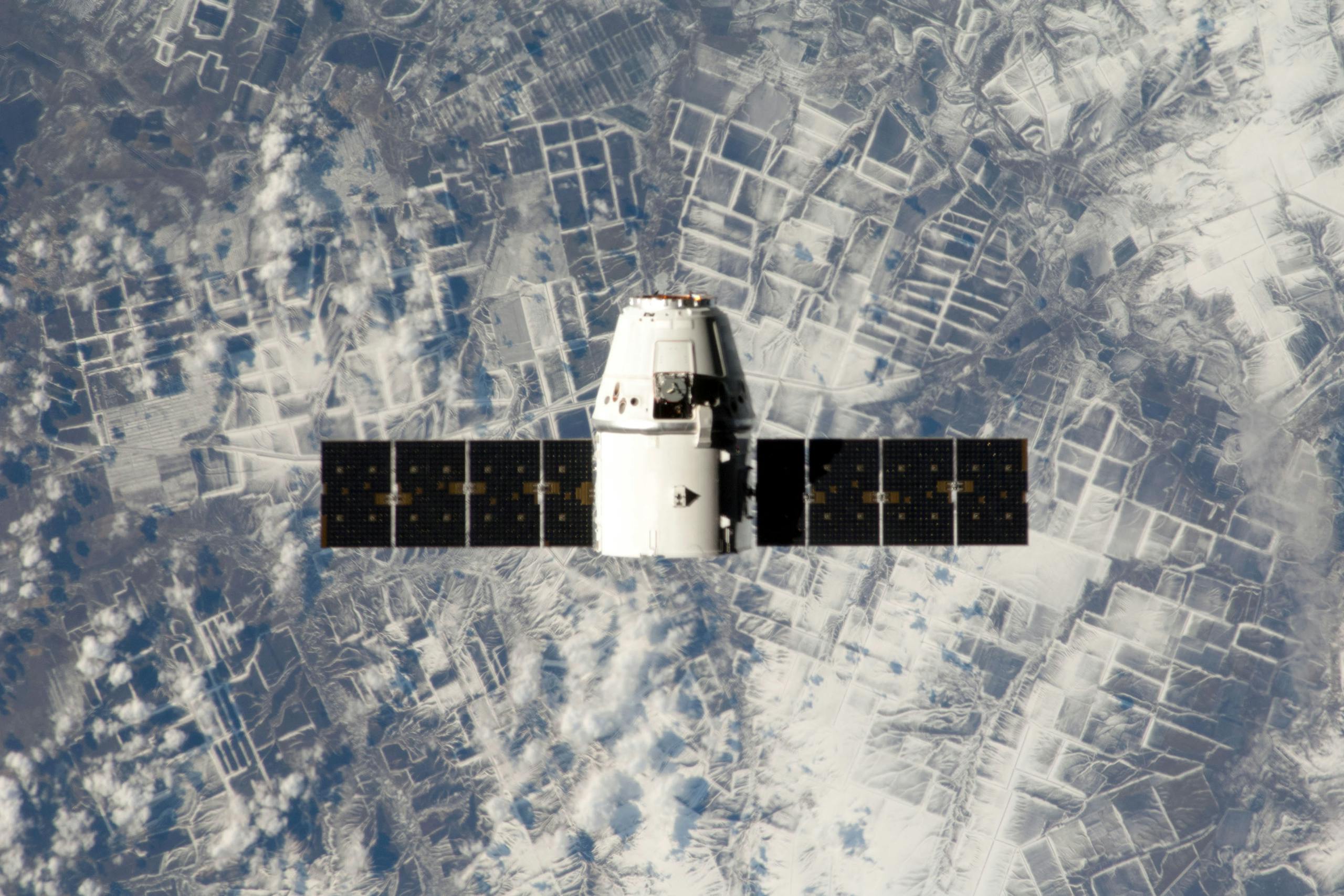
The MOOSE reentry system was a 1960s concept for a one-person, emergency return kit from orbit. Short for “Man Out Of Space Easiest,” MOOSE envisioned a small deorbit motor, a personal heat shield formed by a compact bag-and-foam shell, and a parachute for splashdown. It was never flown and remained a study, but it answered a real question: could an astronaut survive reentry without a full spacecraft?
What is the MOOSE reentry system?
MOOSE was a proposal to give a stranded astronaut a last-resort way home without relying on a dedicated reentry capsule. Packed as a stowable kit, it combined a brief deorbit maneuver, an improvised personal aeroshell to withstand hypersonic heating, and terminal descent under parachute. The idea reflected an era of intense systems experimentation, but MOOSE did not advance to flight test and the approach was ultimately shelved.
How would the MOOSE reentry system have worked?
Although designs varied over time, the basic sequence looked like this:
- Deorbit burn: A small solid-propellant motor would fire opposite the direction of travel to lower the orbit’s perigee into the atmosphere. The burn does not cancel orbital speed; it just ensures atmospheric entry at the next pass.
- Deploy a personal aeroshell: The astronaut would unfurl a compact film bag, then fill it with foam to create a rigid, blunt body “shield” sized for one person. The flexible outer layers and ablative facing were meant to ride the hypersonic shock and manage reentry heat.
- Ride through peak heating and deceleration: The blunt shape maximizes drag and keeps most of the hot flow away from the occupant, similar in principle to capsule heat shields.
- Parachute and recovery: After sufficient deceleration, a parachute would deploy for ocean splashdown and pickup.
The core of the concept was that atmospheric drag, not rockets, would do the heavy braking. The motor was only there to dip the trajectory into the atmosphere; the heat shield and parachute did the rest.
Why wasn’t MOOSE adopted?
Several hard problems made a personal escape kit unattractive compared with proven capsules:
- Heat and stability margins: A one-person aeroshell must stay properly oriented while enduring severe heating. Any puncture, delamination, or attitude upset could be catastrophic.
- Targeting and recovery: Hitting a safe splashdown zone from orbit requires precise timing and attitude control, plus reliable tracking for recovery.
- Training and workload in an emergency: A high-stress, manual sequence leaves little room for error compared with entering a pressurized, automated spacecraft.
- Mass, stowage, and duplication: Every kit adds mass and volume to missions already carrying certified reentry vehicles.
- System reliability and certification: Human-rating a new, unproven personal reentry system to capsule-level safety is a tall order.
In short, MOOSE was ingenious, but conventional crew vehicles solved the same problem with more robust margins and automation.
Do modern technologies make a “MOOSE-like” idea more plausible?
Two modern threads are relevant: flexible heat shields and inflatable structures. NASA has matured Hypersonic Inflatable Aerodynamic Decelerator technology and recently flight-tested the LOFTID inflatable heat shield.
“An inflatable heat shield, unlike traditional rigid heat shields, can be packed to a very small size and then deployed to a scale much larger than a rocket’s payload fairing.”
LOFTID reentered at nearly 8 km per second to demonstrate that a flexible, deployable aeroshell can survive orbital-speed heating and deceleration. That directly validates the physics MOOSE counted on, but at a scale and with instrumentation appropriate to modern certification.
Inflatable and flexible structures have also proved their durability in orbit. The Bigelow Expandable Activity Module (BEAM) was installed on the International Space Station in 2016, expanded successfully, and—after the manufacturer ceased operations—transferred to NASA. As of 2025, BEAM remains in service for on‑station storage, having exceeded its original 2‑year test plan. While BEAM is a habitat, not a heat shield, it demonstrates that multi-layer fabrics, advanced polymers, and flexible architectures can thrive in the space environment for years.
That said, today’s flexible heat shields aim to deliver large payloads safely—returning sizable components from low Earth orbit or enabling precision landings on worlds like Mars—rather than to replace certified crew vehicles with personal kits. Safety, operations, and rescue logistics still favor dedicated spacecraft for people.
Could a single astronaut really survive reentry without a full spacecraft?
Yes in principle, but only with a correctly engineered aeroshell and sequence. Two key points clarify the physics:
- Small burn, big drag: You do not cancel the ~7.8 km/s orbital speed with a personal rocket—that would require prohibitive propellant. Instead, you make a small retrograde burn to drop perigee into the atmosphere. Drag then does most of the braking, converting kinetic energy into heat in the shock layer and heat shield.
- Thermal protection is the heart of the problem: Surviving reentry hinges on keeping the occupant cool enough while maintaining the right attitude. That is what capsules, and modern flexible aeroshells like LOFTID, are built and tested to guarantee.
Modern work on inflatable heat shields shows we can package larger, lighter decelerators than rigid shells, which is a major advantage for future missions. But translating that into a safe, one-person emergency device would still face the same human-rating, operations, and recovery hurdles that sidelined MOOSE.
Bottom line: what MOOSE means today
The MOOSE reentry system remains a fascinating what‑if from the early space age. Its core insight—that clever structures can let the atmosphere do the braking—has aged well, and is now being realized in technologies like LOFTID. Its personal-escape framing, however, was overtaken by safer, better‑integrated crew vehicles. For crews, capsules still win. For cargo return and planetary landings, flexible heat shields are moving from concept to capability.
What does this mean for future missions?
If you are looking for the modern legacy of MOOSE, look to deployable aeroshells and inflatables:
- Returning bulkier items from orbit: Scalable inflatable heat shields can downmass larger components than rigid heat shields constrained by fairing diameter.
- Landing heavy payloads on Mars: Larger decelerators increase drag earlier in the thin Martian atmosphere, a key to landing at human-scale masses.
- Lean logistics in LEO: Expandables, demonstrated by BEAM, save launch volume for habitats and storage, complementing reentry advances.
In short, while you should not expect a backpack “reentry bag” for astronauts, the enabling materials and architectures MOOSE anticipated are now enabling practical, mission‑scale systems.