
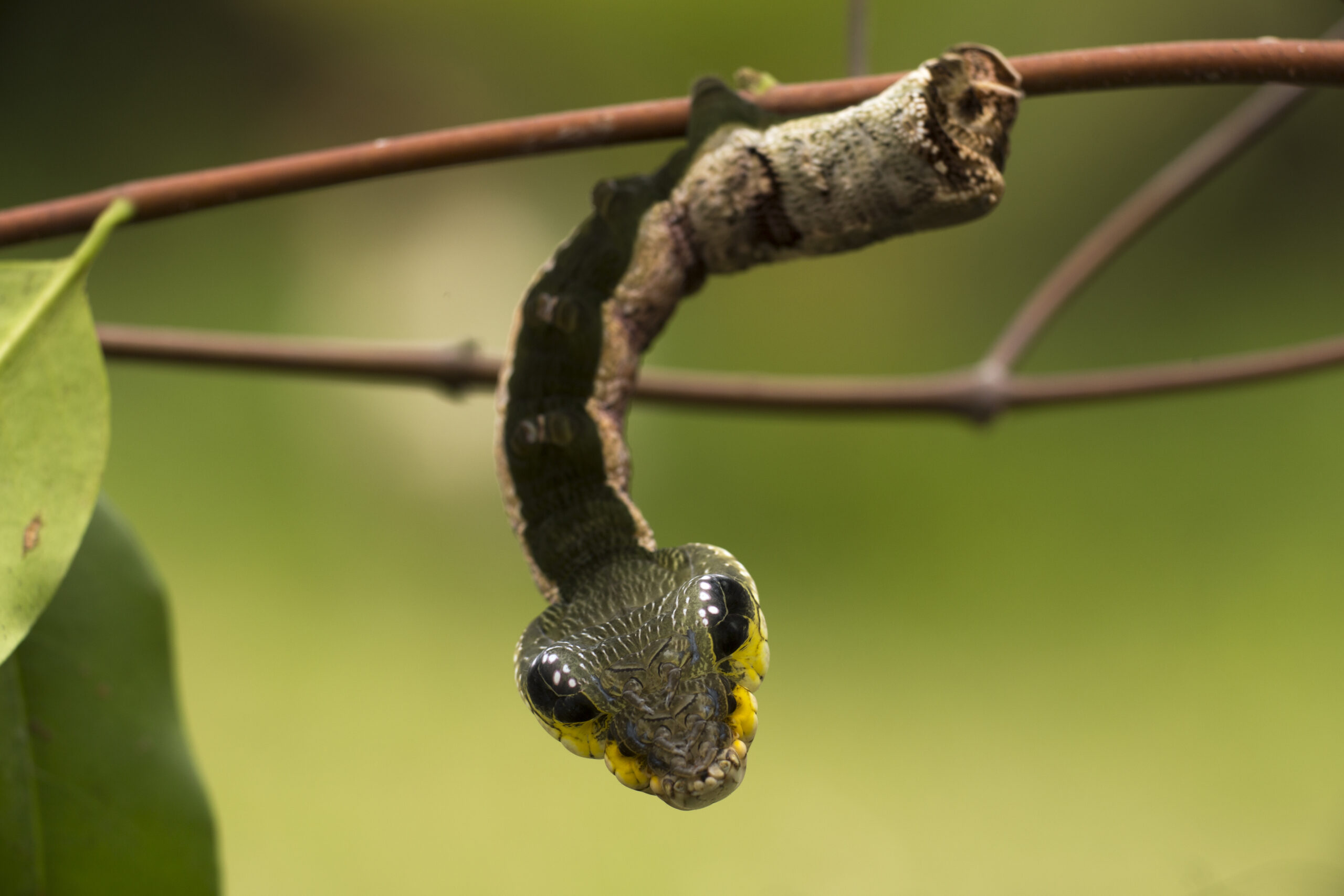
The snake mimic caterpillar is the larval stage of certain hawk-moths, most famously Hemeroplanes triptolemus. It works by rearing up, tucking its real head, and inflating the front body segments to display large eyespots and a triangular “head” shape that resembles a small snake. This startle display is a form of Batesian mimicry that makes predators hesitate long enough for the caterpillar to avoid attack.
What is the snake mimic caterpillar?
The best known snake mimic caterpillar is the larva of Hemeroplanes triptolemus, a hawk-moth in the family Sphingidae. When threatened, it transforms its normally plain profile into a convincing snake-like front end, complete with a broad “head” outline and eye-like markings. The behavior is defensive: it does not attack, but it looks dangerous to birds and other visual predators.
Batesian mimicry is when a harmless species gains protection by resembling a harmful or unpalatable one, causing predators to avoid it (Britannica).
How does the snake mimic caterpillar work?
This display combines body reshaping, coloration, and behavior:
- Head tuck and inflation: The caterpillar retracts its true head and pumps fluid to expand the anterior thoracic segments, creating the triangular silhouette typical of many snakes.
- Eyespots and patterning: Bold eyespots and dark banding align so they look like snake eyes and facial markings when the body is inflated.
- Motion display: It rears, flattens, and may make short, jerky feints. The combination of shape plus motion enhances the illusion and triggers predator caution.
Experiments across caterpillars and butterflies show that large, high-contrast eyespots and sudden startle displays can reduce attack rates by birds, likely by exploiting innate predator avoidance of eye-like patterns and snakes. The snake mimic caterpillar stacks these cues into a particularly convincing package.
Where is it found and what species does this involve?
Hemeroplanes triptolemus is native to Neotropical forests, reported from parts of Central and South America. Several hawk-moth caterpillars show degrees of snake-like displays, but Hemeroplanes is among the most dramatic and widely documented examples in the family Sphingidae. As an adult, it becomes a fast-flying moth with narrow wings, typical of hawk-moths.
Key fact: during the display, the “snake head” is formed by the caterpillar’s enlarged front body segments while the real head is tucked down and largely hidden.
Why does this mimicry evolve?
The trait arises through natural selection, not conscious design. In each generation, caterpillars vary in color, pattern, and behavior. Individuals that, by chance, resemble a snake more closely are less likely to be eaten by predators that avoid snakes. They survive to reproduce, passing on the genes underlying those shapes, patterns, and behaviors. Over many generations, selection refines the resemblance.
This logic is the same process that shapes many anti-predator traits. You can read more about selection in accessible overviews from Britannica. Importantly, the caterpillar does not “know” what a snake looks like, and it does not change its form in response to seeing snakes; the resemblance is an inherited defensive program that develops as the larva grows.
Is the snake mimic caterpillar dangerous, and what does it become?
No. The display is a bluff. The caterpillar lacks venom and poses no danger to people. If the threat passes, it returns to feeding on host plants. After completing several molts, it pupates and emerges as a hawk-moth. The spectacular larval defense contrasts with the relatively plain adult, a reminder that most predation risk in this group occurs during the caterpillar stage.
Common misconceptions and limitations
- Mimicry versus camouflage: Camouflage hides; snake mimicry is a conspicuous startle-and-bluff strategy meant to make predators back off. Many caterpillars use both at different times.
- “Tail” versus “head” confusion: In Hemeroplanes, the snake-like “head” is formed from the front body segments while the real head is tucked away. Other species may place eyespots elsewhere, but the effect is still a front-facing bluff during the display.
- Not perfect, but good enough: The illusion does not need to fool every observer, only to delay or deter typical predators often enough to improve survival.