
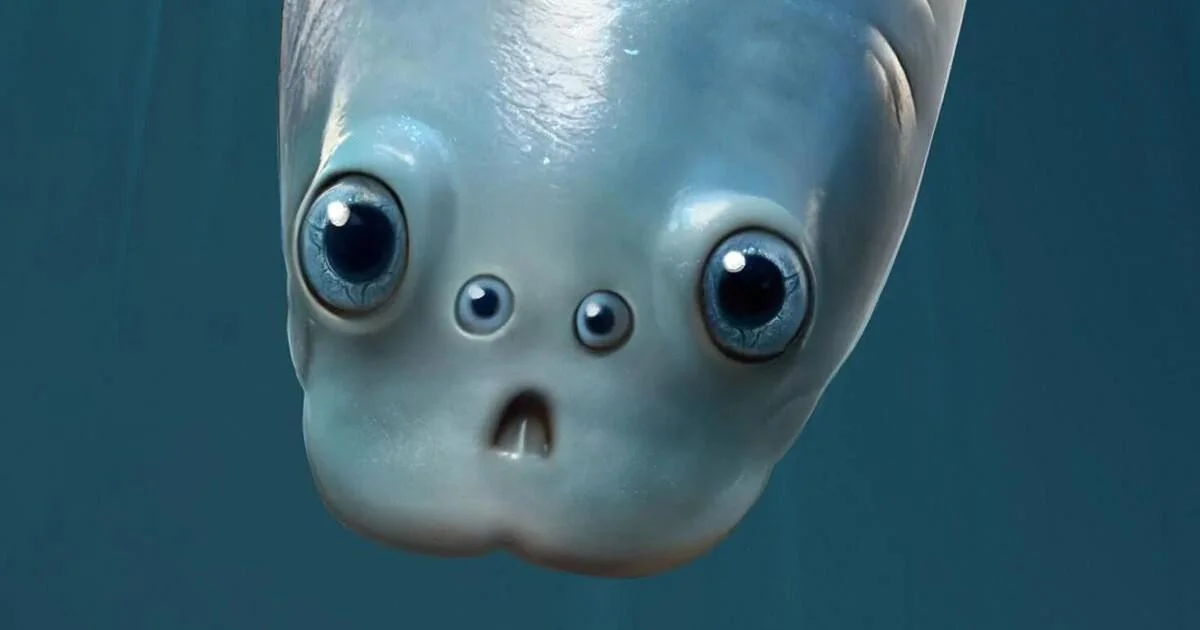
Yes. Multiple exceptionally preserved Cambrian fossils indicate that early vertebrates had four eyes: two large lateral eyes and a second, smaller median pair on the top of the head. In these fossils, all four were camera-type organs with pigment and lenses, and the median pair corresponds to the ancestral pineal complex that later became non-visual in most lineages. The new evidence comes from myllokunmingid vertebrates about 518 million years old described in Nature (2026).
What is the discovery?
Two species of early vertebrates from the Chengjiang biota in Yunnan, China, preserve four distinct anterior ocular structures: two lateral eyes and two median, dorsal eyes situated between them. The study identifies the median pair as the pineal/parapineal complex, not nasal capsules as previously proposed, and shows they were capable of image formation.
The authors report “four camera-type eyes” in the earliest known vertebrates, with melanin-bearing tissues and ovoid lens impressions in both the lateral eyes and the pineal complex (Nature).
This finding extends image-forming vision in the vertebrate lineage to include a dorsal median pair, supporting the deep homology between the lateral eyes and the pineal complex noted in developmental biology.
How do we know early vertebrates had four eyes?
The fossils show four dark ocular spots in consistent anatomical positions. High-resolution analyses revealed melanosomes (melanin-containing organelles that form the light-absorbing retinal pigment epithelium) in both the lateral eyes and the median organs, and preserved impressions consistent with lenses.
- Pigment evidence: The median organs contain abundant melanosomes with size and shape distributions comparable to those in vertebrate retinal tissues.
- Lens evidence: Regularly ovoid, lens-like structures occur in both the lateral and median eyes, indicating camera-type optics.
- Instrumental confirmation: Chemical and ultrastructural data, including Raman spectroscopy, XPS, and ToF-SIMS, distinguish organic eye tissues from surrounding sediment and document melanin signatures consistent with fossilized visual organs, as summarized in the paper’s extended data.
The reinterpretation resolves a long-standing inconsistency: the “extra pair” had been labeled nasal capsules, but early vertebrates at this stage had a single median nostril, making paired nasal capsules unlikely. The anatomical, chemical, and optical lines of evidence together support a visual function for the median pair.
Why early vertebrates had four eyes
The authors argue that having both lateral and dorsal camera-type eyes increased field of view and environmental awareness during the Cambrian, when these small, likely low-trophic vertebrates faced intense predation pressures. A second eye pair would help detect overhead threats and light cues from more directions, aiding escape and orientation.
Expanded visual coverage in the Cambrian seas would have been advantageous for prey detection, predator avoidance, and schooling, consistent with ecological inferences drawn for early jawless vertebrates (Nature).
These functional interpretations are hypotheses consistent with the fossils’ anatomy and the known escalation of sensory systems during the Cambrian radiation.
What is the pineal eye and how does it relate to humans?
The pineal complex in vertebrates consists of the pineal and, in many non-mammals, a parapineal organ. In some living fishes, amphibians, and reptiles, parts of this complex are photoreceptive, and in a few reptiles a superficial parietal eye forms with a cornea, lens, and retina-like cells that detect light from above. In mammals, including humans, the pineal organ is deep in the brain and primarily endocrine, producing melatonin to regulate circadian rhythms. It is developmentally homologous to eyes but no longer forms images.
Developmental genetics has long indicated shared origins for lateral eyes and the pineal complex. The new fossils add direct anatomical evidence that, early on, the pineal complex was not just light sensitive, it was image forming. For background on eye evolution and the pineal complex, see Nature Reviews Neuroscience (2007) and Philosophical Transactions of the Royal Society B (2003).
How do we know early vertebrates had four eyes? (methods and specimens)
The result is based on multiple specimens of two myllokunmingid species from the Chengjiang Lagerstätte, a site renowned for soft-tissue preservation. The study combines imaging and geochemical assays to demonstrate organic, melanin-rich tissues and lens morphologies in the median organs that match visual structures in the lateral eyes (Nature).
- Specimens: Myllokunmingid vertebrates dated to ~518 million years ago, representing the earliest known vertebrates.
- Concordant signals: Morphology, pigment microbodies, and optical elements co-occur in the same structures and differ from surrounding sediment controls.
What does this mean for vertebrate evolution?
The study proposes that four camera-type eyes are an ancestral vertebrate character, later reduced as ecological roles and sensory priorities shifted. As vertebrates diversified and many lineages adopted active predation, the median pair lost image-forming function and, in most groups, became an internal neuroendocrine organ. The work strengthens the case for deep homology between lateral eyes and the pineal complex and pushes back the fossil record of visual pigments by over 200 million years compared with prior melanin finds.
- Today’s diversity: Many non-mammalian vertebrates retain a photoreceptive pineal complex, some reptiles have a parietal eye, and mammals have a non-visual pineal gland.
- Broader context: The finding aligns with evidence that the Cambrian radiation involved rapid innovation in sensory systems and behavior.
What are the limitations of the study?
As with all soft-tissue fossil work, interpretations rely on exceptional preservation and multiple converging tests. The image-forming status of the median eyes is inferred from pigment and lens-like structures, not from neural circuitry. The fossils represent early jawless vertebrates from one locality, so sampling remains limited. Still, the authors thoroughly test alternative explanations and provide chemical, ultrastructural, and comparative anatomical support, and external experts note the interpretations are reasonable, as summarized in an accessible overview by New Atlas.