
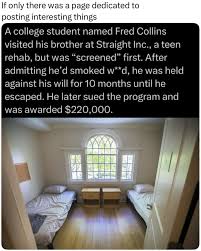
Straight Inc was a U.S. teen drug rehabilitation program founded in 1976 that used confrontational, highly restrictive methods across dozens of centers. It became notorious after investigations and lawsuits alleged abuse and false imprisonment. In 1982, 20-year-old Fred Collins was held there for 10 months after a “screening,” and in 1983 a jury awarded him $220,000 for being illegally detained.
What was Straight Inc?
Straight Inc began in St. Petersburg, Florida in 1976, founded by Mel and Betty Sembler and Joseph Zappala. It operated adolescent programs in at least 16 U.S. states and reported tens of thousands of “graduates” by the early 1990s. The organization is documented to have kept adolescents incommunicado and relied on intensive group sessions led by staff and peers (historical overview).
High-profile figures visited or praised the program in the 1980s, including First Lady Nancy Reagan and Princess Diana, which helped fuel its expansion. Robert DuPont, the first director of the National Institute on Drug Abuse, encouraged the group’s peer-counselor model in the early 1980s (sources compiled here).
Straight’s facilities drew scrutiny in multiple states. Former clients won lawsuits, and state investigators recorded or received allegations of abuse, isolation, and false imprisonment across the program’s footprint.
How did Straight Inc work?
Straight’s philosophy emphasized breaking “denial” through peer pressure and total control of a teen’s environment. New arrivals entered a first phase often called “humbling,” where they could be physically escorted by belt loop, cut off from family and school, and required to participate in hours of “rap sessions” daily. Advancement through several phases restored privileges gradually, sometimes over 10 to 14 months or more, depending on compliance (program description).
- Large-group confrontational therapy and confessional “raps”
- Peer monitoring and restraint by other teens reported in some centers
- Restrictions on sleep, bathroom access, media, and outside contact alleged in suits and inspections
- Parent participation governed by extensive rules, with siblings drawn into parallel sessions
A 1989 follow-up study of former clients at one Virginia center reported lower drug use after discharge for some participants, but the program’s safety, staffing, and coercive elements remained highly contested (Journal of Substance Abuse Treatment, 1989).
What happened in the Fred Collins case?
In 1982, 20-year-old college student Fred Collins tried to visit his younger brother at Straight’s Virginia facility. Before visiting, he was “screened” by teens in the program, admitted occasional marijuana use, and was then enrolled and held against his will. Collins escaped after about 10 months and sued the organization. In May 1983, a jury awarded him $40,000 in compensatory and $180,000 in punitive damages, totaling $220,000, for his unlawful detention (lawsuit summary).
Jury Awards $220,000 to Forced Drug Therapy Victim (The Gainesville Sun, May 27, 1983), as cited in historical accounts of Straight’s litigation.
Coverage and analysis by journalist Maia Szalavitz report that expert testimony during trial framed Collins as a “voluntary” entrant and a “pathological user,” claims undermined under cross-examination when contrasted with formal diagnostic criteria of the time (HuffPost, 2006).
Why was Straight Inc controversial and what did investigations find?
From the late 1970s through the early 1990s, regulators and courts scrutinized Straight centers in Florida, Virginia, Maryland, California, and other states. Records and lawsuits describe practices that authorities deemed unsafe or unlawful in various instances.
- False imprisonment and coercion: Florida officials in 1984 identified minors held against their will or coerced into enrollment; courts later ruled parents could compel minors into treatment, but adults like Collins prevailed in suits (state actions summarized).
- Peer restraints and deprivation: Virginia cited repeated violations for allowing clients to restrain other clients and for depriving sleep, food, and water as punishment (Washington Post, 1991).
- Abuse claims and settlements: Former clients secured verdicts and settlements exceeding $15 million for assault, negligence, intentional infliction of emotional distress, and other harms (case list overview).
What happened to Straight Inc after the lawsuits?
Straight’s rehabilitation operations wound down by 1993 amid declining enrollment, regulatory pressure, and legal liabilities. The corporate entity was later renamed the Drug Free America Foundation (DFAF) in 1995, which no longer runs treatment programs and instead promotes drug policy advocacy through divisions like Save Our Society From Drugs (organizational history).
What does this mean for the troubled teen industry today?
The Collins verdict and subsequent cases against Straight are central to ongoing debates about the troubled teen industry. Survivor accounts and state audits have driven reforms, but oversight remains uneven across jurisdictions. Families considering youth treatment should verify licensing, clinical leadership credentials, independent school access for minors, clear grievance and reporting pathways, and the ability for clients to refuse or end treatment where the law permits.
- Ask whether evidence-based, trauma-informed care is used and documented
- Request written policies on restraints, isolation, nutrition, and sleep
- Confirm how consent works for adults, and the criteria and process for discharge
- Seek independent references and inspect facilities unannounced when possible