
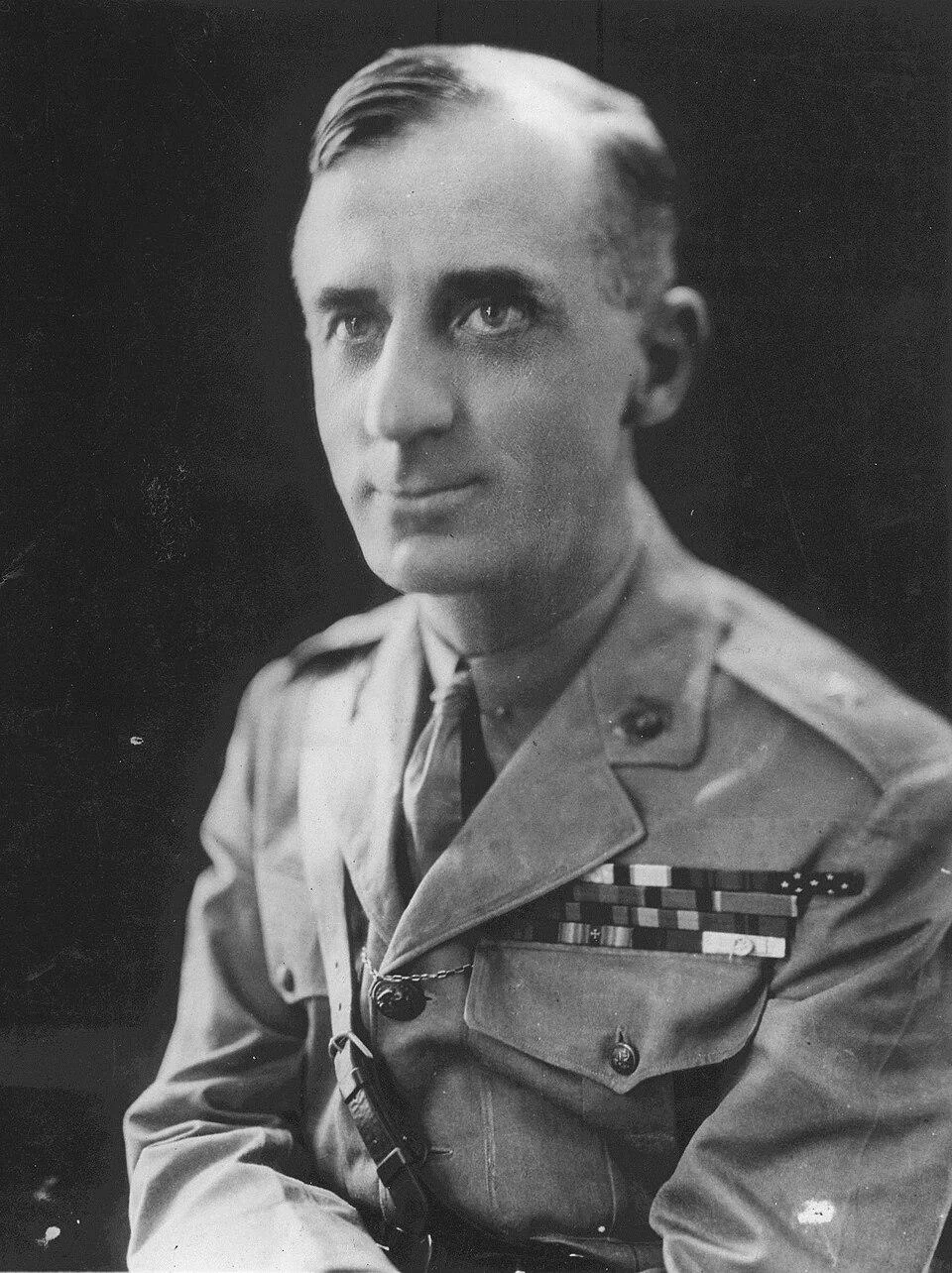
The Business Plot was an alleged 1933 conspiracy by a small group of wealthy American businessmen to organize a fascist-style veterans movement, overthrow President Franklin D. Roosevelt, and install retired Marine Corps Major General Smedley Butler in a powerful new role while Roosevelt remained as a figurehead. The plot became public in 1934 when Butler testified under oath before a special House committee that a Wall Street bond salesman had tried to recruit him to lead an army of up to 500,000 veterans in a march on Washington. Although Congress concluded that such plans had indeed been discussed and might have been carried out, no one was prosecuted and the full scope of the scheme remains debated by historians.
One striking detail is that the official House report stated that there was “no question” attempts to form a fascist organization had been discussed and planned, even as many newspapers initially dismissed Butler’s story as a “gigantic hoax.” That tension between a decorated general’s testimony, a cautious but affirming congressional report, and skeptical media coverage is why the Business Plot still sits in a gray zone between confirmed conspiracy and near-myth.
What was the Business Plot?
The Business Plot, also known as the Wall Street Putsch and the White House Putsch, refers to a claimed plan in 1933 to use a privately funded veterans’ organization to pressure or remove President Franklin D. Roosevelt and roll back the New Deal. Butler said he was approached by Gerald C. MacGuire, a bond salesman connected to the Wall Street firm Grayson Murphy & Co., who claimed to represent powerful financial interests disturbed by Roosevelt’s policies and his abandonment of the gold standard.[1]
According to Butler, the basic idea was to mobilize disgruntled World War I veterans, similar to the earlier “Bonus Army” protests, but this time as a paramilitary force that could be used to intimidate the White House and compel Roosevelt to accept a new power structure. Butler alleged that he was offered ample funding and told he would front a mass veterans’ movement with a half‑million men under arms. In this scenario, Roosevelt would be persuaded to step aside from active rule, allowing a new “Secretary of General Affairs” to exercise de facto dictatorial authority.
The alleged plot never advanced beyond talk and exploratory organizing. No troops were mobilized, no weapons were distributed for a march on Washington, and Roosevelt was never actually confronted by such a force. What survives are Butler’s sworn testimony, corroborating documents on specific travel and lobbying by MacGuire, and a congressional report that acknowledges a serious attempt to build a fascist organization but does not establish a fully operational coup plan.
How did Smedley Butler become involved?
Smedley Darlington Butler was not a marginal figure. He was one of the most decorated Marines in U.S. history, a retired major general with two Medals of Honor, and he enjoyed significant credibility among veterans for supporting the “Bonus Army” protests in 1932. By 1933 he had also become an outspoken critic of Wall Street and of U.S. interventions abroad, later summarized in his pamphlet War Is a Racket.[2]
Butler testified that in mid‑1933 he was repeatedly visited by Gerald C. MacGuire and American Legion figure Bill Doyle. They allegedly urged him first to run for national commander of the American Legion on a platform of restoring the gold standard, and then to head a new, better‑funded veterans’ organization that would be more overtly political. Butler said he was shown a draft speech demanding a return to gold and was told that wealthy backers would pay to have supporters packed into the Legion convention to cheer him on.
According to the later House committee report, investigators were “able to verify all the pertinent statements made by General Butler, with the exception of the direct statement suggesting the creation of the organization” that would lead a coup.[1]
Butler became suspicious of the emphasis on gold and of MacGuire’s admitted research trips to Europe, where he studied fascist veterans’ organizations in Italy and France. He eventually contacted journalist Paul Comly French, who interviewed MacGuire independently. French reported that MacGuire talked freely about the need for a strongman in the United States and praised European fascist models, reinforcing Butler’s alarm. Butler then took his concerns to the McCormack-Dickstein Committee, a House body originally formed to investigate Nazi and other foreign propaganda in the United States.
What exactly did Butler tell Congress?
Butler testified in secret before the McCormack-Dickstein Committee in November 1934. Transcripts released later and summarized in the committee’s final report show that he alleged the following key points:
- He had been approached by MacGuire as the prospective leader of a veterans’ organization, which, once armed and organized, could be used to pressure Roosevelt.
- MacGuire claimed that an army of up to 500,000 veterans could be recruited and financed by unnamed wealthy backers, including individuals linked in the press and later accounts to major corporations and financial houses.[1]
- The public rationale would be that Roosevelt was physically unfit to govern and needed a strong assistant. In private, real power would shift to the new “Secretary of General Affairs”.
- MacGuire openly admired fascist movements in Europe and said he had studied how they organized veterans as shock troops.
The committee then called MacGuire, who denied that any coup had been planned and framed his activities as ordinary political organizing among veterans. Crucially, some of Butler’s factual claims about MacGuire’s travels, finances, and contacts were corroborated by documents and bank records, which convinced the committee that at least an attempt to form a fascist veterans’ group had taken place.
In its February 15, 1935 report, the committee wrote that “there is no question that these attempts were discussed, were planned, and might have been placed in execution when and if the financial backers deemed it expedient.”[1]
However, the report stopped short of naming most of the alleged backers, citing lack of admissible evidence beyond hearsay, and explicitly said that it had no grounds to subpoena several prominent men whose names had surfaced in Butler’s testimony. That limited scope is one reason later historians have disagreed about how close the plot ever came to becoming a concrete coup attempt.
How close did the Business Plot come to an actual coup?
On this question, serious historians fall into roughly two camps. One group, which includes journalist Jules Archer, whose 1973 book The Plot to Seize the White House popularized the story, argues that Butler uncovered a genuine proto‑fascist conspiracy that could have posed a real threat had it not been exposed early. They emphasize the congressional language confirming that planning occurred, MacGuire’s documented trips to study fascist groups, and the broader 1930s context of authoritarian movements gaining ground worldwide.[1]
Another group, including some contributors to the AskHistorians community and more skeptical academic historians, argues that the Business Plot never advanced beyond what one historian has called a “cocktail putsch”: grandiose talk among a few right‑wing activists and fundraisers, whose claims about elite backing were exaggerated or never tested. They note that many supposed conspirators were never questioned, that the committee found only partial corroboration, and that no operational steps like recruiting officers, stockpiling arms, or drafting concrete orders can be documented.
Most scholarly summaries land between these extremes. The English, Spanish, and German Wikipedia syntheses, drawing on multiple monographs, describe it as an “alleged” or “presumed” conspiracy in which some kind of extreme plan was “contemplated and discussed,” but whose real degree of backing and feasibility is uncertain.[3][4] In other words, the Business Plot was probably more than pure fantasy, but less than a fully developed, imminent coup.
Why was no one prosecuted for the Business Plot?
One of the most common questions about the Business Plot is why no alleged plotter was charged with treason, conspiracy, or any other crime. The answer lies in the evidentiary standard and the committee’s cautious mandate. The McCormack-Dickstein Committee was not a criminal court. It could subpoena witnesses and documents, then refer matters to the Department of Justice, but it did not itself indict or prosecute anyone.
In its public statements, the committee emphasized that it would not act on hearsay or newspaper accusations alone. While it found Butler largely credible on verifiable details, it could not independently prove that wealthy businessmen had agreed to fund a coup, nor that concrete steps toward armed rebellion had occurred. MacGuire’s denials, the lack of paper trails directly tying prominent financiers to a coup plan, and the political sensitivity of accusing leading industrialists of treason likely all contributed to the absence of prosecutions.
As one historian summed it up, the committee confirmed that there was an attempt to organize a fascist veterans’ movement, but the evidence did not reach the level of a clear, prosecutable conspiracy to overthrow the government.[1]
There is also the broader pattern that American elites have rarely been held legally accountable for antidemocratic scheming short of open rebellion. Critics point to the Business Plot as an early 20th century example of this pattern, which they see echoed in later contingency plans like Rex 84, a 1980s exercise that envisioned mass detentions of “national security threats” during a declared emergency.[5]
What is the legacy of the Business Plot today?
The Business Plot has had an outsized afterlife relative to the sparse documentary record. It appears frequently in discussions of American fascism, elite power, and the fragility of democratic institutions during crises. It is also a touchstone in debates about Smedley Butler himself. To some, his role in exposing the alleged plot reinforces his later self‑presentation as a repentant “racketeer for capitalism” who turned against the corporate interests he had once served. To others, the lack of prosecutions and limited evidence leaves them skeptical that a real coup was ever close.
Popular culture occasionally references the affair. The 2022 film Amsterdam builds a fictionalized story around a thinly veiled version of the Business Plot, and some alternate history fan theories and video games imagine worlds in which the plot succeeded. At the same time, serious historians use the episode to illustrate how the fear and backlash surrounding Roosevelt’s New Deal policy shifts created space for extreme ideas, even if many of them never left the realm of talk.
Finally, the Business Plot continues to be cited alongside programs like Rex 84 and the FBI’s mid‑20th‑century “ADEX” list of suspected subversives as evidence that contingency planning for mass repression has periodically coexisted with formal democratic norms in the United States.[5] Whether one sees it as a near‑miss coup attempt or as a case study in exaggerated conspiracy claims, it helps illuminate how anti‑democratic projects can arise from the intersection of economic power, political fear, and veteran discontent.