
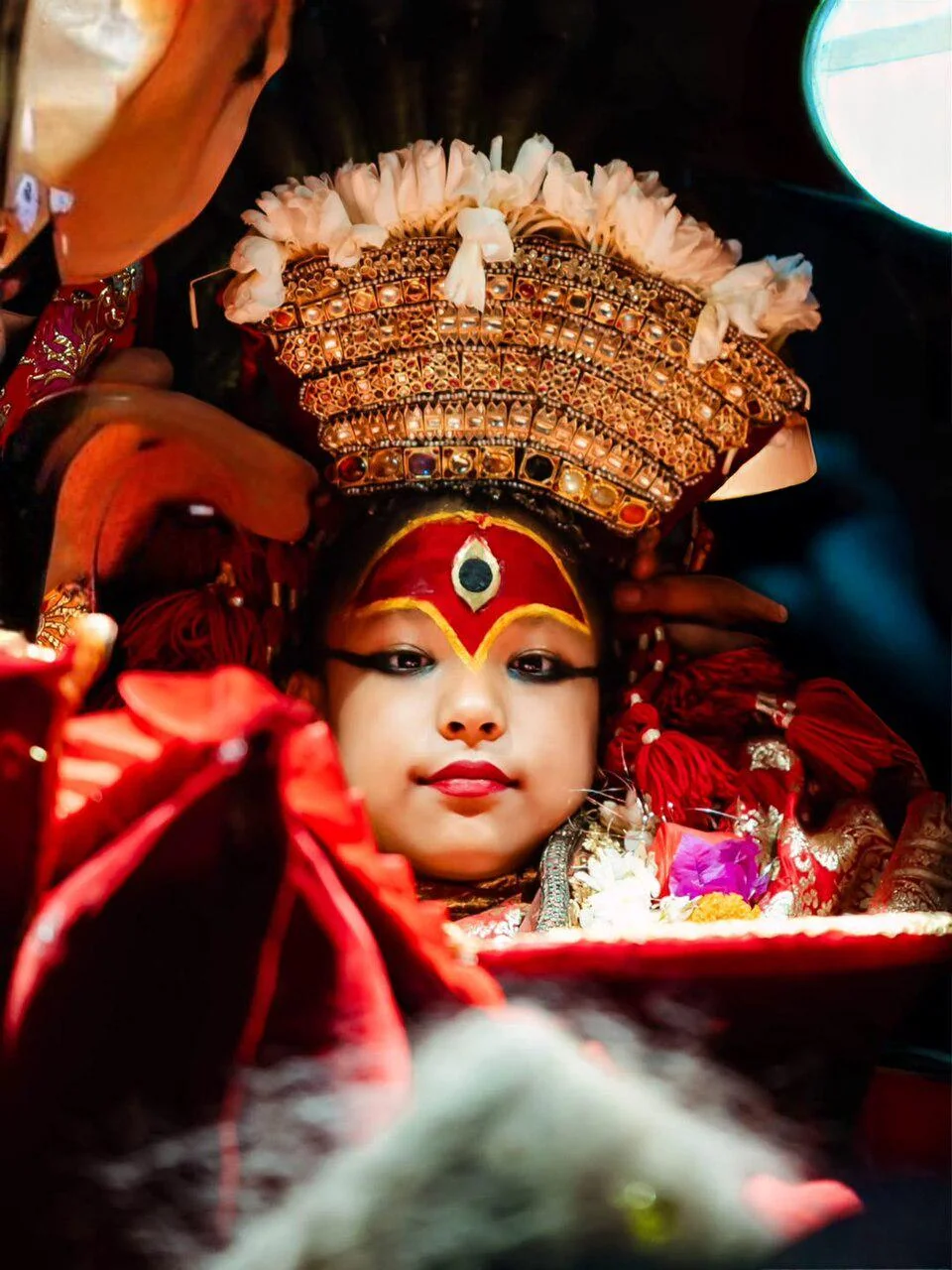
Kumari of Nepal are prepubescent girls from the Newar community who are worshiped as living goddesses, and the tradition works by ritually selecting a child who then lives in semi-seclusion and serves as the embodiment of the goddess until her first menstruation or a significant loss of blood. The best known is the Royal Kumari in Kathmandu, but there are also city Kumaris such as the Kumari of Patan, whose lives are shaped for years by this role. In recent decades, the Kumari tradition has been reformed, with more emphasis on education and child rights, but it remains controversial for the way it separates girls from ordinary childhood and complicates their lives after they return to being “mortal.”
One former Kumari of Patan, Dhana Kumari Bajracharya, famously never menstruated and served for about 30 years until she was replaced in 1984 against her will, a story that highlights both the devotion surrounding these girls and the human cost of the institution.[1] Today, new Royal Kumaris are still being appointed, including a two-year-old girl, Aryatara Shakya, selected in 2025, while courts, activists and communities argue over how to balance an ancient goddess cult with modern ideas about children, schooling and consent.[2][3]
What is the Kumari of Nepal tradition?
The Kumari of Nepal tradition is a religious practice in the Kathmandu Valley in which very young Newar girls, usually from the Shakya or Bajracharya caste, are chosen and worshiped as living goddesses. The word kumari comes from Sanskrit and means “virgin” or “princess,” reflecting the expectation that the girl is prepubescent and has never shed blood. Several cities in the valley have their own Kumaris, but the most prominent is the Royal Kumari of Kathmandu, who resides in a dedicated palace called the Kumari Ghar and appears during major state and religious ceremonies.[2]
In religious terms, a Kumari is believed to be a manifestation of the goddess Taleju (a form of Durga), present in the girl’s body until she reaches puberty. Devotees, including high-ranking officials and historically the king, visit to receive blessings, which are thought to grant protection and good fortune. While there are parallels to other child-deity cults, the Kumari system is unusually institutionalized and public, with fixed residences, formal selection committees and defined roles in festivals.
Key idea: A Kumari is not simply respected or honored, she is treated as the physical, living presence of a goddess for as long as she remains a child without menstrual blood.
This combination of intense veneration and strict purity rules creates a life that is at once privileged and highly constrained. The girl receives gifts, status and material support, but her daily routine, movements and social interactions are tightly controlled in the name of preserving divinity.
How did the Kumari tradition begin?
The precise historical origins of the Kumari tradition are debated, but most accounts trace its formalization to the Malla period of the Kathmandu Valley, particularly to King Jaya Prakash Malla in the 17th or 18th century. According to widely told legends, the king used to play dice at night with the goddess Taleju, who appeared to him in human form. One night the queen glimpsed the secret meeting, or the king behaved inappropriately toward the goddess, and Taleju disappeared in anger. She later appeared in a dream and told the king that, from then on, she would manifest as a young Newar girl who must be sought out and worshiped publicly.[4]
Scholars of Newar religion, such as Gopal Singh Nepali in his 1965 ethnography of the Newars, point out that the worship of powerful mother goddesses was already deeply rooted in local culture. They argue that the royal Kumari institution probably gave official, courtly shape to older village practices of honoring girls as embodiments of divine energy, rather than inventing something entirely new. In this view, King Jaya Prakash Malla extended and standardized an existing goddess cult, tying it to royal power and public festivals like Indra Jatra.
Historically, the Royal Kumari’s horoscope was even matched with that of the king, reinforcing the idea that the ruler’s fate depended on his relationship with the living goddess.[5]
The result is a hybrid institution: deeply embedded in Newar Hindu-Buddhist ritual life yet also shaped by dynastic politics and, more recently, by the transition from monarchy to republic. Even after Nepal abolished its monarchy in 2008, the Royal Kumari tradition has continued, which suggests that many Nepalis see it less as a symbol of royal authority and more as an enduring part of local religious identity.
How is a Kumari selected and what is her daily life like?
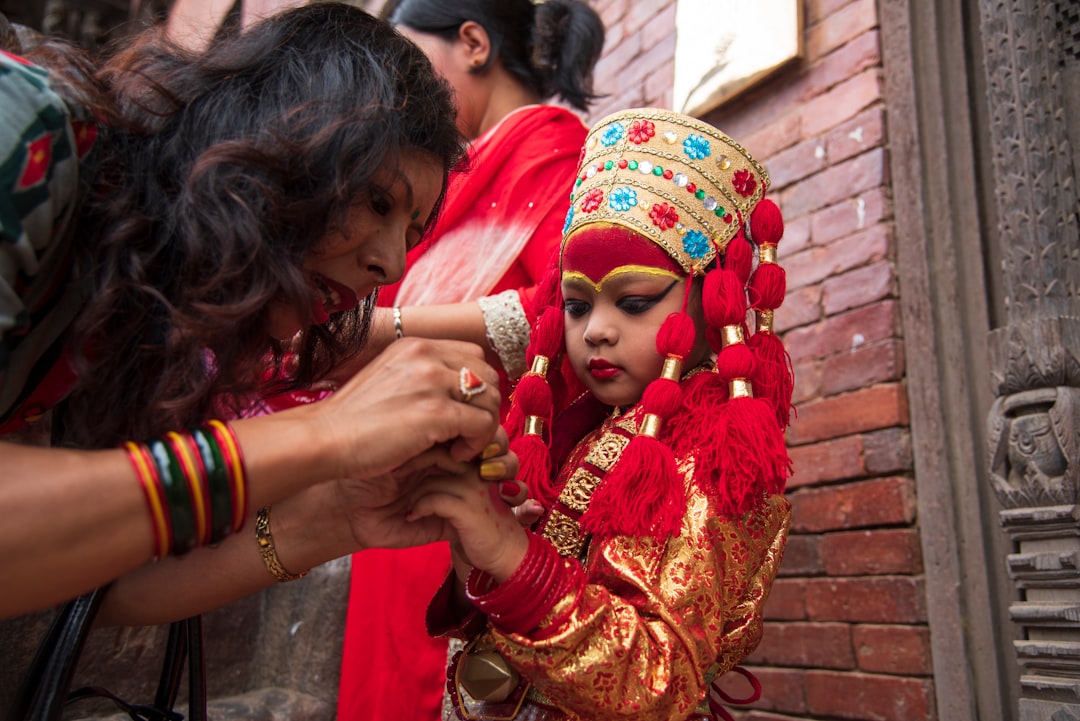
The selection of a Kumari is highly codified. Committees of priests and elders search among eligible Newar girls, traditionally from specific Buddhist lineages like Shakya and Bajracharya. Candidates must meet strict physical criteria, sometimes summarized as the battis lakshanas, or “32 perfections.” These include unblemished skin, particular eye and hair characteristics, and the absence of scars, serious illness or lost teeth.[4] Astrologers also check that her horoscope aligns with religious requirements, historically including that of the monarch.
In some traditional accounts, part of the selection test involves exposing the candidate to ritual scenes meant to be frightening, to confirm that she remains calm and fearless like a goddess. Once chosen, the girl moves into the official residence, such as the Kumari Ghar in Kathmandu or a Kumari house in Patan. Her feet are not supposed to touch the ground outside the residence, so she is carried or transported during public appearances. She wears red clothing and elaborate gold jewelry and sits on a throne to receive visitors who bow for blessings.[6]
Day to day, however, much of her life is quiet. Reports from former Kumaris describe long hours inside the residence, playing with a small number of chosen companions, being tutored, and pausing lessons whenever worshippers arrive. A former Royal Kumari, Rashmila Shakya, recalled that during her tenure in the 1980s she had only one hour of informal classes and was often pulled away from study to sit as a goddess; she later entered formal school behind her age group, which she described as socially and academically difficult.[7]
In modern practice, the state has mandated more structured education for Kumaris, with several hours a day reserved for lessons and teachers funded by the government, a direct response to criticism about lost schooling.[8]
Publicly, the Kumari appears on only a handful of important festival days, when she is carried through the streets on a palanquin. These processions attract large crowds of devotees and tourists and are among the few moments when the wider world sees the living goddess outside her residence.
When does a Kumari stop being a goddess, and what happened in Patan?
By convention, a Kumari’s divine status ends with her first menstruation or with any significant and lasting loss of blood, such as a serious injury. Menstruation is interpreted as a sign that the goddess has left her body, so the girl returns to ordinary life and is replaced by a younger child. This is also why candidates are selected before the age of about four and why the term of service typically ends in early adolescence.[9]
The case of Dhana Kumari Bajracharya, the Kumari of Patan chosen in 1954 at around age two, became famous because she never menstruated. She remained Kumari for three decades until 1984, when she was removed under orders attributed to Crown Prince Dipendra. Priests summoned her for inspection to find some sign that she no longer embodied the goddess. According to accounts summarized in her biography, they found no evidence of menstruation and only a minor scratch on her ear, which they used as justification to declare her ineligible.[1]
Many locals in Patan believed this dismissal and the cancellation of her pension were illegitimate. Stories circulated that a priest who had pushed to end her benefits died suddenly and that this was divine punishment for mistreating the living goddess. Whether or not one accepts that explanation, the controversy underlines how seriously communities take the Kumari’s status, and how blurred the line can be between religious office and personal identity.
After losing her official role, Bajracharya chose to continue living as a Kumari in practice, maintaining seclusion and avoiding walking in public. She reportedly left her house on foot for the first time only after the 2015 Nepal earthquake forced her to evacuate, and many residents of Patan still regard her as holy.[10] Her experience shows that, in some cases, the “goddess” identity does not neatly end when the state or priesthood defines it as over.
Is the Kumari tradition controversial and how is it changing?
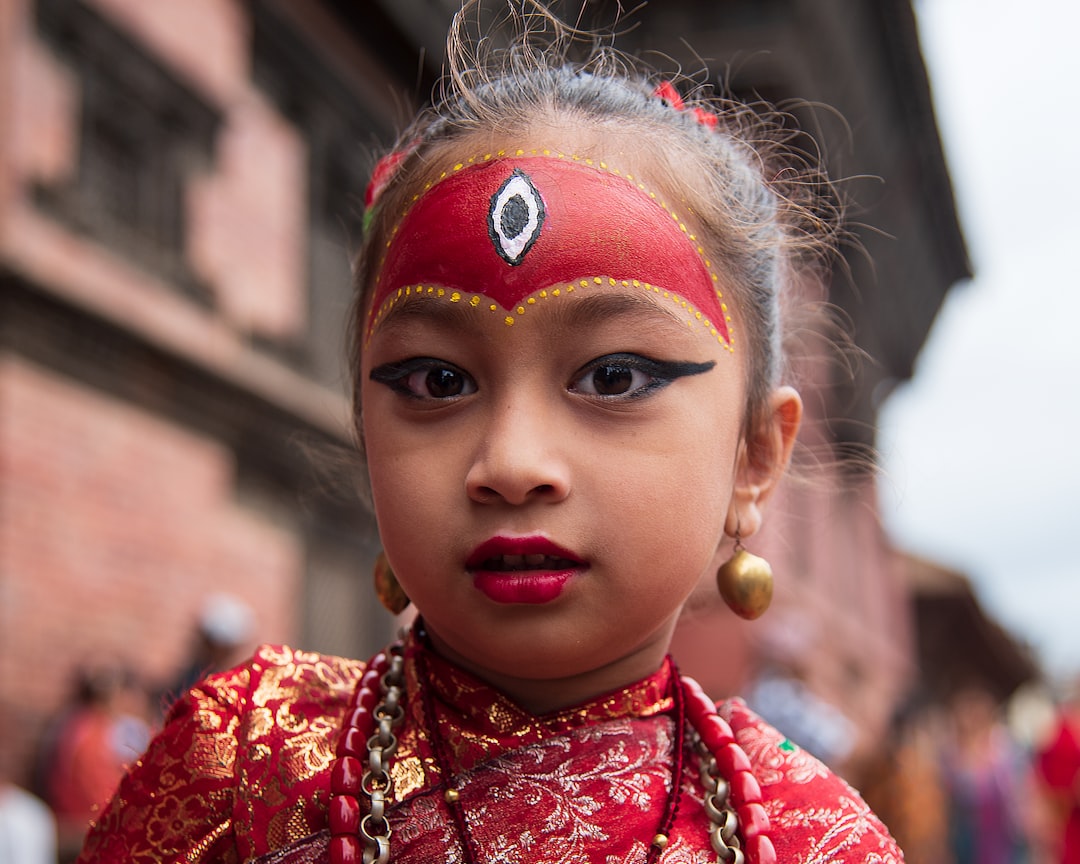
Yes. The Kumari of Nepal tradition has come under sustained scrutiny from Nepali human rights lawyers, child-rights advocates and some former Kumaris themselves. Critics argue that imposing seclusion, ritual obligations and restricted movement on a young child violates international norms such as the UN Convention on the Rights of the Child, which Nepal has ratified. Lawyer Sapana Pradhan-Malla, for example, told The Guardian that “you cannot exploit children in the name of culture,” and that the Kumari is effectively forced to trade her childhood for a revered but isolating role.[7]
Former Royal Kumari Rashmila Shakya, in her memoir From Goddess to Mortal, described the psychological shock of suddenly entering ordinary school, being behind academically, and no longer being treated as divine. Other ex-Kumaris have reported difficulties with social reintegration and with persistent beliefs that marrying a former Kumari brings bad luck, which can affect their personal relationships and marriage prospects.[11]
In response to such concerns, the Supreme Court of Nepal heard a landmark case in the 2000s on the rights of Kumaris. The court recognized the tradition as part of religious and cultural rights but insisted that Kumaris must have access to education and health care, and invited the state to provide stipends and social security for former Kumaris whose rights had been limited.[12] Subsequent reporting from Kathmandu describes set hours reserved for schooling inside the Kumari residences and improved living conditions, including better housing and modest pensions for ex-goddesses.[8]
Modern reforms aim to preserve the Kumari of Nepal tradition while reducing harm, for example by mandating daily lessons, formal exams and small government pensions after retirement.[3]
Supporters of the tradition argue that many families actively compete to have a daughter chosen, that Kumaris are well cared for and accorded dignity, and that reforms have addressed the worst problems. Critics counter that consent is impossible for a toddler and that even with school and stipends, the core structure still asks a child to shoulder heavy symbolic expectations. The debate continues inside Nepal, reflecting a broader tension between safeguarding living heritage and upholding evolving standards of child welfare.
Why does the Kumari of Nepal tradition matter today?
The Kumari of Nepal tradition matters for several reasons. Culturally, it is one of the most visible expressions of Newar religious life and of the broader South Asian idea that divine power can inhabit ordinary human bodies, especially those of girls. Pilgrims and tourists travel to Kathmandu and Patan to glimpse the living goddess at a palace window or during festival processions, and local festivals such as Indra Jatra remain unthinkable without her presence.[6]
Politically and legally, the institution has become a test case for how a modern republic handles powerful premodern symbols. The monarchy has fallen, but the Royal Kumari lives on, now giving blessings to elected leaders instead of kings. Court rulings and activist campaigns around the Kumari touch on questions that extend well beyond one tradition: How far should states go in regulating religious upbringing? When is cultural preservation compatible with children’s rights, and when does it cross the line into exploitation?
At the personal level, stories like that of Dhana Kumari Bajracharya or Rashmila Shakya show the long shadows such roles cast over individual lives, for better and worse. For some former Kumaris, the experience leads to educational and professional opportunities, while for others it brings social isolation and lingering stigma. Understanding the Kumari system, then, is not only about an exotic custom of “living goddesses” but about the very human girls at its center and the societies that decide what kind of childhood they will have.