

Your first “real” job is usually 30% useful work and 70% learning how to be an adult in an industry.
The Amodei AI jobs prediction is about deleting that 70%.
Axios quoted Anthropic CEO Dario Amodei saying AI could wipe out roughly half of all entry‑level white‑collar jobs, pushing unemployment to 10-20%, in the next one to five years. Everyone’s arguing about whether “50% in 3 years” is accurate. That’s the wrong argument.
The key insight is this: the moment a CEO at his level says that out loud, the career ladder starts to rewire itself. Long before the pink slips arrive.
TL;DR
- The Amodei AI jobs prediction matters less as a forecast and more as a management permission slip to cut junior hiring and replace training time with tools.
- Public AI doomerism from CEOs acts like a market signal: it accelerates changes to hiring pipelines and makes displacement hit early‑career workers first and hardest.
- To avoid hollowing out development, both workers and managers need to deliberately redesign entry‑level work, tests, mentorship, and on‑ramp tasks, around AI instead of quietly deleting those rungs.
What Amodei actually said (and why “entry‑level” is the knife)
Look, let’s clear the factual underbrush in one paragraph.
In an on-the-record interview with Axios, Amodei said AI “could wipe out half of all entry‑level white‑collar jobs” and push unemployment to 10-20% in the next one to five years, painting scenarios like “Cancer is cured…the economy grows at 10% a year…and 20% of people don’t have jobs.” The Guardian, Tom’s Hardware and others repeated the same 1-5 year, entry‑level, 10-20% unemployment frame, while people like Nvidia’s Jensen Huang pushed back that he was being too pessimistic.
That’s all the news you need.
Now, what does that actually do inside an organization?
Imagine you’re a mid‑size consulting firm.
You used to hire 40 grads, knowing 10 would be rockstars, 20 would be fine, and 10 would wash out. Their billable work barely justified the salary at first, but you were really buying the future seniors who’d learned your playbook.
Now the Anthropic guy, the one behind Claude, goes on record: “entry‑level is going away.”
If you’re a partner at that firm, the question in your head is not “Is it 50% or 35%?”
It’s: “Why am I still paying full price for training wheels work if the market thinks that’s automatable?”
That tiny shift in attitude is where the damage starts.
Why the ‘50% in 3 years’ fight misses the point
Arguing about the exact percentage is like arguing whether a house fire will reach 40% or 60% of the rooms while you ignore the fact that the staircase is already burning.
McKinsey and others have shown for years that automation usually hits tasks, not entire occupations. Historically, that meant:
- Junior lawyers did fewer document‑review hours.
- Bank tellers handled more complex cases while ATMs took the simple stuff.
- Admins did more coordination, less typing.
You still had a path in.
The Amodei AI jobs prediction is different not because it’s more accurate, but because it’s more convenient for managers.
If the CEO of a leading AI lab tells the world “entry‑level white‑collar work is mostly automatable in 1-5 years,” suddenly:
- Freezing junior hiring looks prudent, not cruel.
- Pushing existing staff to “just use AI more” sounds modern, not extractive.
- Slashing internship programs becomes “aligning with the future of work.”
Whether AI is truly ready to do “half of entry‑level” today is secondary.
What matters is that nobody gets fired for cutting the ladder if the AI guys said the bottom rungs are obsolete anyway.
How CEO warnings become self‑fulfilling job cuts
OK so imagine the labor market as a series of on‑ramps to the highway of mid‑career work.
Each on‑ramp is messy: apprenticeships, grad schemes, rotational programs, “two years of grunt work while you learn the ropes.” This mess is expensive and hard to measure, so it’s always tempting to trim.
Now inject three things at once:
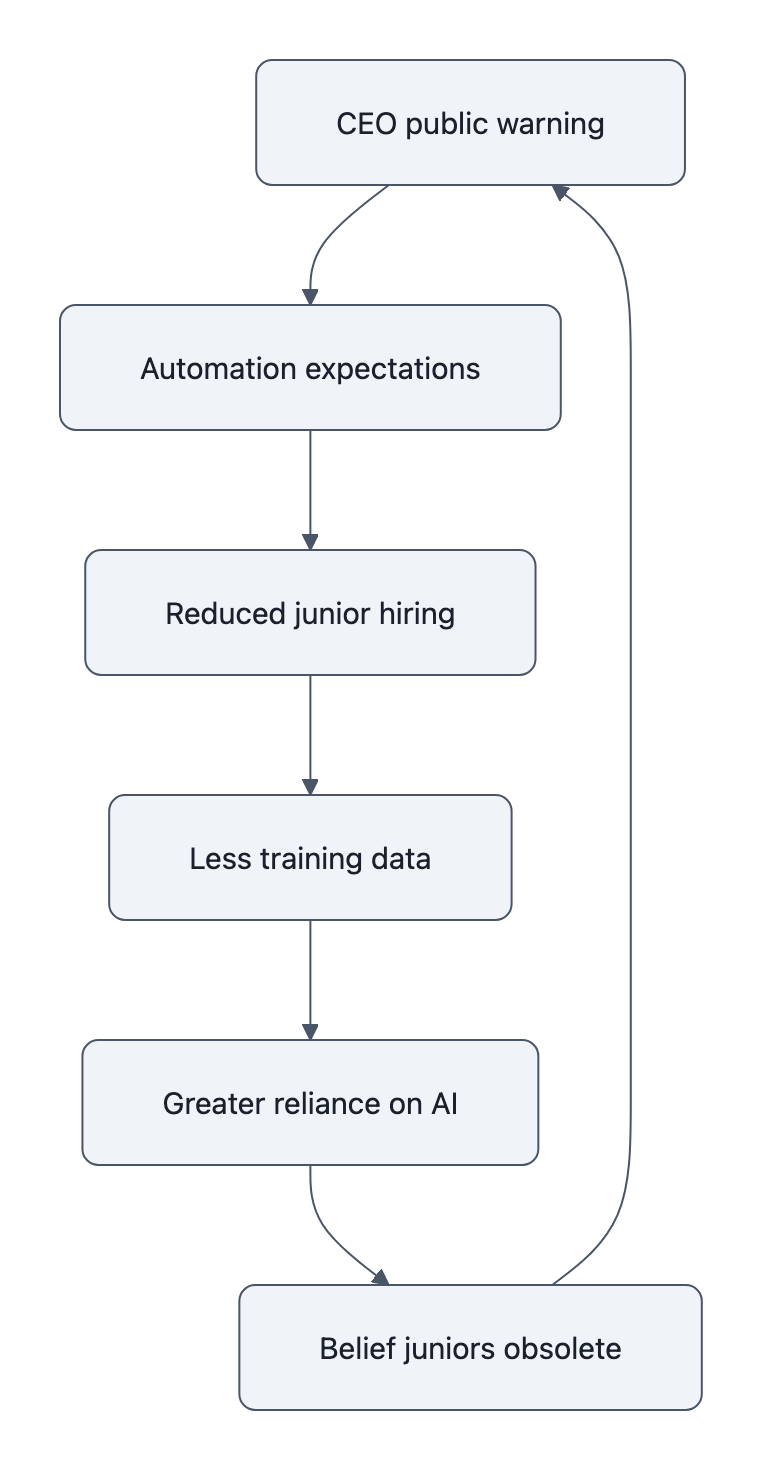
- Amodei’s public warning: entry‑level white‑collar work is highly automatable very soon.
- Tools that look eerily competent on the surface, even if brittle under pressure.
- Shareholder pressure plus deflationary AI expectations: “Why is your cost per task still so high?”
Result: you get a feedback loop.
- CEOs hear peers predicting wiped‑out entry‑level jobs.
- They feel socially and financially safe to reduce entry‑level intake “ahead of disruption.”
- Fewer juniors means less organic training, less internal human redundancy, more dependence on AI tools.
- Workflows get redesigned around tools, not trainees.
- Five years later, surprise: there really are far fewer entry‑level jobs.
The prediction created the conditions that made it true.
We’ve written before about AI and unemployment: people don’t lose trust in work just because of automation; they lose it because institutions quietly change the rules. CEO proclamations are how you announce those rule changes without having to own them.
And notice who gets squeezed first: people who haven’t yet built bargaining power, grads, career switchers, return‑to‑work parents, immigrants without local networks.
Senior staff will still exist. They just won’t have anyone behind them.
The real risk: a hollowed‑out career ladder
Here’s the thing: entry‑level jobs were never just about low‑skill tasks.
They’re where you learn:
- How to talk to clients without tanking a deal.
- What “good” looks like in your field.
- Which corners you don’t cut.
If we decide that AI should do the easy 70% and humans should only do the hard 30%, but we remove the years where humans get to practice on the easy 70%, we’ve built a pipeline problem, not a productivity win.
Fast‑forward five years:
- Law firms have a handful of partners, a thin middle, and almost no associates.
- Engineering orgs have staff+ leads, a sea of contractors, and no juniors who “grew up” in the codebase.
- Accounting, marketing, operations: same pattern.
You get organizations that look efficient on paper and fragile in reality, because the “future seniors” never had the reps.
That’s not just bad for workers. It’s bad for the companies who think they’re being clever.
What workers and managers should actually change in the next 12 months
The Amodei AI jobs prediction shouldn’t send you to Twitter to argue percentages. It should send you to your on‑ramp design.
For early‑career workers, the game board is changing like this:
- Assume the grunt work is gone or contested. If the main value you planned to offer is “I can copy‑paste data into spreadsheets,” you’re competing with the tools, not using them.
- Show that you are an AI‑native apprentice, not a pre‑AI replacement. In portfolios and interviews, demonstrate how you use Claude or other tools to augment work, what you still catch, how you validate, how you escalate.
- Optimize for environments that still invest in training. That might mean smaller firms, regulated industries, or places that explicitly mention mentorship and rotations rather than “move fast with AI.”
For managers, the responsibility is sharper:
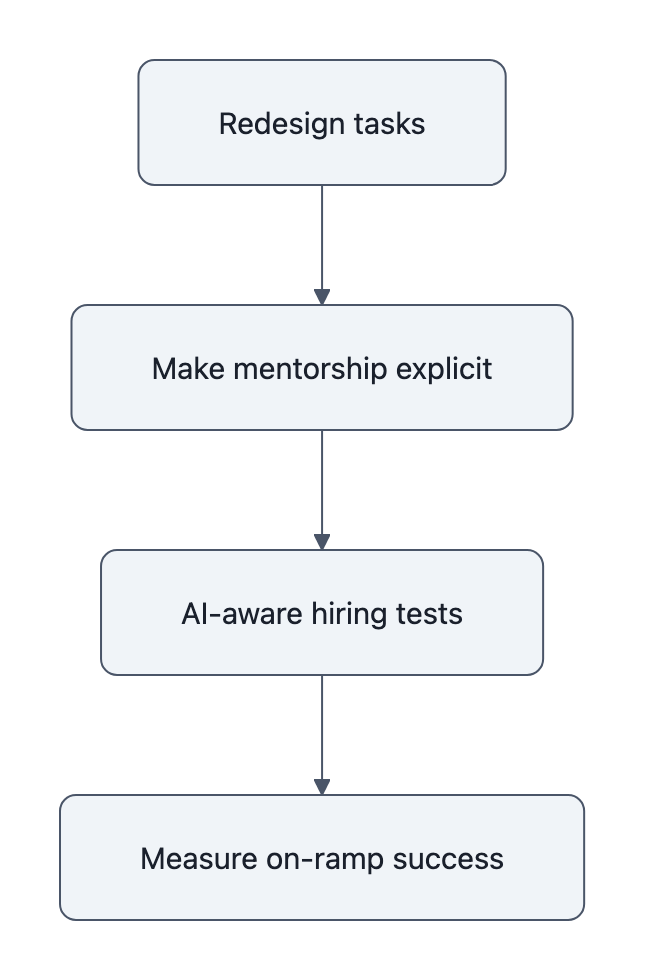
- Redesign entry‑level tasks, don’t delete them.
Take the work AI can handle and turn it into training simulations rather than exits from the pipeline. Let juniors review AI‑generated drafts and explain corrections. That way the low‑value work becomes high‑value feedback. - Make mentorship an explicit job, not “shadowing if there’s time.”
If AI is doing more of the rote work, seniors need scheduled hours to teach judgment. That’s the scarce skill now. - Change your hiring tests.
Stop pretending candidates won’t use AI. Give them a laptop with access to tools and see how they scope a task, prompt, verify, and communicate uncertainties. - Measure on‑ramp success, not just cost per head.
Track how many juniors become effective mid‑levels in 2-3 years in an AI‑rich workflow. If that number drops as you automate, that’s a red flag you’re eating your seed corn.
If you ignore all this and simply shrink junior headcount because “Amodei said 50%,” you’re not preparing for the future, you’re cancelling it.
Key Takeaways
- The Amodei AI jobs prediction is powerful less as a forecast and more as a public green light for cutting entry‑level hiring.
- CEO warnings about AI don’t just describe the market; they nudge companies into decisions that make those warnings come true, especially for juniors.
- The biggest near‑term risk isn’t “no jobs at all,” it’s no rungs on the bottom of the ladder where people learn.
- Workers should position themselves as AI‑native apprentices; managers should redesign, not erase, training work.
- Organizations that hollow out early‑career pathways will look efficient now and brittle later.
Further Reading
- Ready or not, AI is starting to replace people, Axios, Original interview where Amodei lays out the 50% entry‑level and 10-20% unemployment scenario.
- Anthropic CEO says AI could cause up to 20% unemployment, Tom’s Hardware, Summary of the claims plus pushback from other tech leaders.
- Nvidia CEO: You’ll lose your job to somebody who uses AI, CNBC, Puts Amodei’s remarks alongside a more optimistic “use AI or be replaced” framing.
- Wake up to the risks of AI, they are almost here, The Guardian, Discusses Amodei’s longer essay and his broader case about disruption.
- Jobs lost, jobs gained, McKinsey, Classic research on how automation historically reshapes tasks and skills.
- AI and Unemployment: The Real Distrust Problem, NovaKnown, Our look at why fears around AI and work often come down to broken promises, not just broken jobs.
- AI Deflation Risk: When Cheaper Means Weirder, NovaKnown, How expectations of radically cheaper knowledge work pressure organizations into premature automation.
If you take Amodei literally, you’ll argue about how many jobs survive.
If you take him structurally, you’ll start asking a better question: who is still building the people who will do the work that AI can’t?