
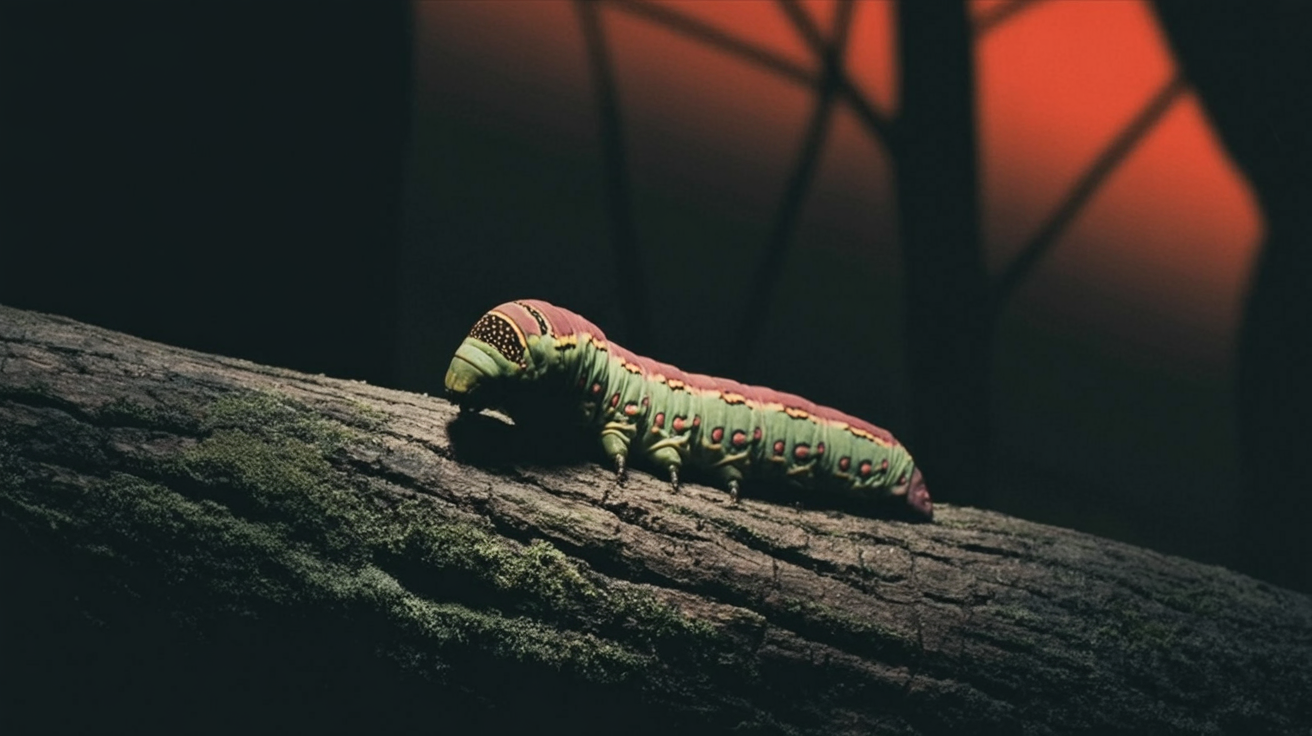
Hawk moth caterpillars use Batesian mimicry by briefly turning themselves into a fake snake display: they inflate the front of the body, reveal large eyespots, and strike a snake-like posture that can make predators hesitate or retreat. The strongest evidence is that this defense works best when the caterpillar is large enough for the illusion to be convincing, while smaller caterpillars get more variable protection depending on the predator and the setting.
In plain terms, this is Batesian mimicry because the caterpillar is harmless while resembling a more dangerous animal. A hawk moth larva cannot bite like a viper, but it can produce a quick visual bluff that says “do not touch”, and sometimes that is enough.
How the Mimicry Works
In species such as the elephant hawk-moth, Deilephila elpenor, the rearward body markings that are usually visible become part of a different picture when the caterpillar is disturbed. The larva withdraws its actual head, swells the front segments, and exposes a pair of large eyespots, producing the outline of a small snake head rather than a soft-bodied insect.
That display is not just color. The behavior matters. Accessible field reporting from National Geographic’s coverage of hawk moth caterpillars shows the animal often rears back and twists its front body into a snake-like stance. The trick works because predators do not get a careful taxonomic inspection; they get a fast, alarming silhouette.
The broader conceptual point is that mimicry is about deception that changes another animal’s behavior. In this case, the target is a predator making a split-second choice about whether to strike.
Why the Defense Is Effective
The key feature is the eyespot. Experimental work on insect eyespots found that predator mimicry, rather than simple conspicuousness, best explains why large eyespots can deter attacks. In other words, the pattern is not just “bright and weird.” It appears to work because it resembles the eye region of something threatening.
That matters for hawk moth caterpillars because their display combines several cues at once:
- Large circular eyespots
- A widened front body
- A reared, snake-like posture
- A harmless model fitting the definition of Batesian mimicry
That bundle of signals is probably why the display can be so startling. A predator sees something that suddenly looks less like prey and more like a small vertebrate head.
Body size also changes the equation. A comparative study across caterpillars found that eyespots are strongly associated with large body size in hawkmoth larvae. The logic is simple enough: if a caterpillar is too small, the “snake head” illusion is less convincing. If it is larger, the fake head starts to sit in the same rough visual category as a small snake. Using the paper’s reported threshold, eyespot-bearing species were concentrated above about 20 millimeters in body length, which helps explain why this trait is especially common in bigger hawkmoth caterpillars.
What the Experiments Show
The strongest comparative evidence comes from the body-size study, which concluded that large caterpillars tend to evolve eyespots while smaller species more often rely on camouflage or other defenses. That is an evolutionary result, not just a neat anecdote: the display appears where it is most likely to work.
More recent experiments show the effect is also context-dependent. A 2025 study on arthropod predators found that eyespots on large insect prey deterred small arthropod predators, reinforcing the idea that relative size matters. The same paper argues that predator type and prey size interact, which is a more realistic picture than “eyespots always work.”
Another 2025 study showed that habitat structure can amplify the effect: when eyespots were revealed from leaf rolls in a “peek-a-boo” presentation, their antipredator value increased. That fits the hawk moth display surprisingly well. A sudden reveal from partial cover is more dramatic than a pattern that is always visible.
So the clean answer is this: hawk moth caterpillar snake mimicry works as a bluff that is most effective when the caterpillar is large and when the display is revealed in the right context. The eyespots matter, but so do posture, body inflation, and the predator’s point of view. Nature is annoyingly good at multimodal UI.
Key Takeaways
- Hawk moth caterpillars use Batesian mimicry by looking like a dangerous snake despite being harmless.
- The display works through a combination of eyespots, front-body swelling, and a snake-like posture.
- Experimental work suggests eyespots deter predators mainly by mimicking a threatening animal’s eyes, not just by being conspicuous.
- Comparative evidence shows snake-mimic eyespots are especially associated with large hawkmoth caterpillars.
- Recent studies indicate the defense is context-dependent, varying with predator type, prey size, and habitat presentation.
Further Reading
- Body size affects the evolution of eyespots in caterpillars, Primary study linking hawkmoth caterpillar eyespots to body size and predator deterrence.
- Predator mimicry, not conspicuousness, explains the efficacy of butterfly eyespots, Experimental paper on why eyespots can scare predators.
- Relative size matters: eyespots on large insect prey deter small arthropod predators, Recent study showing predator response depends on prey size.
- Eyespot peek-a-boo: Leaf rolls enhance the antipredator effect of insect eyespots, Recent study on how habitat context changes eyespot effectiveness.
- The genome sequence of the Elephant Hawk-moth, Deilephila elpenor, Recent source summarizing the larval eyespots and swelling defensive posture.
References
- Kodandaramaiah, 2015, Body size affects the evolution of eyespots in caterpillars
- De Bona et al., 2015, Predator mimicry, not conspicuousness, explains the efficacy of butterfly eyespots
- Relative size matters: eyespots on large insect prey deter small arthropod predators
- Eyespot peek-a-boo: Leaf rolls enhance the antipredator effect of insect eyespots
- The genome sequence of the Elephant Hawk-moth, Deilephila elpenor
- Ruxton et al., 2008, The evolution of Müllerian mimicry
- Deception as Mimicry
Last reviewed: 2026-06