
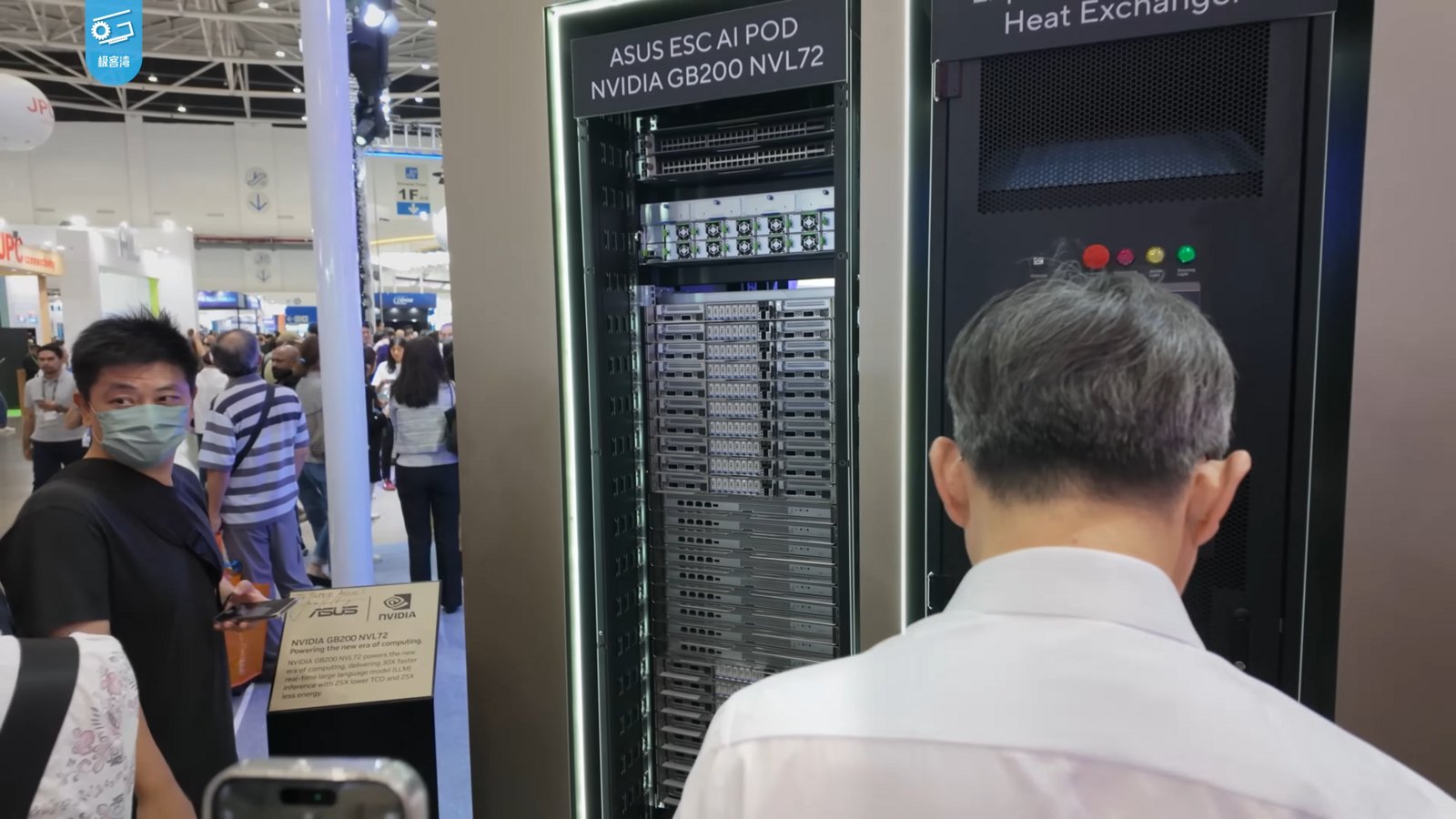
Nvidia is reportedly assembling a $500 billion AI-infrastructure financing effort, not launching a publicly documented $500 billion committed fund. CNBC reported on August 10, 2026 that Nvidia is working with Apollo, Blackstone, BlackRock’s Global Infrastructure Partners, Brookfield, Goldman Sachs and KKR to put together the package.
That distinction is the whole story. The reported money could finance GPU purchases, data-center construction and long-term power supply, three constraints already shaping the AI data-center power-equipment bottlenecks, but no public disclosure identifies signed commitments, debt terms, specific projects, customer contracts, or Nvidia’s own capital at risk.
The reported $500 billion financing consortium
The unnamed person who spoke to CNBC said the firms would assemble capital for AI infrastructure. Nvidia, Apollo, Blackstone, BlackRock/GIP, Brookfield, Goldman Sachs and KKR reportedly make up the group. CNBC said an announcement could come as early as that Monday; at publication, none of the named companies had responded to its requests for comment.
The immediate beneficiaries are easy to identify. AI developers need enormous upfront spending before they can train or serve a model; asset managers get long-lived, fee-bearing assets and structured-credit deals; Nvidia gets customers with a way to pay for systems that can cost billions of dollars per cluster. As demand increases, Nvidia’s central role in AI compute gives it unusual leverage over the financing ecosystem around its hardware.
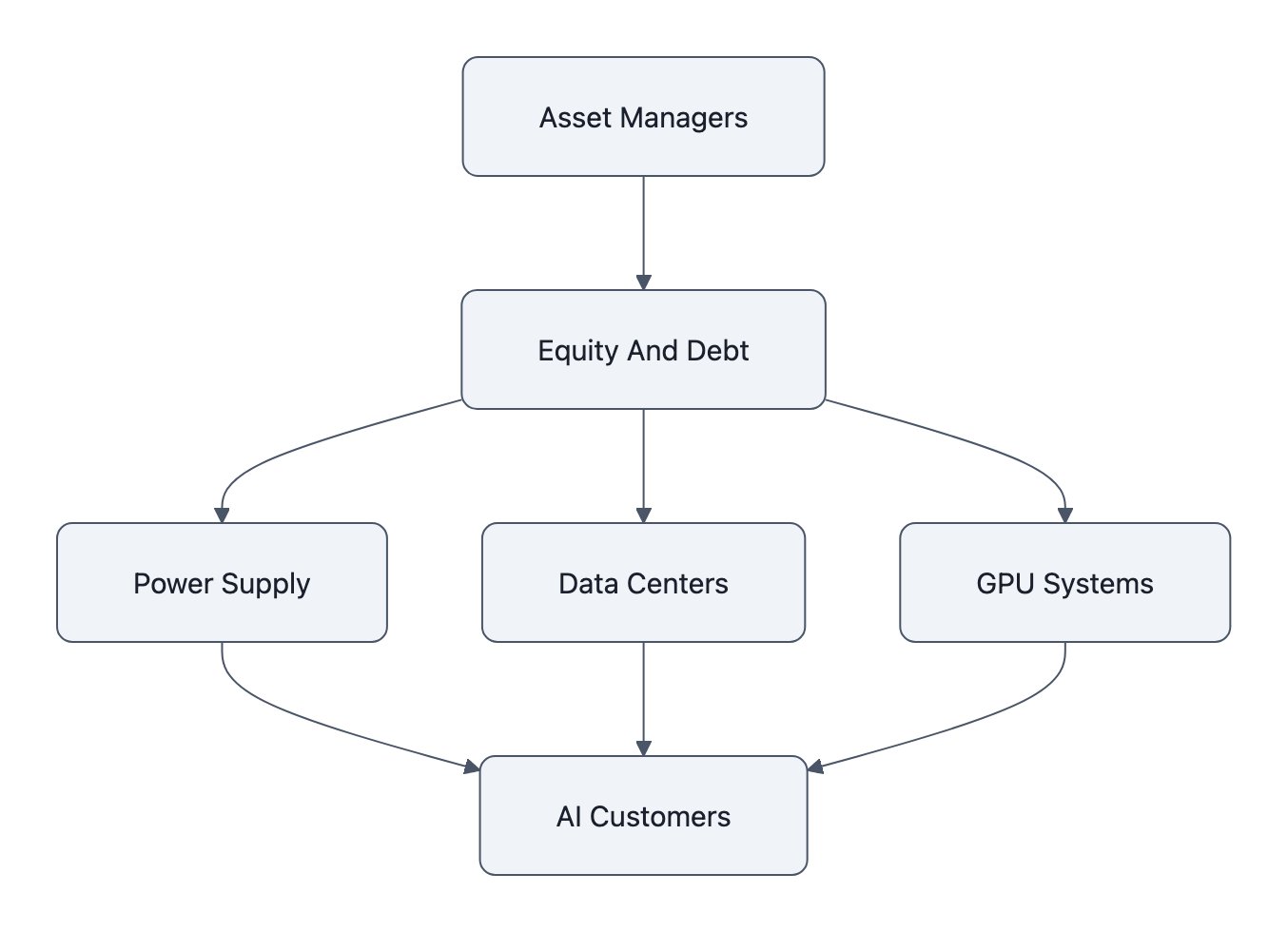
Asset-manager capital is not just a bigger checkbook. A project needs land, transmission connections, generation or power-purchase agreements, a data-center operator, racks and networking, then customers willing to sign multi-year compute contracts. The party financing those layers can influence which region gets a buildout, which projects secure scarce electricity capacity, and which AI company obtains the resulting compute.
That is particularly relevant when GPU bills are becoming a strategic constraint rather than a line item. AI compute costs and budget pressure can push model builders toward leases and long-term capacity agreements instead of outright hardware purchases. For an infrastructure investor, those contracts turn servers into an asset with scheduled payments. For Nvidia, they turn a customer’s capital-spending problem into a financeable transaction.
The $500 billion figure should therefore be read as potential financing capacity until the consortium discloses what sits behind it. That could include equity from investors, debt provided against assets or contracted lease payments, co-investment from customers, and prospective projects not yet selected. It does not mean half a trillion dollars is sitting in a single vehicle ready to deploy.
“The move highlights the growing role of private capital in financing the costs of the artificial intelligence boom.”, CNBC
Precedents show headline capacity can exceed committed equity
Brookfield’s November 2025 AI-infrastructure program is the cleanest comparison because it laid out both numbers. Brookfield announced an ambition to acquire up to $100 billion of AI infrastructure assets, but its Brookfield Artificial Intelligence Infrastructure Fund launched with a $10 billion equity-commitment target and $5 billion already committed. The rest was expected to come through co-investors and financing.
| Program | Disclosed equity or capital target | Headline investment capacity |
|---|---|---|
| Brookfield BAIIF, 2025 | $10B target; $5B committed | Up to $100B in assets |
| BlackRock/GIP AIP, 2025 | $30B sought | Up to $100B with debt |
| Reported Nvidia consortium, 2026 | Not disclosed | $500B reported effort |
BlackRock/GIP’s AI Infrastructure Partnership made the arithmetic equally explicit in March 2025. The partnership said it would seek $30 billion from investors, asset owners and corporations, and could mobilize up to $100 billion only when debt financing was included. Nvidia joined that partnership as a technical adviser.
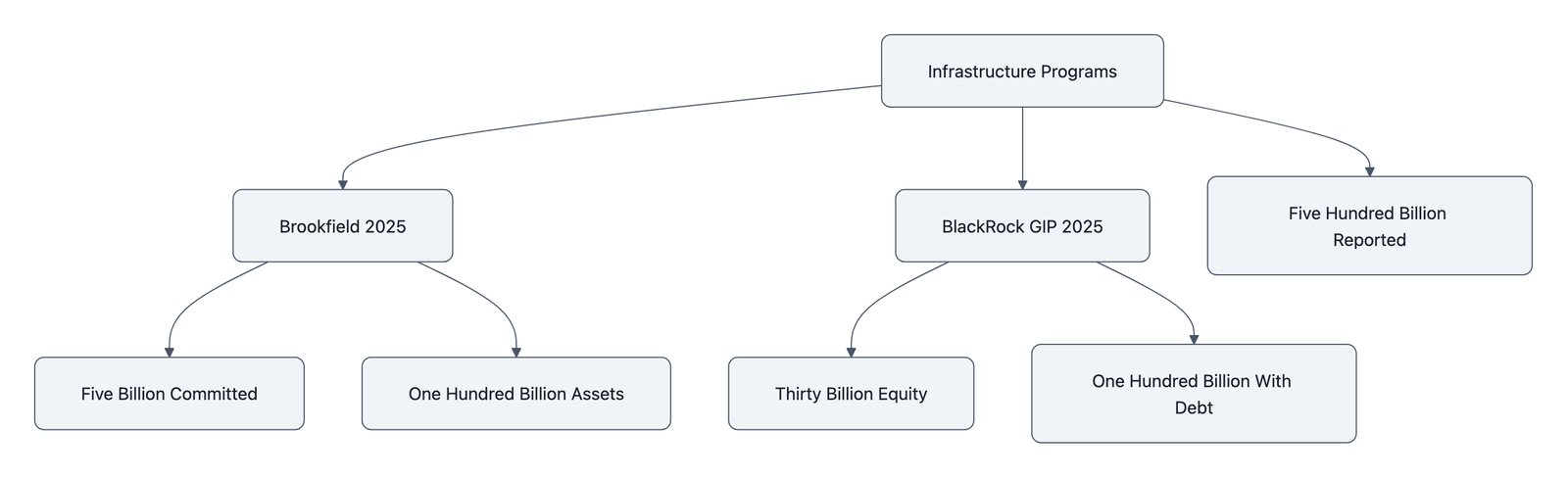
Those examples do not prove the reported $500 billion consortium uses the same leverage or has the same structure. They do establish the relevant convention: a headline infrastructure total can be many times larger than the equity committed at launch. The principal disclosures here also come from Brookfield and BlackRock/GIP themselves, not independent audits of project-level deployment.
GPU lease vehicles make Nvidia both supplier and capital backer
Apollo’s January 2026 deal with Valor Compute Infrastructure and xAI shows how the model can work in practice. Apollo-led funds supplied a $3.5 billion capital solution to support Valor’s $5.4 billion acquisition and lease of data-center compute infrastructure, including Nvidia GB200 GPUs, to an xAI subsidiary.
The equipment was financed through a triple-net lease. In that structure, the tenant leases the compute infrastructure while taking responsibility for costs such as maintenance, insurance and taxes; the financing vehicle owns the assets and receives contractual lease payments. Valor said the vehicle was designed to give investors quarterly cash distributions and upside from owning the compute assets.
Nvidia was not only the GPU supplier. Apollo said Nvidia invested in Valor Compute Infrastructure as an anchor limited partner, alongside Valor’s institutional investors.
That arrangement gives Nvidia a second role: it can help capitalize a vehicle that purchases its own hardware, while the vehicle leases that hardware to an AI customer. It is not inherently improper, the investors and lessee still have their own financial interests, but it makes disclosure of terms, risk allocation and customer commitments more important than an eye-catching deployment number.

Apollo’s Valor/xAI transaction does not establish that the proposed $500 billion package is a copy of that deal, or even that it represents a wholly new pool of capital. It establishes something narrower and more useful: Nvidia already has a documented precedent for being both the equipment vendor and an anchor investor in a GPU-finance vehicle.
The test for the reported consortium is now straightforward: disclose the equity actually subscribed, the debt leverage, the projects and power commitments it controls, and the customers obligated to pay. Until then, $500 billion is a financing ambition, not $500 billion in the bank.
Key Takeaways
- Nvidia is reportedly working with six major asset managers on a $500 billion AI-infrastructure financing effort.
- The reported figure is not supported by public disclosures of signed capital commitments or a fund structure.
- Brookfield’s 2025 program paired a $100 billion asset ambition with a $10 billion equity target and $5 billion in commitments.
- BlackRock/GIP’s AI Infrastructure Partnership sought $30 billion and reached $100 billion only by including debt financing.
- Apollo’s Valor/xAI deal shows Nvidia can be both a GPU supplier and an anchor investor in a vehicle buying Nvidia systems.
Further Reading
- Nvidia, Wall Street asset managers partner on $500B AI push, CNBC’s report on the proposed Nvidia-led financing consortium.
- Brookfield Launches $100 Billion AI Infrastructure Program, Brookfield’s filing detailing its equity target, commitments and asset-acquisition ambition.
- BlackRock/GIP, Microsoft and MGX welcome Nvidia and xAI to AI Infrastructure Partnership, The partnership’s stated capital target and debt-inclusive investment potential.
- Apollo backs $5.4 billion Valor and xAI data-center compute infrastructure transaction, Apollo’s description of the Valor GPU acquisition and lease arrangement.