
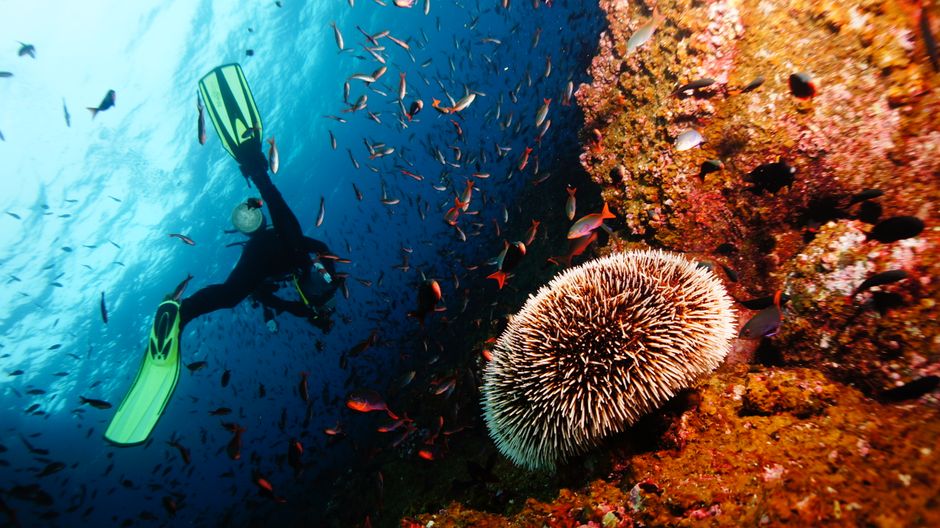
Galápagos coral records indicate that El Niño-related sea-surface-temperature variability in the eastern equatorial Pacific rose about 37% above its preindustrial level after 1984. The result, published by paleoclimatologist Julia E. Cole of the University of Michigan and colleagues in Science on August 27, 2026, is evidence that the eastern Pacific expression of ENSO is intensifying as the planet warms.
That does not mean every El Niño, everywhere in the Pacific, is now 37% stronger. It means the swings in reconstructed ocean temperature around the Galápagos, where eastern-Pacific El Niños produce some of their largest anomalies, have become substantially larger, chiefly because warm El Niño events have grown stronger.
The 37% rise in eastern-Pacific ENSO variability
ENSO, short for the El Niño-Southern Oscillation, is the coupled Pacific ocean-atmosphere cycle that helps set the odds of floods, droughts, wildfires and coral bleaching around the world. When surface water warms unusually strongly in the eastern tropical Pacific, it can rearrange rainfall far beyond the ocean basin.
Cole’s team found that modern eastern-Pacific ENSO variability was 37% ±8% higher than in the preindustrial interval from 1000 to 1850. Their “modern” period begins after 1984; their reconstructed 20th-century interval, from 1850 to 1981, was already 16% ±9% higher than the preindustrial baseline.
The number is a change in the standard deviation of reconstructed interannual sea-surface-temperature anomalies: in ordinary language, the year-to-year temperature swings became wider. It is not a 37% increase in average ocean temperature, a prediction for future damage, or a universal multiplier for all El Niño events.
The reconstruction suggests that the widening came from the hot end of the cycle. The authors found increasingly positive skewness, a statistical signature of unusually large warm excursions, rather than an equal strengthening of El Niño and La Niña phases. The Science paper describes the recent eastern-Pacific variance as unprecedented in its millennium-long record.
“The increase in El Niño’s strength closely parallels the rise in global temperature that is due to human causes such as the burning of fossil fuels,” Cole told the Associated Press.
The study’s practical claim is narrower, but still consequential: a warmer climate may be loading the dice toward larger eastern-Pacific warm events, the kind that can extend warming from South America toward the central Pacific and alter weather patterns worldwide.
Boris Worm, a marine scientist at Dalhousie University who was not involved in the study, told AP that strong El Niños have “much stronger impacts on climate hazards and extremes worldwide.”
The coral reconstruction and model comparison
The researchers built their record from 28 coral time series across five Galápagos islands. Some came from living corals; others were subfossil coral skeletons recovered from the islands.
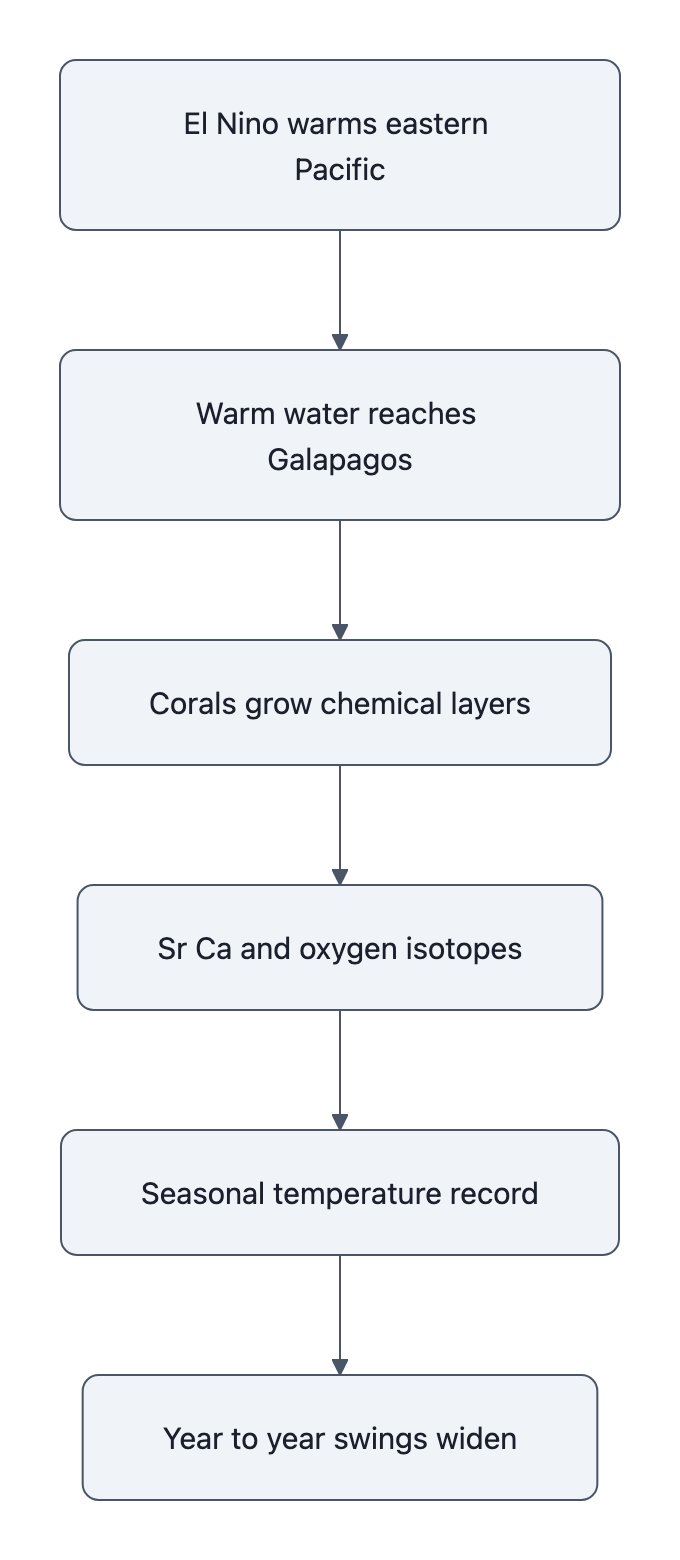
Each coral acts a little like a temperature logger that cannot be unplugged. As it grows, it lays down a calcium-carbonate skeleton whose chemistry changes with surrounding water temperature. The team used uranium-thorium dating to establish ages, then measured strontium-to-calcium ratios and oxygen isotopes in the skeletons to reconstruct seasonally resolved sea-surface temperatures.
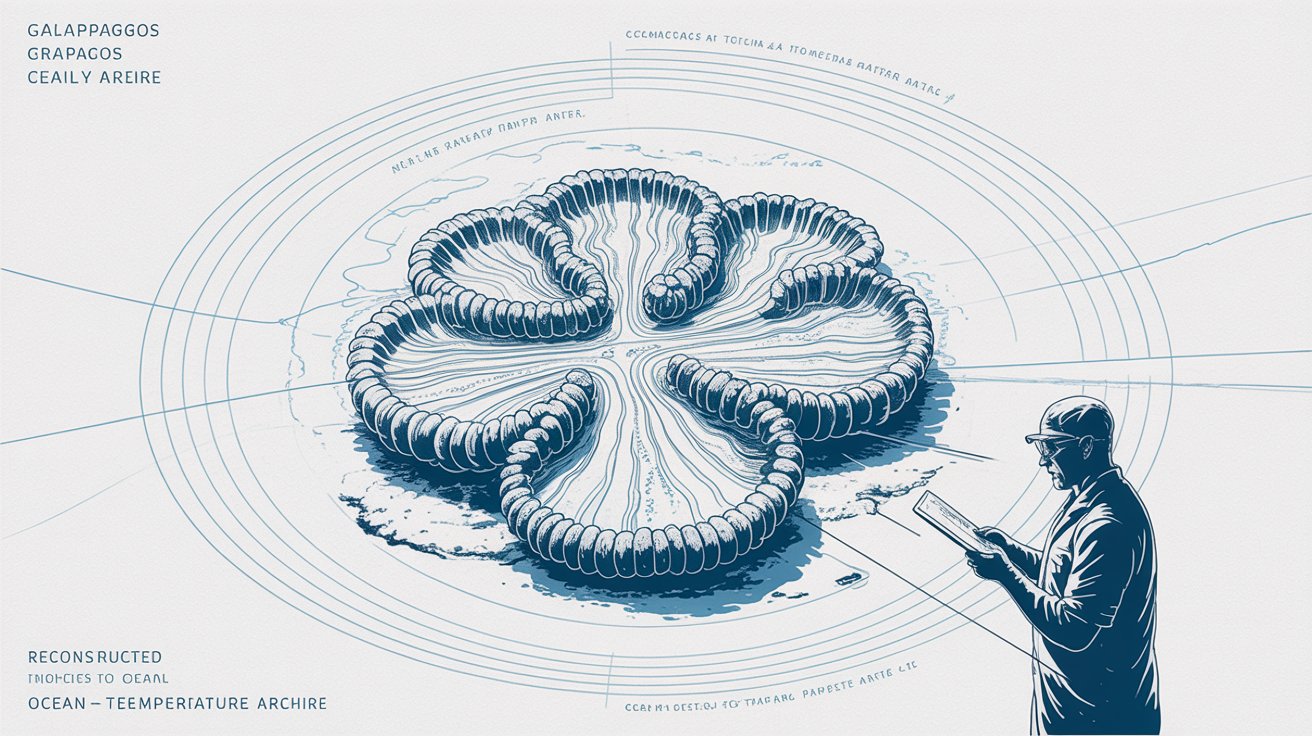
The final record spans 1047 to 2014, although it samples 51% of the years in that period. Those gaps matter: this is not a continuous millennium-long thermometer trace. But it is a high-resolution regional record from a part of the Pacific where direct systematic satellite sea-surface-temperature observations only began in the 1980s.
The authors then compared the coral result with simulations from the Community Earth System Model Last Millennium Ensemble, or CESM-LME. In that comparison, recent Galápagos variability exceeded the range generated by simulated natural forcing and internal climate noise. The study treats that mismatch, plus the record’s close correspondence with rising global temperature, as evidence supporting an anthropogenic contribution.
It is a meaningful attribution result for the eastern Pacific, not a finished causal account for ENSO as a whole.
The model comparison has its own constraint. The CESM ensemble is limited, and the authors note that its tropical-Pacific trade-wind bias can affect the ENSO pattern in the same region used for the coral comparison.
Why the basin-wide climate-change claim remains unsettled
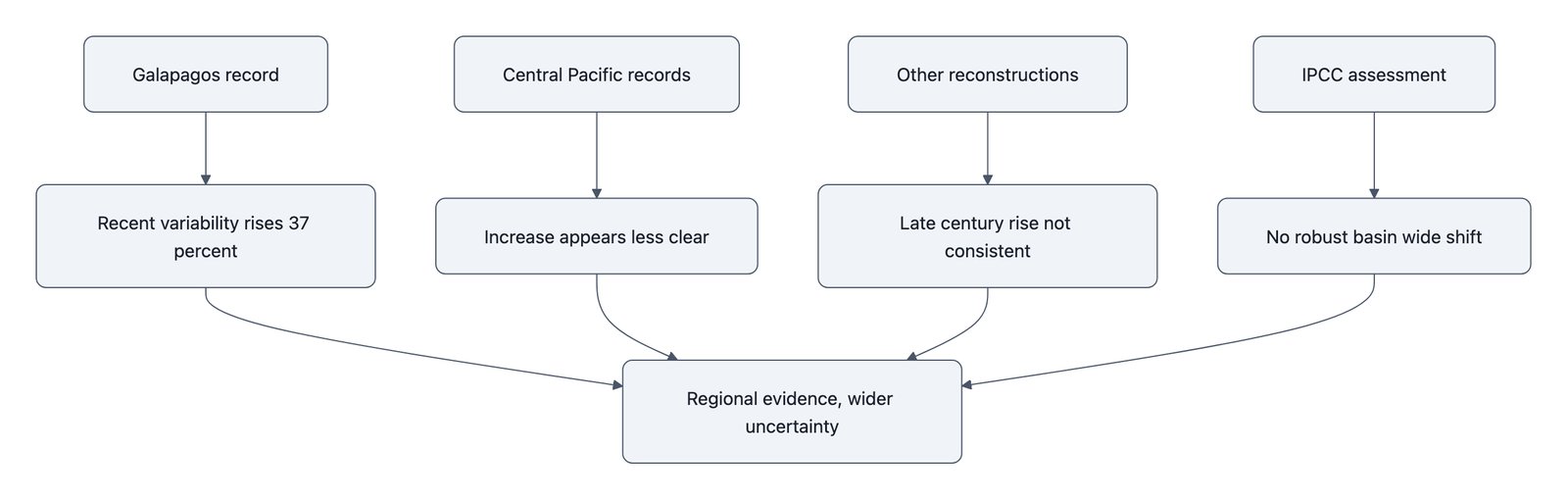
The regional pattern does not reproduce equally clearly across the Pacific. Central-Pacific coral data also show increased variability, but less distinctly than the Galápagos record.
More importantly, Cole and colleagues’ manuscript acknowledges that other continuous coral, tree-ring and multiproxy ENSO reconstructions do not show the same sharp late-20th-century increase. The authors suggest those records may suffer from age uncertainty or data-inhomogeneity bias, but that explanation is interpretive rather than independently established.
There is also a nearer-term disagreement. Michael Mann of the University of Pennsylvania and John Bruno of the University of North Carolina, both speaking to AP, pointed to instrumental water-temperature observations near the Galápagos that suggest declining ENSO-related variation. Cole responded that the short observational window can be distorted by where it falls between major “super” El Niños.
The broader assessment remains cautious. IPCC AR6 found no observed sustained ENSO shift beyond multicentennial variability, and found no robust near-term projected change in the amplitude of ENSO sea-surface-temperature or rainfall variability.
That makes the Galápagos result valuable precisely because it is not a generic “El Niños are stronger now” headline. It is a carefully located record of an eastern-Pacific change, and a challenge for the rest of the evidence to either match or explain.
Key Takeaways
- Galápagos coral records show eastern-Pacific ENSO temperature variability about 37% above the preindustrial level after 1984.
- The increase largely reflects stronger warm El Niño events rather than a uniform increase in every part of the ENSO cycle.
- The reconstruction uses uranium-thorium dating and coral Sr/Ca and oxygen-isotope chemistry from 28 time series across five islands.
- The record samples 51% of years between 1047 and 2014.
- Other ENSO reconstructions, recent local observations and IPCC assessments leave the basin-wide conclusion unresolved.
Further Reading
- Recent strengthening of eastern Pacific ENSO is unprecedented in the last millennium paleorecord, The peer-reviewed Science paper reporting the Galápagos coral reconstruction.
- Recent intensification of eastern Pacific ENSO is unprecedented across the last millennium, The authors’ manuscript with reconstruction methods, coverage and model comparisons.
- As super El Niño strengthens, study suggests that climate change is intensifying El Niños, Independent reporting and outside scientists’ reactions.
- Chapter 2: Changing State of the Climate System, IPCC AR6 assessment of observed ENSO changes.
- Chapter 4, IPCC AR6 assessment of projected ENSO variability under warming.