
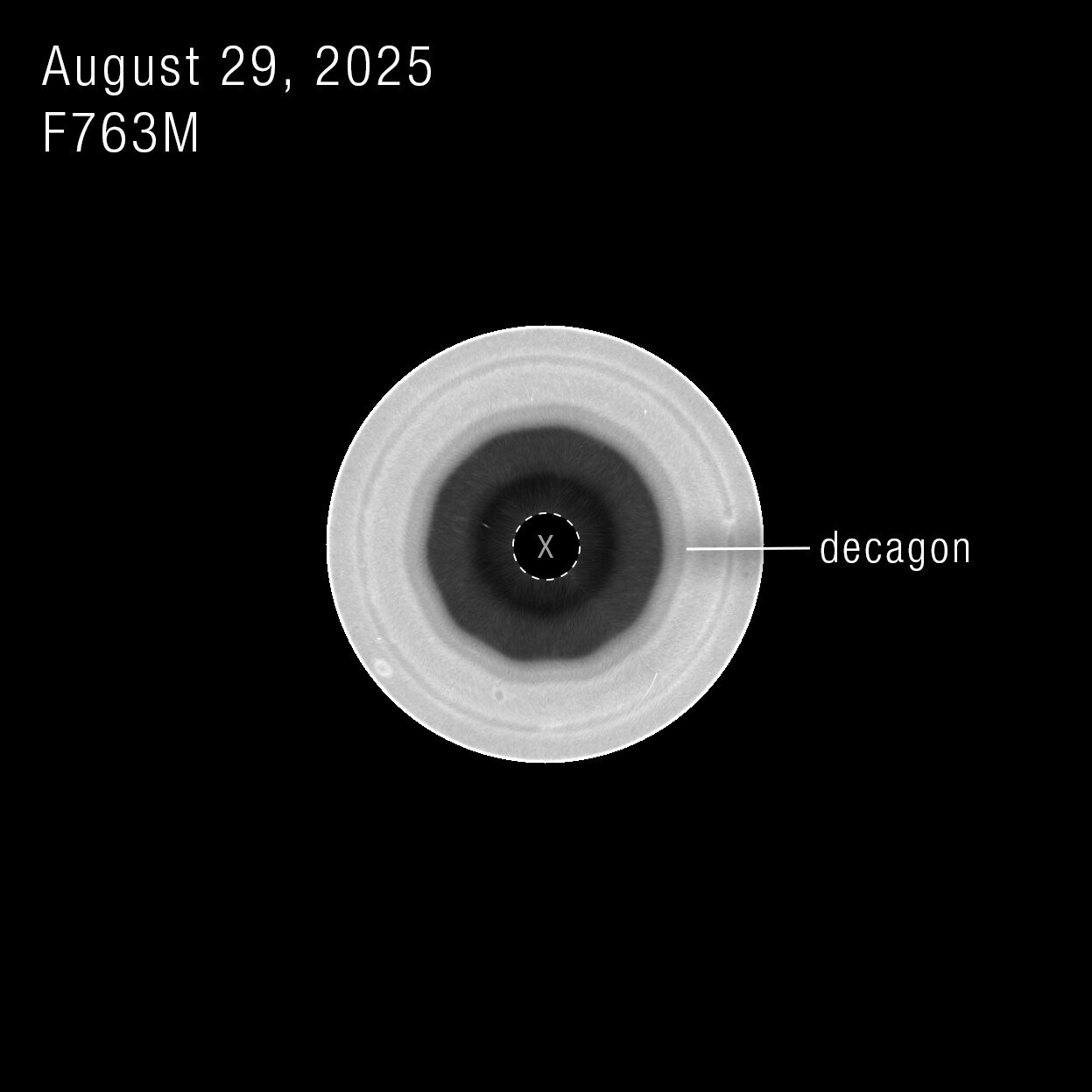
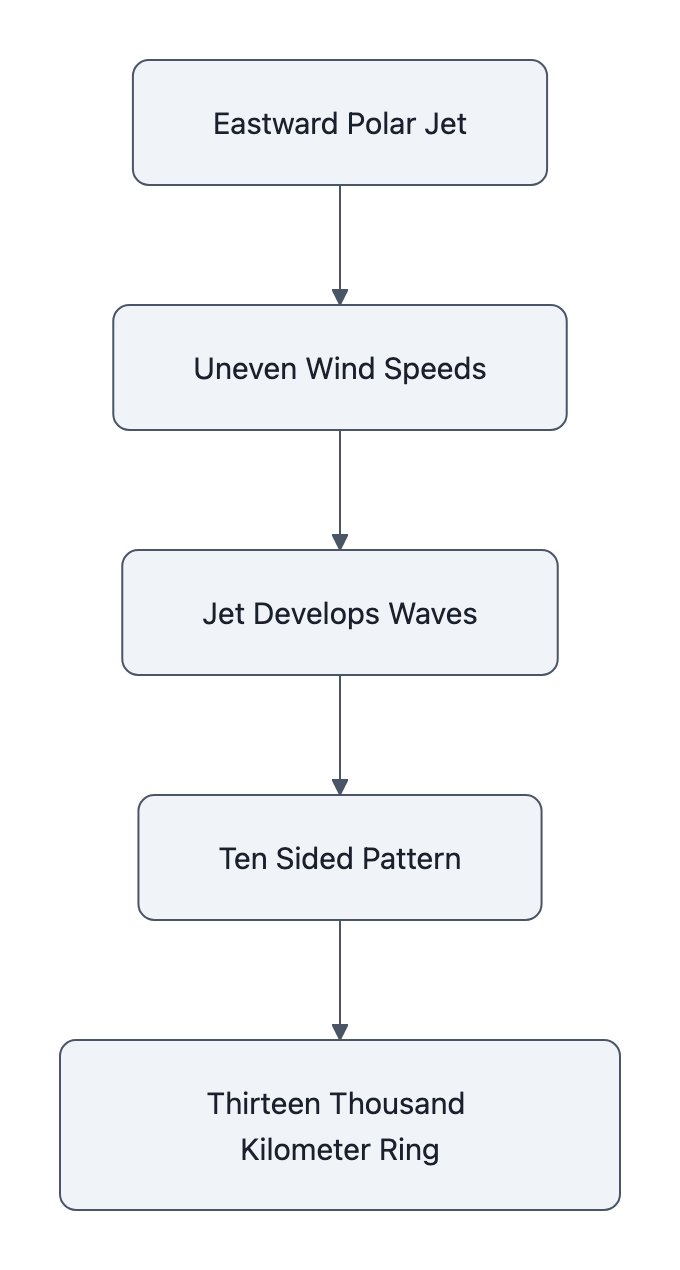
Saturn has a 13,000-kilometer-wide, 10-sided wave circling its south pole, NASA reported on September 2, 2026. It rides an eastward-moving band of wind near 63° south latitude, turning a normally smooth-looking jet into a decagon.
The pattern is real and unusually orderly. But it is not yet Saturn’s confirmed second permanent polar polygon: Hubble has followed it only from 2023 through 2025, while the planet’s north-pole hexagon has persisted through observations for more than 40 years.
The 13,000-Kilometer Wave at 63° South
The decagon is an atmospheric wave embedded in one of Saturn’s powerful eastward jets. Rather than blowing around the pole in a clean circle, that jet now bends repeatedly into ten broad sides. At roughly 13,000 kilometers across, it is slightly wider than Earth.
Agustín Sánchez-Lavega, a planetary scientist at the University of the Basque Country and lead author of the 2026 Science Advances study, and amateur observers Trevor Barry and Jean-Paul Oger first noticed a subtle wavy band in ground-based images in 2024. Hubble’s Outer Planet Atmospheres Legacy, or OPAL, images then pushed the feature’s visible history back to 2023 and showed it becoming much clearer in 2025.
“We’ve never seen anything quite like this in Saturn’s southern hemisphere,” said Amy Simon, OPAL’s principal investigator at NASA’s Goddard Space Flight Center.
The timing is partly a matter of geometry. Saturn’s changing seasons gradually brought its south pole back into a useful view from Earth. Hubble can photograph full rotations without the blurring caused by Earth’s atmosphere, allowing scientists to separate a persistent wave pattern from a one-off smear in the clouds.
The north-pole comparison is unavoidable. Saturn’s northern hexagon is a six-sided wave wrapped around a polar jet, observed repeatedly since the early 1980s. Sánchez-Lavega’s team had searched Hubble images for a southern counterpart since 1990, and Cassini, Saturn’s orbiter from 2004 to 2017, did not see a long-lived southern formation.
“The northern hexagon has been there every time we’ve looked for more than 40 years. This feature is different, it appears to be strengthening,” Simon said in NASA’s account of the finding.
That last point is the useful one. The decagon is not evidence that Saturn simply has matching polygon machines at each pole. It is evidence that a southern jet has entered a particularly organized state, and that scientists have caught it while it is still changing.
The researchers have not settled on a cause. The study identifies the structure as a wind-driven atmospheric wave, but possible triggers include an instability in the jet itself, influence from deeper layers of Saturn’s atmosphere, the seasonal cycle, or a nearby storm. The shallow-water simulations used in the study did not reproduce the observed southern configuration exactly.
There is also older southern evidence that makes “first polygon ever” too neat. A 2006 analysis of Cassini images found periodic, polygonal-looking disturbances in the southern hemisphere in 2004: an ephemeral four-node feature spanning about 120 degrees of longitude near the 60.5°S jet, consistent with a wavenumber-12 pattern, and a faint pattern near 74.5°S. The authors found no direct analog to the northern hexagon.
Those Cassini patterns were incomplete and short-lived. The new feature is more coherent, more plainly regular, and appears to run around the planet. Still, the record supports a narrower conclusion: Saturn’s southern high-latitude jets can make polygons. Whether this one sticks is another question.
NASA and the study team say the decagon’s future is unknown. Hubble, ground-based telescopes, and potentially the James Webb Space Telescope can continue watching it, but Saturn will decide whether this is a durable atmospheric landmark or a beautifully geometric weather event that comes apart.
Key Takeaways
- Saturn’s newly reported south-polar structure is a 10-sided atmospheric wave within an eastward jet near 63°S.
- The decagon is about 13,000 kilometers across and was tracked in Hubble observations from 2023 to 2025.
- Ground-based observers first noticed the undulating southern band in 2024.
- The feature is more coherent than earlier southern polygonal disturbances seen by Cassini in 2004.
- Its persistence and cause remain unknown, unlike Saturn’s north-pole hexagon, which has been observed for more than 40 years.
Further Reading
- NASA’s Hubble Tracks New Decagon Encircling Saturn’s South Pole, NASA’s account of the Hubble observations and the decagon’s development.
- A decagon wave around Saturn’s south pole, The peer-reviewed Science Advances study reporting the observations and modeling.
- Cassini imaging of Saturn: Southern hemisphere winds and vortices, Cassini’s record of earlier transient southern polygonal-looking disturbances.
- Scientists discover a mysterious wave shaped like a decagon in Saturn’s atmosphere, Independent coverage of the finding and its unresolved origin.
- Saturn has a big, weird decagon around its south pole, Reporting on the decagon’s scale and uncertain lifetime.