
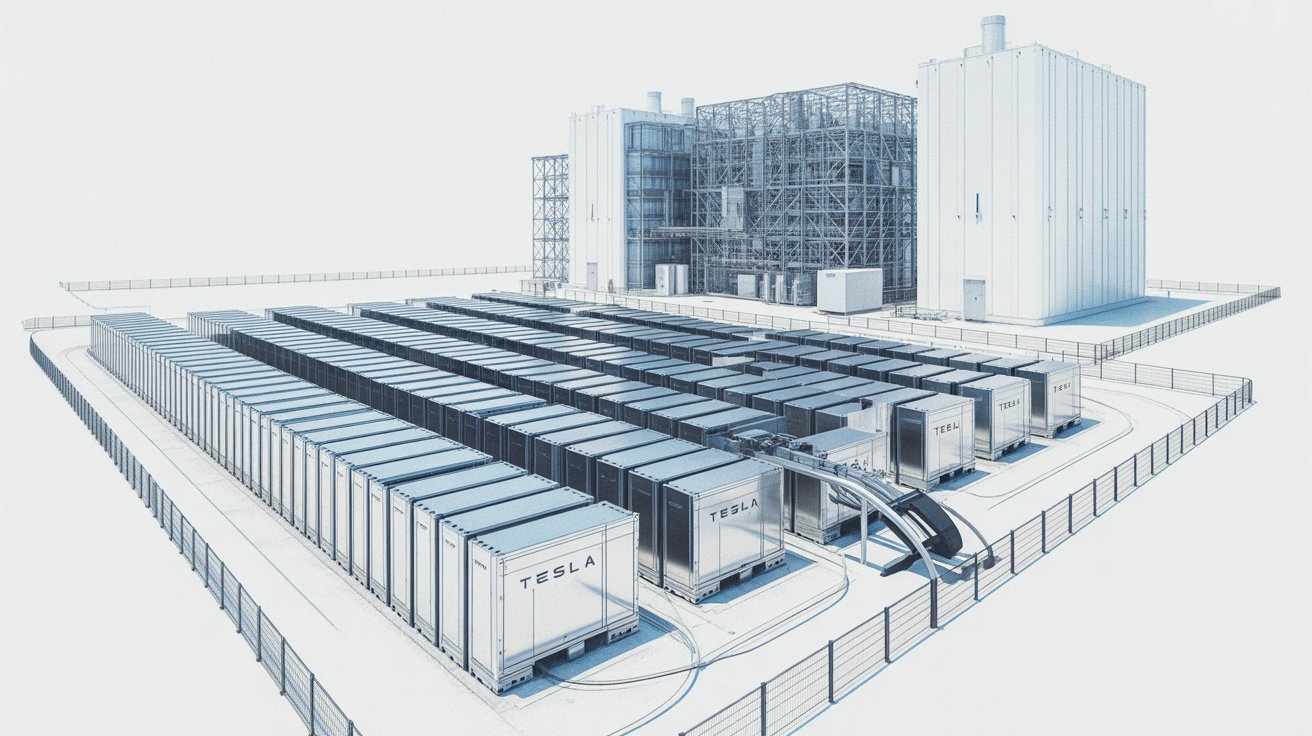
Satellite imagery from July 11 showed 720 Tesla Megapack containers at SpaceXAI’s Colossus 2 campus in Memphis, an AI data-center site that needs enough electricity to train and run large GPU clusters. Canary Media counted the containers, but neither Tesla nor SpaceXAI has confirmed the total or published the system’s specifications.
The batteries could let the campus take electricity when demand is lower, then use it when the grid is strained, or disconnect from the grid for four hours when Tennessee Valley Authority calls for curtailment. But as of July, the linked Southaven power site still had 69 temporary gas turbines in operation. The batteries are large; whether they are replacing the turbines is another matter.

720 Megapacks in July 11 satellite imagery
A Megapack is Tesla’s container-sized lithium-ion battery system for utilities and industrial sites. Put hundreds together, and they can store electricity at one time of day and release it later, an increasingly valuable trick as data centers add abrupt, heavy loads to local grids. It is the same basic job behind broader investment in utility-scale battery technology, but placed directly beside one of the country’s most power-hungry AI campuses.
Canary Media’s count implies roughly 2.8 gigawatt-hours of storage, enough electricity to supply 2.8 gigawatts for one hour or 700 megawatts for four hours. The estimated output range is 720 megawatts to 1.4 gigawatts, depending on which Megapack model is on site. Those are model-based estimates, not disclosed specifications.
The scale would put Colossus 2 in contention for the largest battery system in the United States, but that claim is not settled. California’s operating Edwards & Sanborn project has more than 1,066 MW of power and 3,287 MWh of storage; Colossus 2’s final installed capacity remains unclear.
Competing public numbers have made the uncertainty worse. SpaceXAI developer Riley Trettel cited 3.3 GWh to the TVA board on August 20, while Memphis Light, Gas and Water chief executive Doug McGowan later described 2,000 MW behind the meter, meaning equipment serving the customer’s site rather than exporting power through the wider grid. MLGW, TVA and SpaceXAI have not reconciled those figures in a published specification.
Tesla has reason to welcome a deployment visible from space. Its energy-generation-and-storage revenue rose 13% year over year to $3.139 billion in the second quarter of 2026, partly on higher Megapack deployments. But the segment’s gross margin fell from 30.3% to 20.4%, as costs rose faster than revenue and Tesla reported a lower average Megapack selling price.
That makes the Memphis project a useful demonstration of volume, not necessarily a proof of lucrative volume. Tesla’s own filing says the business sold more Megapacks while earning less per unit on average. At a time when AI data-center power-equipment spending is becoming a major hardware market, the battery business is chasing scale with its margins under pressure.
TVA’s four-hour curtailment arrangement
The project’s practical purpose is clearer than its nameplate capacity. Under the reported arrangement, Colossus 2 must be able to leave TVA’s system for up to four hours when asked to curtail demand. Canary Media reported that on-site batteries and generation would keep the campus running during that period.
That is a grid bargain: the utility gets a customer that can stop drawing an enormous load at short notice, while the customer gets access to the grid when supply permits. For a data center, batteries can also absorb sudden changes in GPU demand that would otherwise hit the grid all at once.
“The battery is not yet connected to TVA’s grid.”
Trettel made that statement to TVA’s board on August 20, 2026. So the visible hardware did not, at that point, establish an operating grid battery. A direct TVA connection is useful only once the equipment behind it is commissioned, connected and able to perform the four-hour obligation.
That distinction matters because data-center grid access is increasingly a negotiation over who absorbs scarcity. Utilities elsewhere have begun limiting or delaying new connections; the constraints are no longer theoretical, as shown by data-center grid-connection disputes in Texas.
69 Southaven turbines and measured NOx emissions
The battery’s arrival has not ended the fuel-burning part of the story. Mississippi regulators counted 69 temporary gas turbines at SpaceXAI’s Southaven site by July, Scientific American reported. Under the retirement schedule described in that report, some newer turbines could remain in place until July 2027.
A separate August 23 preprint, using NASA’s TEMPO atmospheric instrument, estimated that nitrogen oxide emissions from the Southaven plant averaged 730 ± 185 kilograms per hour after February 2026. The researchers said that was about 16 times the emissions rate expected under the site’s March permit. The study is a preprint, not peer-reviewed research.
The permitting fight is still live. The Justice Department said it intervened on June 16 in litigation brought by private plaintiffs alleging Clean Air Act violations involving xAI and MZX Tech’s power equipment; the department also said Mississippi had determined no permit was required. That is the federal government’s litigation position, not a resolution of the plaintiffs’ allegations.
Canary Media reported that if grid supply is inadequate, the Megapacks could be charged by gas generators in an islanded microgrid. In that arrangement, a battery shifts fossil-generated electricity through time rather than displacing it. Until SpaceXAI discloses how Colossus 2 is operating after its TVA connection, there is no public evidence that the 720 containers have reduced generator use at Southaven.
Key Takeaways
- Canary Media counted 720 Tesla Megapack containers in July 11, 2026, satellite imagery of SpaceXAI’s Colossus 2 campus.
- The visible containers imply an estimated 2.8 GWh battery system, but its final capacity and output have not been disclosed.
- Tesla’s energy-storage revenue rose 13% in the second quarter of 2026 while segment gross margin fell to 20.4%.
- Colossus 2 is expected to be capable of leaving TVA’s grid for four hours during curtailment calls.
- Mississippi regulators counted 69 temporary gas turbines at the linked Southaven site in July 2026.
Further Reading
- xAI has quietly built a massive battery at its Memphis data center hub, Independent reporting on the Megapack count, capacity claims, TVA arrangement and generator uncertainty.
- Tesla builds largest grid battery in US at xAI’s Memphis site, The originating report on the reported 720-Megapack deployment and estimated capacity.
- Tesla, Inc. Form 10-Q for the Quarterly Period Ended June 30, 2026, Tesla’s quarterly energy-storage revenue, deployment and margin disclosures.
- The data center backlash comes for SpaceXAI’s Colossus, Reporting on Southaven’s temporary turbines, permitting dispute and local opposition.
- Quantifying AI data center nitrogen oxide (NOx) emissions from space, Preprint estimating Southaven NOx emissions using satellite observations.
- Justice Department Files to Intervene and Dismiss Lawsuit that Would Hamper America’s AI Innovation and Security, The Justice Department’s account of the federal permitting litigation.
Last reviewed: 2026-09