
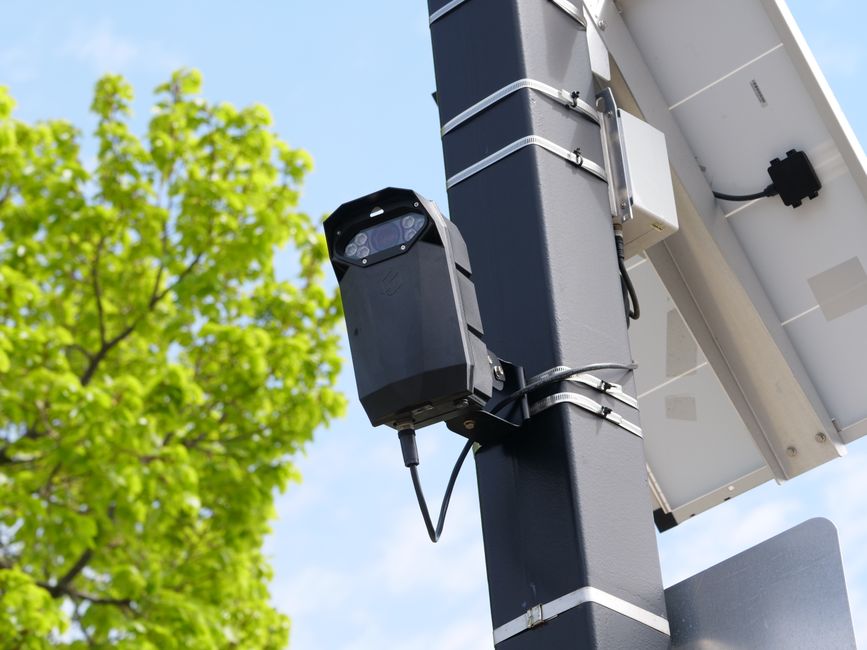
Boston Police ended its Flock Safety license-plate-reader pilot after discovering that other police agencies had been able to search data from Boston’s cameras through Flock’s nationwide lookup system for the trial’s first three days. The city’s contract said only trained Boston Police Department personnel could access the 45-camera system, with data sharing disabled. Boston’s annual surveillance report says the nationwide setting was enabled by Flock “in error.”
Boston did not stop using automatic license plate readers. It declined to renew Flock, then began new camera pilots with Motorola Solutions and Axon. The vendor changed; the city’s plan to scan passing vehicles did not. The Boston Globe reported that both replacement pilots began before two city councilors said they had been informed.
An automatic license plate reader photographs vehicles as they pass, converts plates into searchable text, and stores the time and location. That means a police search can reconstruct where a particular car was seen without stopping its driver. The data may identify a vehicle rather than a person on its face, but it can become driver-identifying data when it is tied to registrations, repeated movements, or a case file.
Three days of nationwide direct access
The Flock pilot began on April 1, 2025, with 45 cameras supplied at no cost. Its planned rules were unusually clear: trained BPD personnel would use it, sharing would be turned off, and images and plate records would be deleted after 30 days.
Within three days, BPD learned that the nationwide lookup tool let outside law-enforcement agencies query data collected by Boston cameras directly, rather than asking Boston to conduct a search on their behalf. WBUR reported that the access conflicted with the contract terms and the city’s own configuration.
BPD says it had checked that its data-sharing controls were disabled. The city’s report says Flock had enabled the nationwide function anyway, “in error.” Flock did not respond to WBUR’s request for comment. The public record therefore establishes the setting and its duration, not what any outside agency actually searched.
The distinction between direct lookup and a written request is not administrative trivia. Under direct lookup, an outside department can type in a plate and see whether Boston cameras recorded it. Under a request system, the outside department has to ask BPD, leaving Boston to decide whether to run the search. One is a shared national camera network; the other at least puts a Boston officer in the loop.
“We have actually abandoned Flock.”
Mayor Michelle Wu described the outcome plainly in a GBH News appearance, saying, “We have actually abandoned Flock.” That applies to Flock’s contract, not to the underlying surveillance practice.
BPD had the setting disabled once it learned of the problem, and the city says there was no further direct access. But the department did not immediately terminate the pilot. It continued for another 156 days, ending on September 4, 2025. The city’s surveillance report records the dates and the corrective action.
The vendor changed; the city’s plan to scan passing vehicles did not.
The report does not name the agencies that used the nationwide tool, say how many agencies used it, or confirm that any individual vehicle record was searched. The access log that could answer those questions is not public. That is the central gap in Boston’s account.
77 outside requests and 11,004 BPD searches
After BPD closed the nationwide route, other agencies had to submit written requests. Federal, state, and local agencies sent BPD 77 requests during the pilot. Boston’s report does not disclose which requests BPD granted, declined, or acted on.
Inside BPD, officers made 11,004 searches of the Flock database in five months. That is about 73 searches per day across the 151 days from April 1 through September 4, calculated from the report’s search total and pilot dates.
The report found that officers attached a case number associated with a specific crime to only about half of those searches. Its audit recommendation was straightforward: future searches should require one. The recommendation appears in the city’s annual surveillance report.
A case-number requirement does not prevent a department from collecting vehicle-location data. It does create a basic record of why an officer searched and what investigation supposedly justified it. Boston’s own audit found that this record was often absent while the Flock pilot was running.
The broader lesson is less flattering than a one-off “vendor error” narrative. BPD verified one setting, Flock’s platform made another path available, and outside access existed until BPD discovered it. A system built to make plate data searchable at national scale will tend toward wider sharing unless the technical and contractual controls are independently checked—and publicly auditable.
A new vendor, the same cameras
Boston’s replacement programs show what the city actually abandoned. BPD began a 45-camera Motorola Solutions pilot in February 2026 and a 30-camera Axon pilot in June 2026. Both were described as replacements for Boston’s aging plate-reader system.
| Pilot | Cameras | Start date |
|---|---|---|
| Flock Safety | 45 | April 1, 2025 |
| Motorola Solutions | 45 | February 2026 |
| Axon | 30 | June 2026 |
The new pilots also arrived with limited public visibility. Two Boston city councilors said in August 2026 that they had not been told about the Motorola and Axon programs before they began. That matters because the Flock episode was not only a dispute over a vendor’s setting. It exposed how much surveillance capacity can be deployed before elected overseers—or residents—know which databases are being connected.
Flock’s system is not disappearing from the wider policing market. Other governments have already reconsidered their exposure: Abbott, Texas, for example, paused new Flock spending amid scrutiny of how plate-reader networks can be shared beyond the agency that installed the cameras.
Boston has now replaced a Flock pilot that gave outsiders three days of direct national access with two fresh pilots whose operating rules have not received the same public accounting. The next surveillance report will be more useful if it can answer the question this one cannot: who searched Boston’s camera data, and what did they find?
Key Takeaways
- Boston’s 45-camera Flock Safety pilot began on April 1, 2025, and ended on September 4, 2025.
- Outside law-enforcement agencies had direct nationwide lookup access to Boston camera data during the first three days of the pilot.
- BPD disabled the nationwide-sharing setting after learning that it had been enabled by Flock in error.
- BPD conducted 11,004 searches during the five-month pilot, while outside agencies submitted 77 written requests after direct access ended.
- Boston did not renew Flock, but it subsequently began plate-reader pilots with Motorola Solutions and Axon.
Further Reading
- Boston police Flock pilot surveillance report — WBUR reporting on the nationwide-access finding in Boston’s surveillance report.
- City of Boston Annual Surveillance Report — The city report covering the pilot’s use, searches, outside requests, and audit recommendations.
- Boston dumps Flock over nationwide sharing — Ars Technica reporting on the contract violation and Boston’s decision.
- Axon and Motorola pilots — The Boston Globe’s reporting on Boston’s replacement pilots and council oversight concerns.