
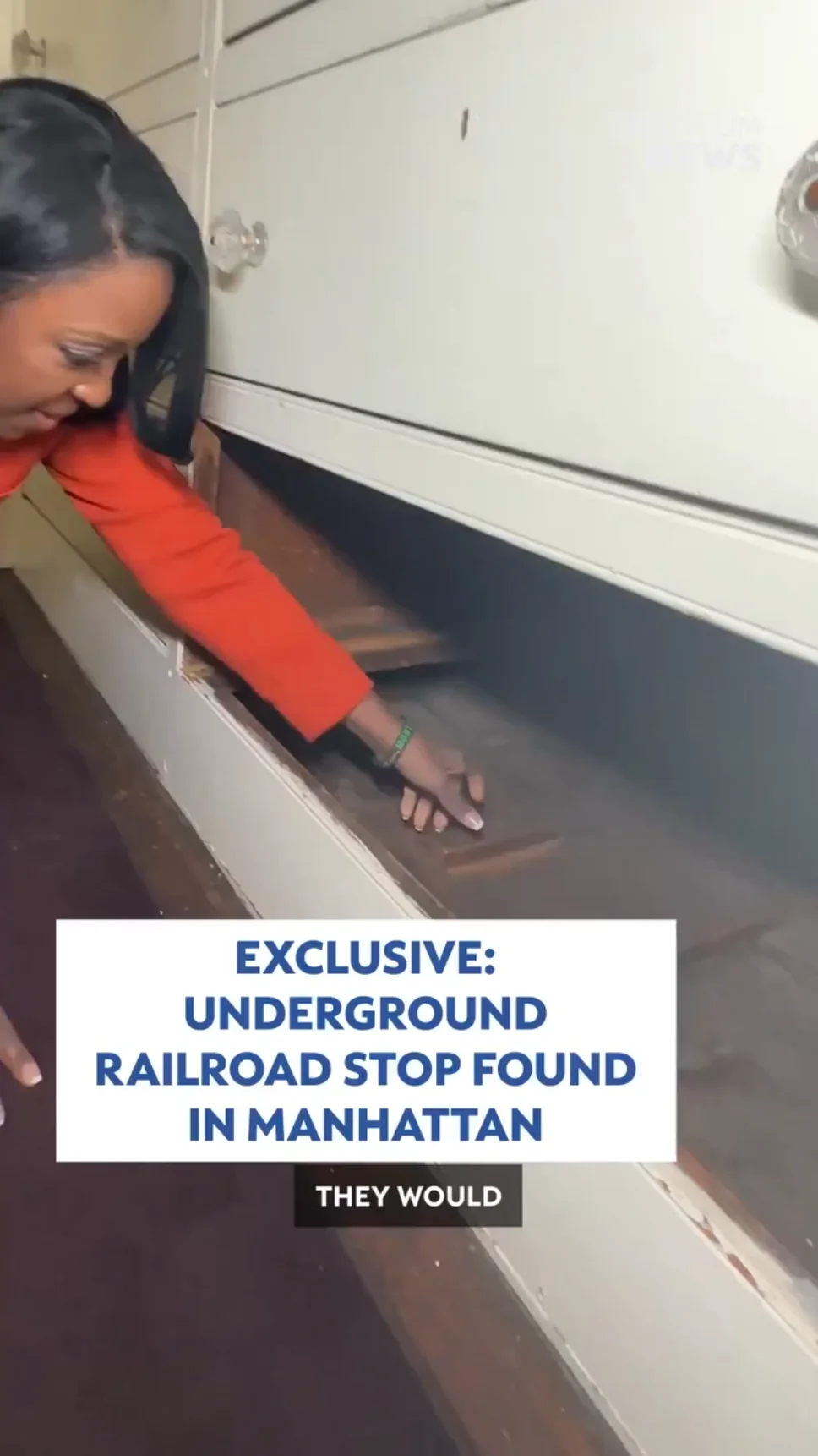
The recent discovery of an Underground Railroad safe house at the Merchant’s House Museum in Manhattan is real, but it is not a newly found tunnel. Historians and preservation architects have identified a long-known but poorly understood hidden passageway behind a bedroom dresser as a deliberately concealed hiding place for people escaping slavery. Their investigation connected the space to the broader Underground Railroad network that operated in New York City, which remained dangerous for fugitives even though it was a free state.
What makes this discovery unusual is that it is the first confirmed Underground Railroad site identified in Manhattan in more than a century, and it is preserved inside the city’s first landmarked house. According to reporting by NY1 and comments from preservation attorney Michael Hiller, experts now see the passage as a “generational” find, both for historic preservation and for understanding how the abolitionist movement functioned in New York City.
What exactly was discovered at the Merchant’s House Museum?
The Underground Railroad safe house in Manhattan centers on a narrow hidden shaft built into the west wall of the Merchant’s House, a 19th century townhouse on East Fourth Street that is now a museum. Behind a set of built-in bedroom drawers, one heavy bottom drawer can be removed to reveal a rectangular opening in the floor, roughly 2 by 2 feet across. That opening leads into an enclosed vertical passage with a ladder descending to the lower level of the house, carefully concealed within the walls.[NY1]
Museum staff had known for years that some sort of void existed behind the drawers, and electricians had run modern wiring into the space. What changed recently was the interpretation. A team of architects and preservation specialists examined the size, placement, and construction details and concluded that this was not simply a maintenance chase or quirky storage nook. Instead, they identified it as a deliberately concealed hiding place that would have been invisible to 19th century slave catchers or city marshals searching the house.
NY1 reports that curator Camille Czerkowicz and outside experts now describe the Merchant’s House as a “safe house” that sheltered enslaved Africans escaping bondage. The builder of the house, Joseph Brewster, was a documented abolitionist, and historians argue that he had both the motive and the control over the original construction to incorporate a secret refuge. While there is no way to reconstruct every use of the passage, specialists like preservation attorney Michael Hiller call the find the most significant of his career, because it provides rare, physical evidence of how the Underground Railroad operated in an urban context.
The passageway is described by historians as a “masterwork of deliberate concealment,” engineered so that its existence would not be apparent to outsiders who might be hunting fugitives.
Why would the Underground Railroad need a safe house in New York City?
One of the most common questions raised in response to the Merchant’s House Museum discovery is why an Underground Railroad safe house would exist in New York City at all. Many people assume that once someone fleeing slavery reached a free state like New York, they were automatically safe. In practice, federal law and court decisions meant that even in Northern cities, Black people could be captured and sent south.
The key turning point was the Fugitive Slave Act of 1850, part of the Compromise of 1850. This federal law required officials and even ordinary citizens in free states to assist in capturing alleged fugitive slaves. It denied accused fugitives a jury trial and forbade them from testifying on their own behalf. Commissioners who ruled that a person was a fugitive were paid more than those who ruled in favor of freedom, which created a powerful incentive to return people to bondage.[Fugitive Slave Act of 1850]
Under the 1850 act, enslavers or their agents could come into New York with only sworn testimony of ownership and have suspected fugitives arrested and sent south. Historians like James Oakes note that there was effectively no statute of limitations: Black men and women who had been living as free people in the North for decades could still be seized and re-enslaved. As a result, New York City became a dangerous place for both recent escapees and long-time residents of African descent.
Because of this legal framework, the Underground Railroad did not simply move people from “South” to “North” and then stop. It extended all the way to Canada, where British law offered stronger protection than U.S. law. According to research summarized by historian Noralee Frankel, the Black population of Canada grew from about 40,000 to 60,000 between 1850 and 1860, in part because fugitives chose to keep moving beyond U.S. borders. New York City safe houses like the Merchant’s House would have offered temporary hiding places while people arranged to travel further north.
Under the 1850 Fugitive Slave Act, reaching a free state did not guarantee safety. True legal security often required crossing the border into Canada.
How did the Underground Railroad work in New York City?
In New York City, the Underground Railroad was less a single “route” and more a patchwork of safe houses, churches, and community networks. Abolitionist groups, Black churches, free Black communities, and some white allies provided shelter, food, legal assistance, and directions for the next leg of the journey. Scholars like Eric Foner have documented how New York served as both a destination and a transit point for people fleeing enslavement, especially after the Fugitive Slave Act raised the stakes.[Fugitive Slave Act overview]
Within the city, hiding places served several overlapping purposes:
- Emergency refuge when slave catchers or marshals were in the area, allowing fugitives to evade immediate capture.
- Short-term shelter while contacts arranged transportation by ship, rail, or wagon to upstate New York, New England, or directly to Canada.
- Concealed meeting points where information could be exchanged without attracting attention.
Buildings like the Merchant’s House were especially important because they looked entirely ordinary from the street. The house was owned for nearly a century by the Tredwell family, whose furnishings and layout have been preserved as a time capsule of upper-middle-class life. The hidden shaft, however, suggests that beneath that respectable surface, the structure contained a high-risk, clandestine function.
The passage accessed through the dresser drawer fits a broader pattern of “negative space” construction used in Underground Railroad sites throughout the North. In some houses, there were false walls, curtained alcoves, or concealed attics. In others, there were trapdoors to crawl spaces or short tunnels linking to outbuildings. The Christiana Resistance in Pennsylvania, for example, involved a farmhouse that functioned as a defensive stronghold when marshals tried to enforce the Fugitive Slave Act. Local Black residents had organized for years to protect fugitives and sometimes armed themselves to resist capture attempts.[Christiana Riot]
In an urban townhouse like the Merchant’s House, carving out space inside an interior wall behind a built-in dresser would have been a subtle, effective way to hide one or two people for hours while a search took place. The ladder down to the ground floor likely provided a discreet way to move in or out of the hiding place between sweeps.
How do historians know this was an Underground Railroad safe house?
Some online commenters have questioned whether the Merchant’s House passageway really belonged to the Underground Railroad, especially because modern electrical wiring and wood supports are now visible inside the shaft. Historians and preservationists working on the site have addressed this by separating the original 19th century construction from later modifications and by looking at the broader historical context.
From the NY1 report and museum statements, several lines of evidence support the Underground Railroad interpretation:
- Documented abolitionist builder. The house was built in the early 1830s by Joseph Brewster, who is identified in contemporary sources as an abolitionist.[NY1] As the original builder, he could design hidden spaces that later owners might not fully understand or even know about.
- Deliberate concealment. The passage is not a simple service chase. It is accessed only by removing a false-bottom drawer, requires a contorted entry, and is located away from obvious maintenance runs. Experts call it a “masterwork of deliberate concealment” because it was engineered to be invisible to anyone not shown the trick.
- Physical alignment with escape routes. The vertical shaft and its ladder connect bedrooms upstairs to the lower level, where a person might exit more discreetly or move further into the building’s core. This is consistent with known designs of hiding places in other Underground Railroad sites.
- Historical timing. The house dates from the 1830s, and the period from the 1830s through the 1860s was precisely when Underground Railroad activity peaked, especially after the 1850 Fugitive Slave Act made Northern cities more dangerous.
There are also counterarguments. Earlier documentation from the New York City Landmarks Preservation Commission, cited by some skeptics, suggested that a similar passage at the Merchant’s House could have been used simply to service sliding parlor doors. That interpretation treated stories about hiding fugitives as “unfounded rumors.” The new investigation, by contrast, involved physically entering the space, analyzing its construction, and correlating it with Brewster’s abolitionist record and evolving scholarship on how Underground Railroad sites functioned.
Because few written records of Underground Railroad operations were kept at the time, to avoid incriminating participants, historians often have to weigh circumstantial but converging pieces of evidence. In this case, the combination of architectural analysis, builder biography, legal context, and expert review has been strong enough that the Merchant’s House Museum and outside specialists now confidently refer to the structure as a “safe house” rather than a mere curiosity.
Given the clandestine nature of the Underground Railroad, definitive paper trails are rare. Researchers rely on architectural forensics, local oral histories, and period law to interpret spaces like the Merchant’s House passage.
Why does this Manhattan Underground Railroad discovery matter today?

The identification of an Underground Railroad safe house in Manhattan matters for several reasons that go beyond the novelty of a “secret tunnel behind a dresser.” It changes how we understand New York City history, deepens public awareness of federal complicity in slavery, and raises new questions about how to preserve endangered historic structures.
First, it challenges the idea that New York was simply a “free” and relatively progressive city during the antebellum period. The very existence of a hidden refuge inside a respectable townhouse underscores how precarious life was for Black people in the North under the Fugitive Slave Act. Events like the Christiana Resistance in Pennsylvania, where Black residents and allies used armed force to resist a slave-catching raid in 1851, show that the law sparked conflict far beyond the South.[Christiana Riot]
Second, the discovery provides rare, tangible evidence of abolitionist courage in New York. Council members quoted in the NY1 piece argue that many New Yorkers have forgotten the city’s role in the abolitionist movement. A physical hiding place that visitors can see, even if they cannot enter it themselves, makes that history immediate and concrete in a way that documents alone often cannot.
Third, it intersects with ongoing debates about preservation and development. The Merchant’s House Museum has warned for years that a proposed multi-story building on the adjacent lot could destabilize the historic structure. In newsletters to supporters, the museum has detailed its concerns that excavation and heavy construction could damage original plasterwork and structural elements.[Merchant’s House campaign] The recognition of a unique Underground Railroad safe house inside the building may strengthen the case for stricter protections.
Finally, the story resonates because it connects past and present forms of surveillance, policing, and resistance. Commenters who see parallels between 19th century slave patrols and modern immigration or law-enforcement practices are drawing on a long tradition of analysis that treats slavery, its legal apparatus, and its aftermath as part of a continuous history. The dresser and its hidden ladder become a symbol of both the brutality of that system and the ingenuity of those who opposed it.
What can visitors expect at the Merchant’s House Museum now?
The Merchant’s House Museum plans to integrate the Underground Railroad safe house into its tours and educational programs. According to NY1, the museum will offer “unprecedented access” to the property, though physical access into the passage itself is likely to remain limited for safety and conservation reasons.[NY1]
Visitors can already explore the preserved parlor, bedrooms, and kitchen, which present a detailed picture of upper-middle-class domestic life in the 19th century. Interpreting the house as an Underground Railroad safe house adds a second narrative layer: beneath the genteel furnishings and family stories lies a site of resistance to slavery. This dual identity mirrors the complexity of New York’s own history, where wealth from Southern cotton and Northern commerce coexisted uneasily with anti-slavery activism.
For those interested in the broader context, the museum’s new interpretation can be paired with visits to other Underground Railroad and abolition sites in the region, from churches and houses in Brooklyn and Manhattan to sites in upstate New York and Pennsylvania. Together, they trace a network that stretched from Southern plantations through Northern cities all the way to Canadian communities like Buxton, Ontario, where refugees such as William Parker, a leader of the Christiana resistance, ultimately settled.[Christiana Riot]
In that sense, the Manhattan Underground Railroad discovery is not an isolated curiosity. It is one more documented link in a chain of places that together tell a story of surveillance, risk, solidarity, and the long struggle for freedom on both sides of the U.S. border.