
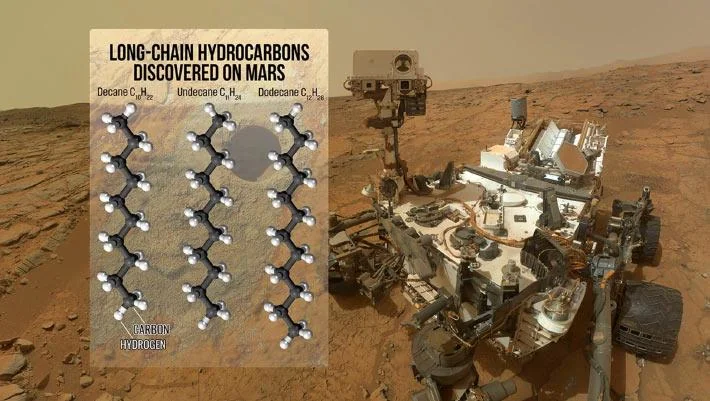
No, Mars organics do not by themselves prove life on Mars. Mars organics are carbon‑containing molecules that can be produced by biology or by nonbiological chemistry. A recent study of Curiosity rover samples from Gale Crater, published in Astrobiology, argues that known nonbiological sources fall short of explaining certain ancient alkanes, which keeps a biological origin possible but unproven (Astrobiology study).
What are Mars organics?
Organic molecules are compounds built around carbon. They include simple species like methane and alkanes, and more complex ringed or sulfur‑bearing compounds. On Earth, many organics are made by life, but they can also form without life in space, in meteorites, and in water‑rock reactions.
Organic molecules can be biological or abiotic in origin, so their presence on Mars is not proof of life.
NASA’s Curiosity rover has detected a variety of organics in 3.5‑billion‑year‑old mudstones in Gale Crater using the SAM instrument suite, including thiophenes and other carbon compounds preserved in rock (NASA/JPL; Science, 2018). NASA’s Perseverance rover has also mapped diverse organic signals in Jezero Crater with its SHERLOC instrument (NASA Mars 2020).
What did the NASA study find about Mars organics?
The new analysis looked at the measured abundance and molecular patterns of ancient alkanes released from a Martian mudstone when Curiosity heated powdered rock. By comparing those measurements with models of delivery and production from known nonbiological sources, the authors concluded that the tally from meteorites, interplanetary dust, surface chemistry, and other abiotic inputs does not fully match the observed amounts and distributions.
The study’s central claim: known nonbiological sources, from meteoritic infall to surface chemistry, fall short of accounting for the alkanes detected by Curiosity (Astrobiology).
This shortfall leaves two broad possibilities: either there are additional, still unquantified abiotic pathways or preservation mechanisms on Mars, or some fraction of the detected alkanes could be degradation products of once‑living matter. The data do not distinguish between these scenarios, so the result is consistent with biology but does not require it.
How could organics form without life on Mars?
Several abiotic processes can generate or deliver organic molecules on Mars:
- Meteoritic and dust delivery: Carbonaceous meteorites and interplanetary dust carry a wide suite of organics, including alkanes and amino acids (NASA Astrobiology).
- Water‑rock chemistry: Reactions like serpentinization can produce hydrogen and support Fischer–Tropsch‑type abiotic synthesis of hydrocarbons from CO or CO2 (USGS).
- Photochemistry and volcanism: Ultraviolet light and volcanic gases can drive organic formation in the atmosphere or near the surface, with products later trapped in sediments.
- Impact chemistry: Shock heating during impacts can form or transform organic compounds and bury them for preservation.
Interpreting Curiosity’s oven‑based measurements is complicated by Martian perchlorates, reactive salts that can alter or chlorinate organics during heating. This means the instrument may detect fragments or transformed molecules rather than intact originals (NASA on SAM).
Could biology explain the alkanes in Gale Crater?
Possibly, but not uniquely. On Earth, biological lipids and cell membrane components can break down over geologic time into straight‑chain alkanes. If Mars once hosted microbial ecosystems, their remnants could contribute to the signal.
Stronger evidence for a biological origin would include multiple, independent biosignatures measured together, for example:
- Distinctive molecular patterns such as specific even‑ or odd‑chain preferences tied to known biological pathways
- Stable isotope fractionations in carbon, hydrogen, sulfur, or nitrogen that are hard to produce abiotically
- Complex biomarkers like hopanes or steranes that are degradation products of cell membranes
- Microscale textural or morphological clues that co‑locate with organics
Curiosity’s instruments are not optimized to measure all of these, so the current data cannot confirm or reject a biological source.
What evidence would actually prove past life on Mars?
Planetary scientists generally look for a converging set of lines of evidence rather than a single molecule. Convincing proof would likely require:
- Well preserved sedimentary samples that contain intact, source‑diagnostic organics
- High precision isotopic measurements that match biological fractionation patterns
- Mineralogic and textural context that rules out known abiotic synthesis pathways
- Replication across multiple samples and sites
Laboratory analysis of carefully selected and documented Martian rocks offers the best chance to establish unambiguous biosignatures (National Academies, 2022 Decadal Survey).
What happens next for confirming the source of Mars organics?
Two near‑term paths can sharpen the picture:
- In situ exploration: Perseverance continues to analyze Jezero Crater rocks and Perseverance samples cached for return, building mineral and organic context with SHERLOC, PIXL, and SuperCam (NASA Mars 2020).
- Deeper drilling and new instruments: ESA’s Rosalind Franklin rover is designed to drill up to 2 meters to reach better preserved organics and analyze them with the MOMA mass spectrometer.
- Mars Sample Return: Returning selected Jezero cores to Earth for laboratory study remains the gold standard, though mission scope and schedule are being reworked (NASA MSR).
Bottom line: the Astrobiology study strengthens the case that Mars preserved more organics than standard geologic inputs alone would predict, especially in Gale Crater. That raises the stakes for carefully targeted analyses and eventual sample return, but it is not a declaration of life.