
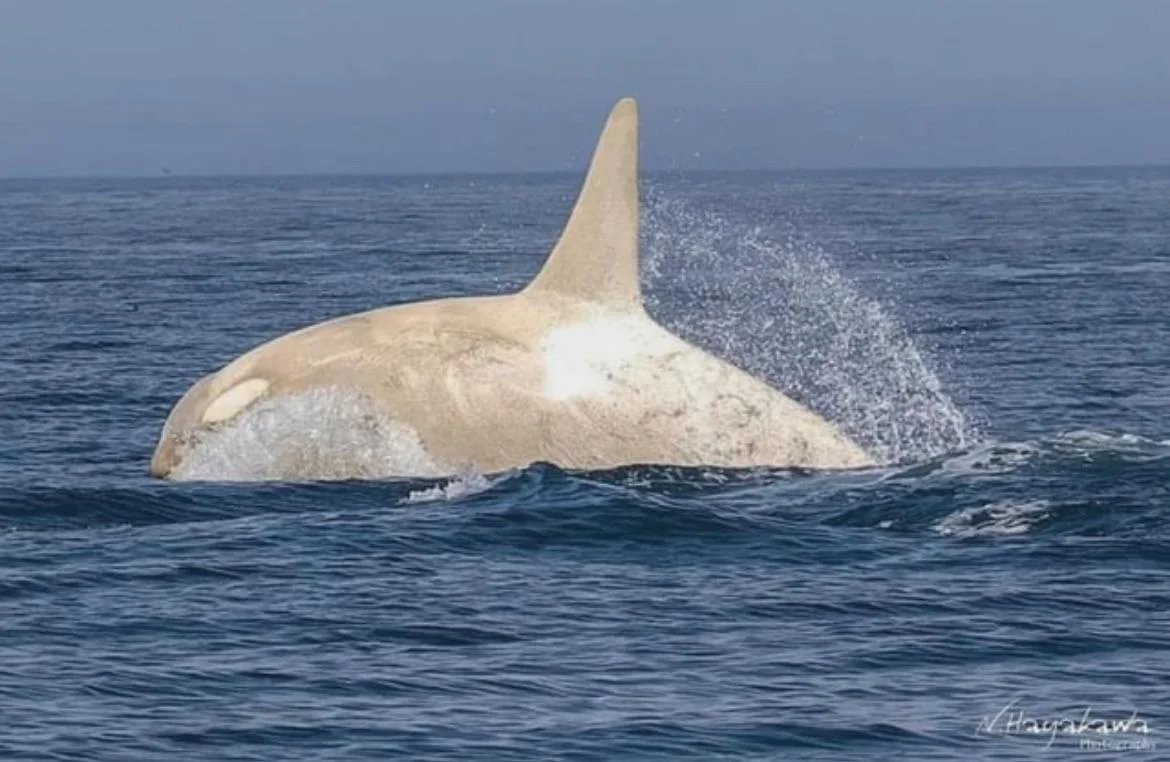
Albino orcas do exist, but most white killer whales photographed in the wild are not true albino. They are usually leucistic, meaning they have reduced skin pigmentation but still retain some color in the eyes and body patterns. This is why many so‑called albino orcas have dark eyes and faint saddle patches, and why their scars appear as striking dark lines on pale skin.
What are albino orcas?
An albino orca would lack melanin entirely, producing a completely white body and pinkish or red eyes because blood vessels show through the iris. Confirmed, true albinism in killer whales appears to be extraordinarily rare. By contrast, several documented white individuals show features inconsistent with albinism, such as dark irises and visible, though faint, body patterns.
Orcas (killer whales) are actually the largest oceanic dolphins, and their typical black‑and‑white patterning comes from melanin and other pigments in the skin. Variants in the genes that control pigment production or distribution can produce white or pale animals.
How do albino orcas differ from leucistic orcas?
Albinism is a total lack of melanin in the skin, hair and eyes; leucism is a partial loss of pigmentation in the skin while the eyes retain normal color.
- Eyes: True albinos have very light, pinkish eyes; leucistic orcas typically have dark eyes.
- Patterns: Albinos are uniformly white; leucistic individuals often show faint saddle patches or shading where normal patterns would be.
- Genetics and health: Some forms of leucism are benign, but others can be linked to syndromes. A captive white orca named Chimo reportedly had Chediak–Higashi syndrome, which affects immunity and is associated with pale coloration.
Field reports from the North Pacific describe multiple white orcas with dark eyes and residual patterning, supporting leucism rather than albinism. One such case is the juvenile known as Tl’uk, observed in British Columbia and Washington State waters.
Why do white orcas have such visible dark scars?
The lines and tally‑like marks on orca skin are called rake marks. They are made by the teeth of other orcas during social interactions, play, and occasional aggression that helps establish social rank. On normally dark skin, healed rake marks look light because scar tissue often lacks pigment. On pale or leucistic skin, the contrast reverses: healing can deposit relatively more pigment or expose underlying pigmented layers, so the marks look dark against a white background. This makes every scrape stand out dramatically in photographs.
In addition to social rakes, orcas can pick up scratches from prey, ice, or rough surfaces. The prominent visibility on white animals does not necessarily mean they are injured more often, only that their marks are easier to see.
How rare are white orcas and where have they been seen?
Researchers recorded five to eight white orcas in a single season off Russia’s Kuril Islands in the northwestern Pacific, an unusual concentration that raised concerns about inbreeding in that region (The Independent summarizing Aquatic Mammals research).
White orcas have been photographed in several parts of the North Pacific, including the Kuril Islands and Kamchatka (the adult male nicknamed “Iceberg”), the Aleutians, and waters off northern Japan. Occasional sightings have also occurred in the northeastern Pacific, such as the leucistic juvenile Tl’uk. These animals are strikingly visible when traveling with normally pigmented pod mates.
For background on orca populations and their ranges, see NOAA Fisheries’ killer whale overview.
Does being white affect orca health and survival?
It depends on the cause. True albinism can bring reduced visual acuity and sun sensitivity. Some leucism variants appear compatible with long lives in the wild (for example, Iceberg has been observed as a mature adult), while others, such as leucism associated with Chediak–Higashi syndrome, can be linked to immune problems and shortened lifespan as seen in the captive orca Chimo.
White orcas may be more conspicuous to prey and rivals, but documented individuals are often accepted by their pods and can reach adolescence or adulthood. However, scientists have cautioned that clusters of white animals in a region may indicate reduced genetic diversity, potentially from inbreeding, which can elevate the frequency of rare traits (report).
What does this mean for conservation?
White orcas are visually compelling indicators of underlying biology: pigment genetics, social behavior, and population history. Their appearances draw attention to broader threats killer whales face, including pollutant exposure and prey declines. Some scientists have called orcas among the most contaminated marine mammals due to bioaccumulated legacy chemicals, which can affect reproduction and immunity. Protecting prey species, reducing pollutants, and maintaining genetic diversity in regional populations will benefit white and normally colored orcas alike.