
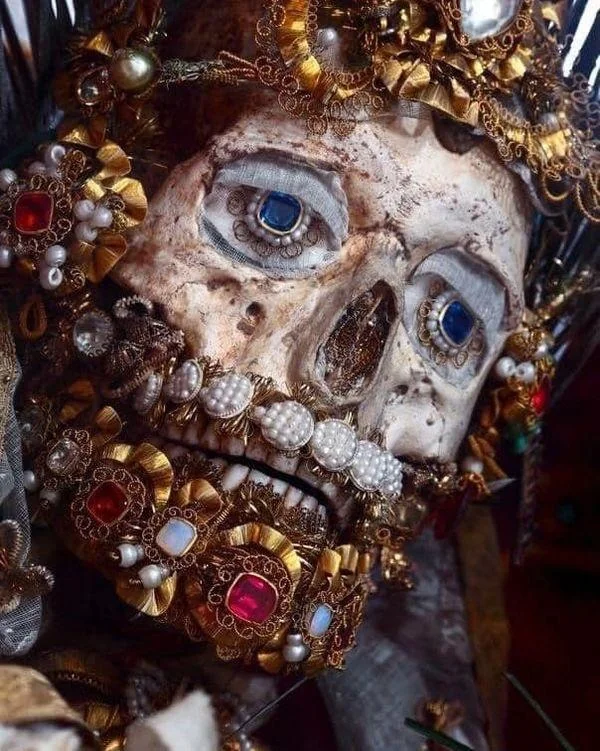
Catacomb saints are jeweled skeletons of early Christians that were exhumed from the catacombs of Rome between the 16th and 19th centuries, given new identities as martyrs or saints, and installed in churches across German speaking Europe as relics. They were lavishly decorated with gold, silver and precious stones, then displayed in ornate reliquaries as powerful visual symbols of Catholic holiness and triumph. According to historians, very few of these catacomb saints can be securely linked to a specific historical person, and many were anonymous remains reimagined as heavenly patrons.
One reason they look so spectacular is that whole communities poured money and craftsmanship into them. Nuns, goldsmiths and embroiderers might spend years turning a bare skeleton into an explosion of silk, gems and filigree, a project that could cost dozens of gulden for a single body. Modern art historian Paul Koudounaris, who tracked down and photographed many surviving examples, has called them some of the most extravagant religious artworks of the Baroque era.
What are catacomb saints?
The term catacomb saints refers to human remains taken from the Christian sections of Rome’s underground catacombs and reclassified as relics of early martyrs or saints, then sent abroad for veneration. As summarized in the standard encyclopedia entry on the subject, they were ancient Christians carefully exhumed, transported and installed in churches from the late 1500s into the 1800s, typically covered in gold and precious stones to signal their supposed sanctity.
Scholars note that although the bodies belonged to people who were almost certainly Christian, there is little evidence that most had any special religious status in life.
In Catholic theology, a relic is a physical object, often the body or bones of a holy person, believed to connect the faithful with divine power. By the 17th century, full body relics had become rare showpieces. The bejeweled skeletons from the Roman catacombs offered a way to supply parish churches, monasteries and even private chapels with spectacular, seemingly ancient martyrs at a time when older relics had been destroyed or discredited.
Catacomb saints were, in effect, anonymous Christian dead reimagined as named heroes of the early Church, then elevated into glittering icons of Catholic piety.
How did catacomb saints originate?
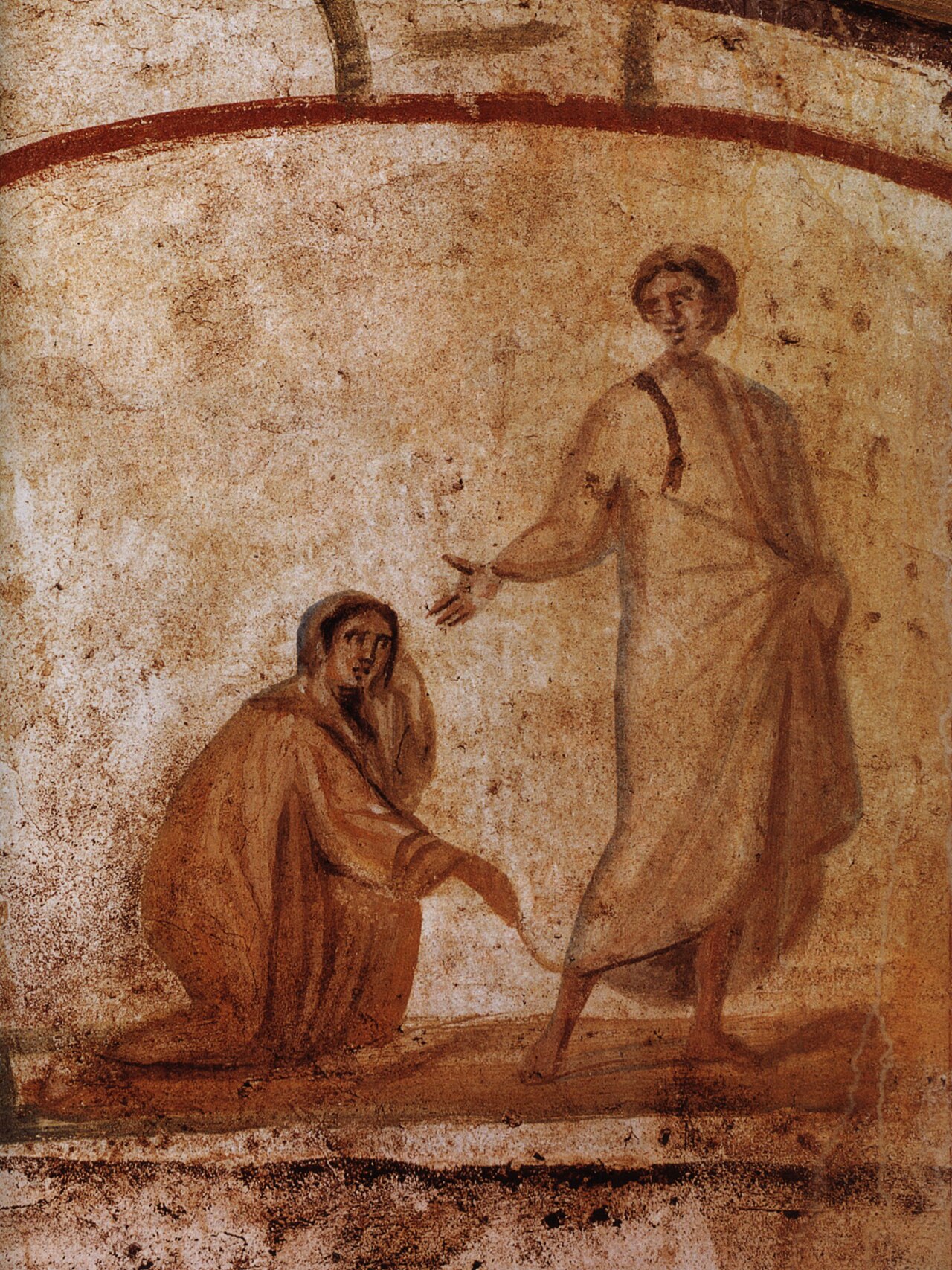
Catacombs are underground cemeteries, carved as networks of tunnels and burial niches beneath cities like Rome beginning in the 2nd century CE.
Archaeologists estimate that hundreds of thousands of people, pagan, Jewish and Christian, were interred in the Roman catacombs over several centuries.
These burial places fell out of use and were largely forgotten in the Middle Ages.
The immediate background for catacomb saints was the violent Protestant iconoclasm of the 16th century, known in Dutch as the Beeldenstorm, when Calvinist crowds destroyed statues, altarpieces and relics across parts of the Low Countries and other regions of northern Europe.
Historians of the Reformation describe Catholic churches being systematically stripped of religious images and sacred objects during these uprisings.
Contemporary accounts from 1566 document large scale smashing and removal of church art and fittings.
In this context, the rediscovery of the Roman catacombs in 1578 gave Catholic authorities an enormous new source of relics. According to research summarized by historian Trevor Johnson in the Journal of Ecclesiastical History, Vatican officials organized the exhumation of skeletons from these underground cemeteries and their distribution to churches, especially in what is now Germany, Austria and Switzerland.
Each body, or sometimes partial remains, could be assigned a saintly or martyr identity, then dispatched to a town eager to rebuild its sacred landscape.
The practice continued for roughly three centuries. A recent chapter on catacomb saints in a Cambridge University Press companion volume on Counter Reformation sanctity notes that thousands of such relics were translated from Rome to Catholic communities across Europe after 1578, with Bavaria serving as a major destination and case study.
How were catacomb saints identified and decorated?
The process of turning anonymous bones into catacomb saints combined rudimentary archaeology, devotional imagination and local politics. Priests and officials working in the catacombs looked for signs that a skeleton might be a martyr, such as symbols scratched on nearby slabs or proximity to early Christian inscriptions. In practice, as Koudounaris and other scholars point out, these identifications were often extremely tenuous, and most of the remains could not be connected to a specific person or documented martyrdom.
Once selected, a skeleton would be placed in a decorated coffin and formally recognized as a martyr or saint, often given a Latin name if none was known. When the relic arrived in its new home, the real transformation began. Local nuns, artists and goldsmiths might spend months or years rebuilding the bones into a lifelike figure: wiring the skeleton together, padding it with gauze, and dressing it in silk, embroidery and armor of tiny metal plaques.
An article in the Telegraph on these relics records that one church spent 75 gulden just on dressing its saint, a significant sum for the time.
The famous photographs by Paul Koudounaris, published in his 2013 book Heavenly Bodies: Cult Treasures & Spectacular Saints from the Catacombs, show just how elaborate this work could be.
In interviews about the project, he describes skeletons whose ribcages and skulls are almost entirely obscured beneath jewels and gold filigree, sometimes so dense that the bones are barely visible.
One especially ornate example, nicknamed St Albertus, is covered from head to toe in gemstones, intended as a physical representation of what theologians called the “heavenly Jerusalem,” the glittering city of the blessed.
Koudounaris has emphasized that contemporaries saw these relics less as morbid curiosities and more as earthly manifestations of divine glory.
To early modern Catholics, the jeweled bones were not grotesque displays of wealth, but proof that those who suffered for the faith would be rewarded with unimaginable splendor in heaven.
Financing this splendor was a delicate matter. Directly selling relics was condemned as simony, the buying and selling of sacred offices or objects. Yet, as Johnson documents, church officials still found ways to raise money by charging fees for transporting the relics from Rome, for the blessing ceremonies, and for the work of decoration itself.
Historian Diarmaid MacCulloch has compared the fashion for acquiring catacomb saints among rich Bavarian families to modern personalized license plates, with patrons seeking relics that shared their own names or could serve as prestigious household protectors.
Why did the Catholic Church promote catacomb saints?
Catacomb saints were part of the broader Counter Reformation effort to respond to Protestant criticism and reassert Catholic identity. Protestants had attacked the cult of relics as idolatrous and fraudulent, pointing out that many claimed relics of medieval saints lacked documentation or multiplied impossibly across Europe. In reply, Catholic leaders wanted to demonstrate that their churches could still offer tangible links to the earliest, most heroic generations of Christians.
According to Koudounaris, writing in Heavenly Bodies and in interviews with outlets like LAist, the idea was to create “the biggest and most fantastic relics ever seen,” full body jeweled skeletons expected to overwhelm viewers with awe.
By rooting these relics in the catacombs of Rome, the heart of the ancient church, Catholic authorities could argue that they were reconnecting believers with authentic early martyrs, not simply inventing new cults.
A Snopes review of the phenomenon, drawing on Koudounaris’s work, notes that these relics functioned as highly visible propaganda, assuring the faithful that “we are strong, and we are back and we are the true way for the faithful.”
On the ground, catacomb saints also served local needs. Towns that received a skeleton often named it as their patron and celebrated its installation with processions and special masses. Stories of miracles began to accumulate. One jeweled saint in Switzerland, for example, became a patron for people with urinary disorders after a woman claimed healing from incontinence when the relic passed through her town, a case Koudounaris has highlighted in public talks.
Such narratives helped root these imported, anonymous remains firmly in local religious culture.
There were political and social signals too. Possessing a particularly ornate catacomb saint advertised a church’s loyalty to Rome and its access to Roman favor. For wealthy patrons who donated gems or paid for decoration, the relic offered a way to display generosity and piety at the same time, literally encrusting charity onto a holy body that would be admired for generations.
Are catacomb saints real saints, and what happened to them?
From a modern historical perspective, most catacomb saints cannot be confirmed as specific individuals, let alone as canonized saints. Contemporary Catholic sources already distinguished them from formally recognized saints by calling them martyrs or using descriptive labels rather than full biographical names. As Koudounaris told one interviewer, church officials “were sending bones of presumed martyrs, not actual saints,” because no one knew who most of the remains originally belonged to.
A Snopes fact check on viral images of these skeletons reaches a similar conclusion: the objects are real, but the saintly identities attached to them were almost certainly invented long after the people died.
By the late 18th and 19th centuries, attitudes shifted. The Enlightenment brought greater skepticism about relics, and some Catholic reformers worried that opulent jeweled skeletons looked superstitious or embarrassing. According to the Wikipedia summary based on Johnson’s archival work, many catacomb saints were stripped of their finery during this period, locked away in storage, or quietly destroyed. In some places, local devotion persisted, and the relics survived.
A well documented example comes from Rottenbuch in Bavaria. In 1803, during secularization reforms, the town’s two catacomb saints were auctioned off by the civil authorities. Nearly two centuries later, in 1977, residents raised funds to bring them back, an episode reported in both Johnson’s monograph on the Upper Palatinate and modern summaries of the cult.
This pattern, loss followed by nostalgic recovery, is common for surviving catacomb saints.
Today, catacomb saints occupy an ambiguous place. Some are still displayed in European churches as historical relics and objects of veneration, especially in parts of southern Germany, Austria and Switzerland. Others have been reinterpreted as art or heritage rather than active devotional foci. Koudounaris’s Heavenly Bodies and subsequent media coverage have drawn new attention to them as extraordinary works of Baroque sculpture and embroidery, created around and through human remains.
Whether seen as dubious relics, masterpieces of devotional art, or unsettling reminders of how the dead can be repurposed for the living, catacomb saints capture a moment when faith, politics and craft converged on the human skeleton.