

A group of tech billionaires is talking about raising not just another campaign war chest, but a $100 million-to-$500 million political endowment to shape California for decades. That might sound like just “more money in politics,” but it’s actually a shift in how billionaires influence California politics, from buying single elections to building a permanent machine.
TL;DR
- This isn’t just rich people overspending on one ballot measure; it’s an attempt to turn California politics into a long‑horizon venture investment with compounding returns.
- An endowment‑style fund plus vehicles like Building a Better California and Grow California can outlast individual campaigns, ballot measures, and even the specific “billionaire tax” that provoked them.
- California’s campaign‑finance rules assume episodic races; they’re badly designed for a world where one side is constructing a perpetual political endowment.
This Is Not Ordinary Spending: Why an Endowment‑Style Fund Matters
OK, so imagine two neighbors arguing over a community garden.
One shows up once a year with a big check for seeds. The other quietly buys the land under the garden, sets up a trust, and hires the gardener year‑round.
Both are “spending money.” Only one now effectively owns the future of that space.
That’s the gap between typical big‑donor behavior and what Bloomberg reported: Sergey Brin and other tech billionaires floating an endowment‑style fund, starting with around $100 million, with a goal in the $500 million-plus range, to build a durable operation in Sacramento. Around that idea, you already see related entities: Brin‑backed Building a Better California (roughly $35 million raised, including a reported $20 million from Brin) filing housing and tax‑focused ballot measures, and Grow California, seeded with about $40 million from Chris Larsen and Tim Draper, targeting state legislative races as a counterweight to unions.
Look, wealthy donors dropping tens of millions on a race is old news. What’s new is the time horizon.
An endowment doesn’t think in two‑year election cycles. It thinks in 20‑year narrative arcs.
Instead of “How do we beat this specific 2026 billionaire tax?”, the question becomes:
“How do we make sure proposals like this stop even getting serious traction by 2030?”
That’s a completely different game.
How billionaires influence California politics is changing
Traditional billionaire influence is episodic.
- A scary ballot initiative shows up.
- A handful of billionaires pour in $10-$20 million.
- Ads flood the airwaves for 3 months.
- Election happens. Everyone goes home.
The new model looks more like a VC fund:
- Permanent vehicle
A PAC or nonprofit that doesn’t shut down when the election is over, like Building a Better California continuing to write housing and tax rules via new initiatives. - Portfolio approach
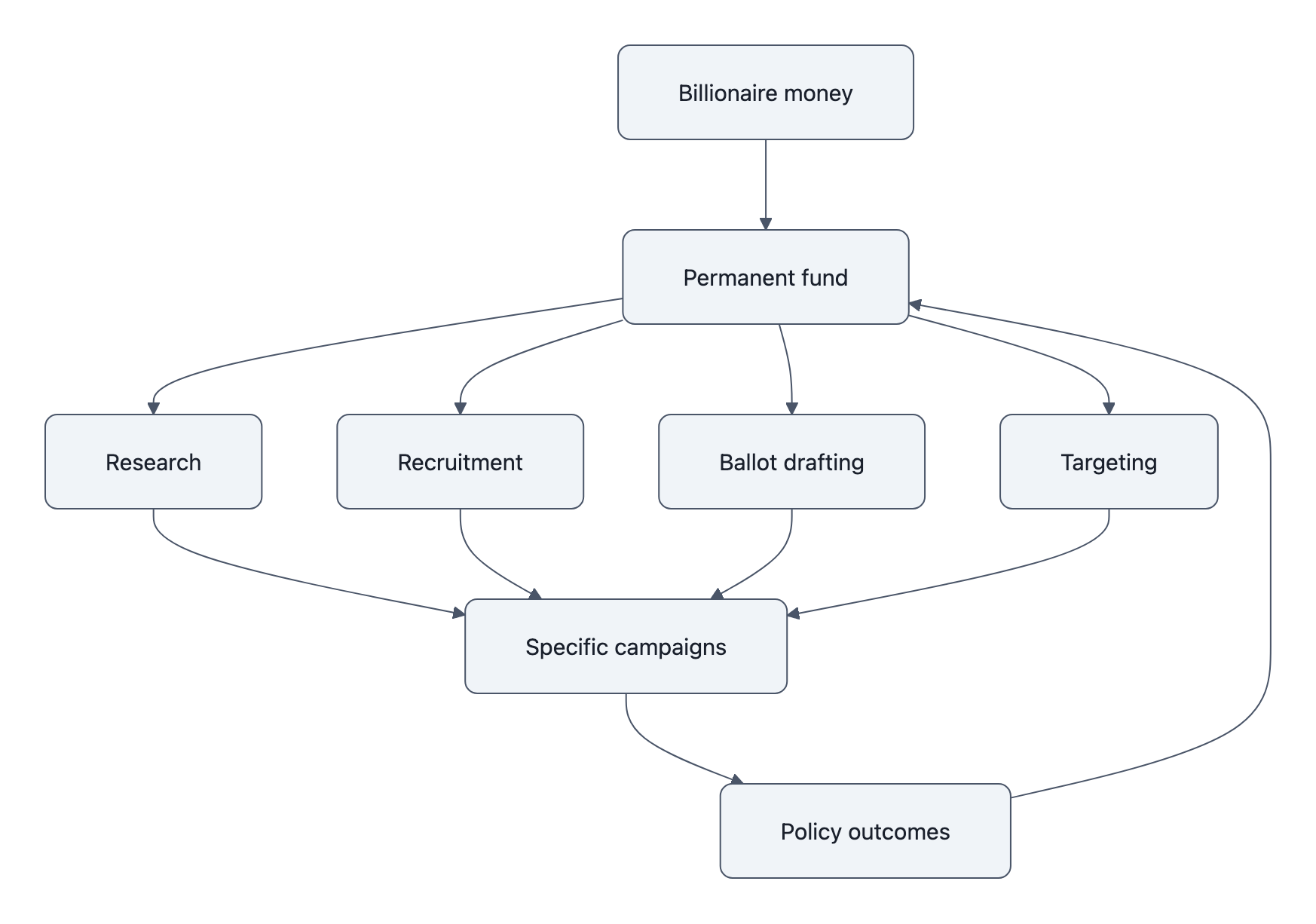
Instead of betting everything on one “unicorn” campaign, the fund backs a portfolio of levers:- Ballot initiatives to set policy baselines.
- Legislative races (Grow California) to reshape who writes the laws.
- Long‑term media and narrative work so future initiatives start on friendlier ground.
- Compounding advantage
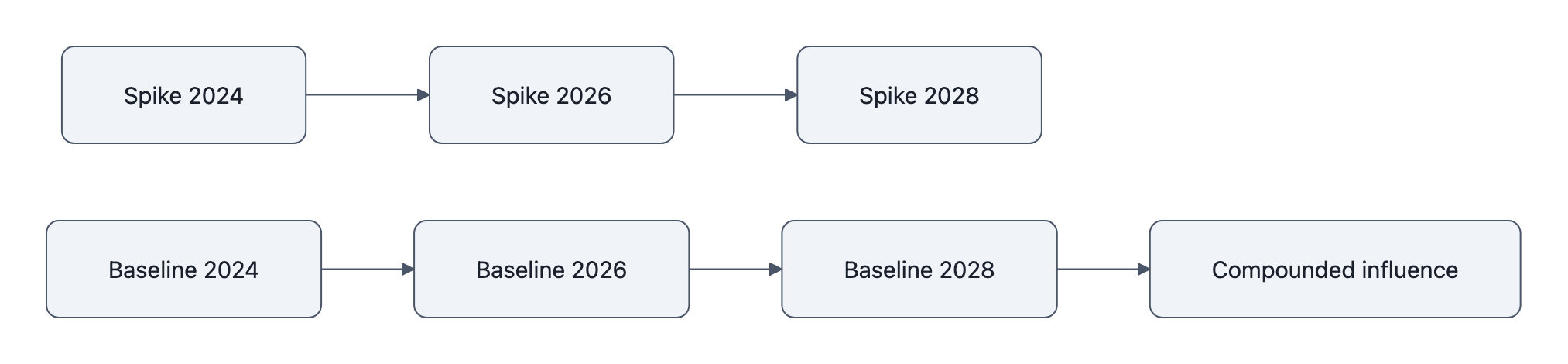
You learn what messages work in 2026, refine them in 2028, control the drafting tables in 2030.
The key insight is that this is structural, not situational.
Most voters will only notice the surface: another “Concerned Californians for Jobs and Innovation” ad buy. Underneath, there’s a standing operation that retains consultants, maintains voter files, shapes candidate recruitment, and quietly tunes the system between cycles.
Campaign finance law treats each race like a separate Olympics. This is more like building the Olympic committee.
Why the 2026 “billionaire tax” triggered a tech backlash
The spark here is specific: a proposed 2026 “billionaire tax”, a one‑time 5% levy on net worth over $1 billion, backed by SEIU‑UHW and other unions, headed for the ballot if it survives the signature process.
That looks like a one‑off wealth transfer. What it really did was something more important: it changed the risk calculation for the ultra‑rich.
Here’s the mental math if you’re sitting on $10 billion of mostly illiquid stock:
- Before: “California’s expensive, but wealth taxes are politically radioactive. Worst case, my income taxes nudge up.”
- After: “A well‑organized union can put a 5% hit on my entire net worth on the ballot, and they only have to win once.”
Chris Larsen basically spelled this out when he said the wealth‑tax proposal “woke up the sleeping giant like I have never seen.” That’s not just hurt feelings. That’s a boardroom‑style wake‑up call: the tail risk is now existential.
Once you view policy as existential risk, you stop thinking like a donor and start thinking like an LP managing a portfolio:
- You don’t just fight this tax; you invest in making sure future coalitions can’t mount similar efforts.
- You don’t just fund ads; you recruit and train candidates who share your priors.
- You don’t just run one “No on 2026 Wealth Tax” campaign; you build a data and legal infrastructure that will be reused every time tax or labor policy drifts in your direction.
The billionaire tax is the match. The endowment‑style fund is the sprinkler system, permanently installed, always on standby.
What an endowment‑style machine actually does differently
To see how this plays out, imagine two worlds in 2030.
World A: Old model
A new wealth‑tax measure appears. Business groups scramble, raise $60 million, barrage TV and social media for six months, narrowly win, and then disband the campaign. All the data, staffing, and institutional memory scatters to the wind.
World B: Endowment model
By 2030, the endowment‑style fund has:
- A standing research shop testing economic messages year‑round.
- Long‑term contracts with organizers in swing legislative districts.
- Lawyers who have spent 4 years drafting “preemptive” ballot measures and constitutional tweaks that quietly restrict how wealth taxes can be written.
When the new measure appears, they don’t start from zero. They:
- Reuse targeting data from 2026 and 2028.
- Plug the new threat into a pre‑built narrative (“job‑killing, innovation‑threatening repeat”).
- Potentially file a counter‑initiative that narrows tax authority even if the original fails.
The same $60 million now sits on top of a permanent backbone. That’s the multiplier.
And here’s where California campaign‑finance rules show their age.
The state absolutely regulates:
- How much individuals can give to specific candidates.
- Disclosure of donors to ballot‑measure committees.
- Lobbyist registration and reporting.
But those rules assume discrete contests, candidate X vs. candidate Y, Initiative A vs. Initiative B, not a multi‑cycle entity whose real work happens in between elections: grooming candidates, drafting measures, running think‑tank‑style research, and building voter‑behavior models.
There’s no cap on “having a constant machine that’s always on.”
There’s disclosure, sure. You can see that Sergey Brin gave tens of millions to Building a Better California if you dig through the Secretary of State’s portal. But disclosure is like publishing the recipe after the meal is served. The power lies in the kitchen, and that’s what the endowment is funding.
What Californians should watch next (and how influence becomes durable)
So what do you actually watch if you don’t want to spend your weekends parsing filings?
A few key signals tell you whether this is turning into the permanent machine Bloomberg hinted at:
- Staff, not just spend
When you see these groups growing full‑time staff, policy directors, organizing directors, research leads, that’s endowment logic. Campaigns hire sprinters; endowments hire marathoners. - Ballot measures that look “weirdly early”
If you start noticing preemptive constitutional amendments around tax rules or “process reforms” that constrain how initiatives can be written, that’s the machine thinking two ballots ahead. - Cross‑cycle branding
If the same names, Building a Better California, Grow California, whatever comes out of the Brin chats, keep reappearing with different issue campaigns under their umbrella, you’re looking at a platform, not a project. - Who the newcomers are aligned with
When fresh‑faced “housing reform” or “education innovation” candidates pop up in safe blue districts, follow the independent expenditures around them. The real play is often not flipping red seats, but redefining what “normal” looks like inside one party.
And there’s a deeper shift here that connects to how billionaires influence California politics more broadly.
Once politics is treated as a long‑term asset class, the goal isn’t just winning. It’s de‑risking the environment, smoothing out the policy volatility that might produce another one‑time billionaire tax, another aggressive labor push, another wave of regulation.
In other words: the richest people in the state are trying to buy not just outcomes, but predictability.
The uncomfortable truth is that the fight over the 2026 billionaire tax is just the visible tip; the real contest is whether one side builds a political endowment while the rest of us keep thinking in election‑night timelines.
Key Takeaways
- The emerging $100M→$500M fund is about turning episodic campaign money into a perpetual political endowment that quietly shapes the rules of the game.
- Vehicles like Building a Better California and Grow California show the new playbook: permanent infrastructure, cross‑cycle strategy, and a portfolio of initiatives and candidates.
- The 2026 billionaire tax didn’t just threaten wealth; it taught billionaires they face one‑time, existential ballot risks, pushing them toward long‑horizon defensive investing in politics.
- California’s campaign‑finance system regulates races, not machines, leaving plenty of room for a durable, endowment‑style operation to operate in the gaps.
- The real story isn’t “more money in politics,” it’s the compounding advantage of a side that never goes home between elections.
Further Reading
- Sergey Brin‑Backed PAC Pushes to Counter California Billionaire Tax, Bloomberg’s original reporting on the endowment‑style fund idea and funding targets.
- SF billionaire Michael Moritz joins Google’s Brin in hefty political donation, Details on Building a Better California’s donors, filings, and stated goals.
- California’s billionaires pour cash into elections as big tech seeks new allies, Overview of billionaire‑backed efforts, including Grow California and responses from unions.
- AP background on the proposed California ‘billionaire tax’, Plain‑language explainer of the one‑time wealth tax proposal and its political context.
- California Secretary of State, Campaign Finance & Lobbying, Official portal for tracking donors, PAC filings, and ballot‑measure committees.