
Open two browser tabs: one mainstream news video, one big right-wing show. Watch the pre-roll and host-read ads. The right-wing content online is hawking $60 supplements, gold IRAs, tactical gear, “patriot” coffee; the mainstream channel is begging you not to skip a mid-roll for a car or insurance.
Look, the important question isn’t “Why is the right so popular?”
It’s “Why do advertisers pay so much more for that audience?”
TL;DR
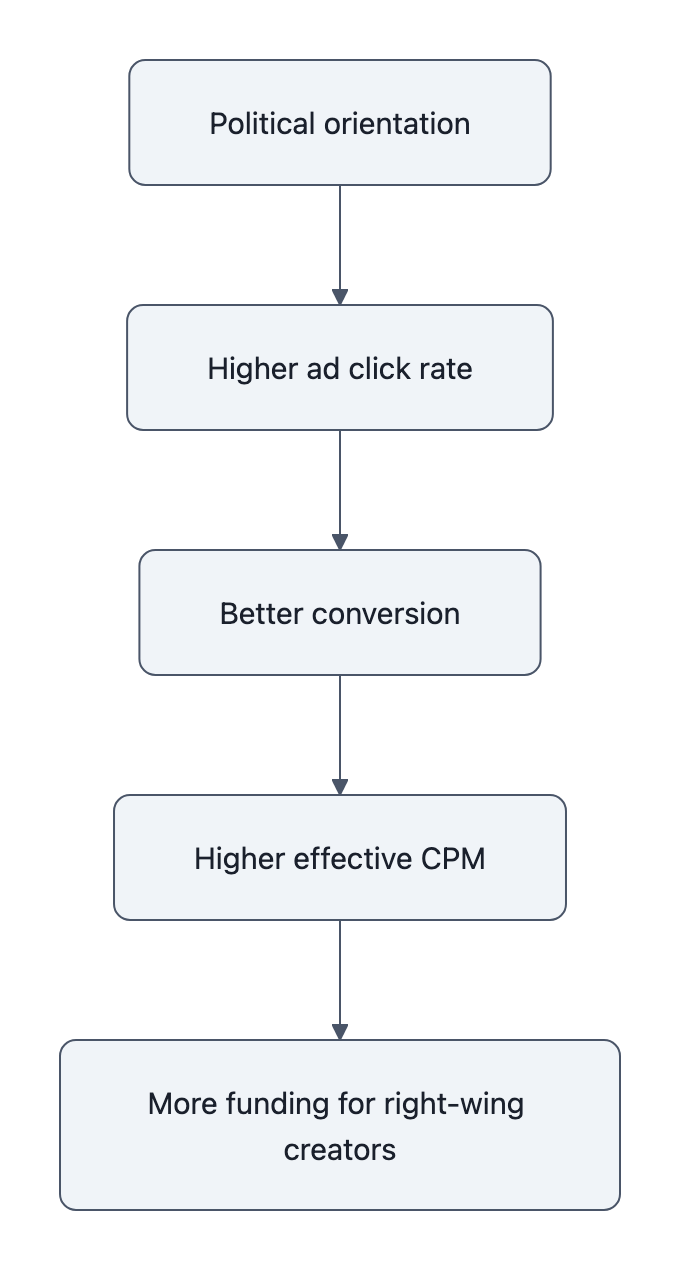
- Conservative audiences click more sponsored links and buy more from ads, making right-wing content online a better advertising asset per viewer.
- That extra ROI gets converted into premium ad rates and ideological brand deals, which fund a self-reinforcing creator flywheel the left simply doesn’t have.
- The resulting money gradient explains the reach, the scams, and a lot of the misinformation, an incentive story long before it’s an algorithm story.
Why right-wing content online attracts ad dollars
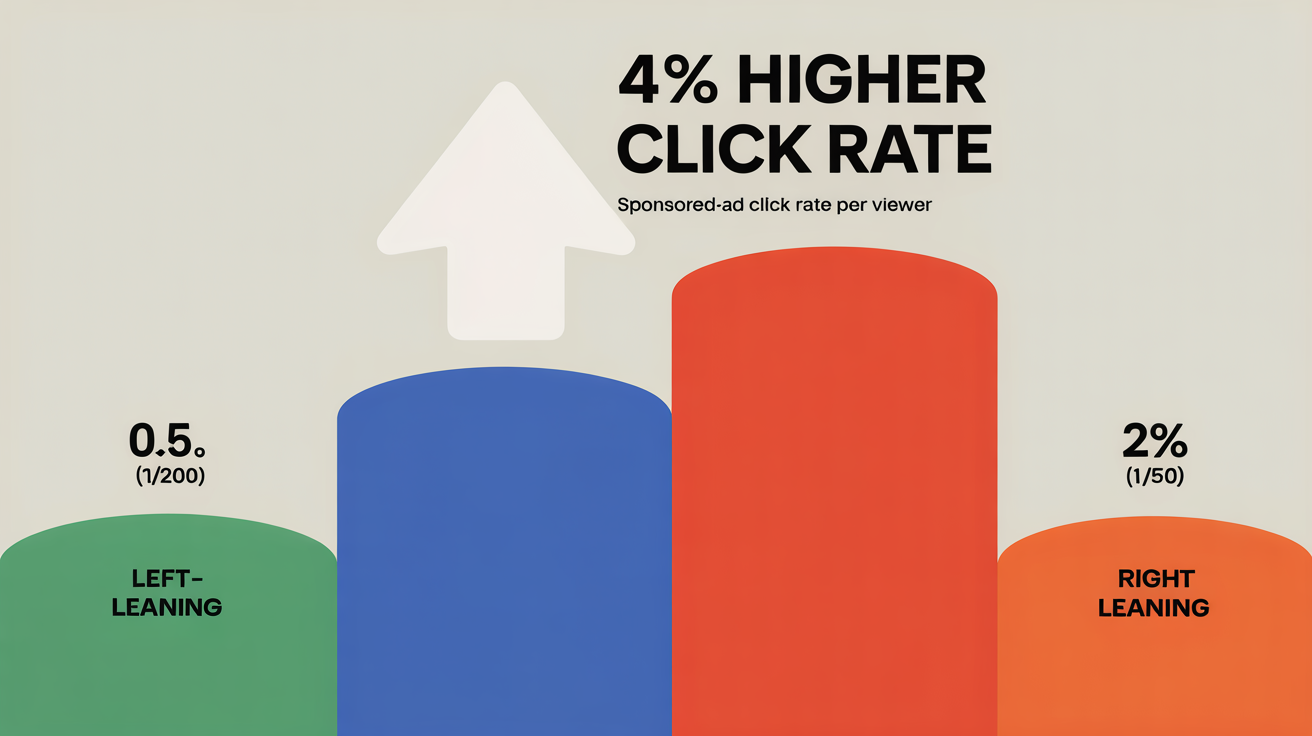
OK, so imagine two identical channels: same views, same watch time, same topics, one leans left, one leans right.
On the left-leaning channel, 1 out of 200 viewers clicks a sponsored link and maybe buys.
On the right-leaning channel, 1 out of 50 does.
If you’re buying ads, those channels are not equal. The right-leaning audience just made your campaign 4x cheaper per sale. You don’t need a conspiracy; you need a spreadsheet.
Alexander Davidson’s 2024 study looked at 500,000+ visitors to a nationwide retailer and found that a 10% increase in a state’s conservative identity predicted a 6.4% increase in sponsored search ad clicks, after controlling for age and income. Politics beat demographics.
Advertisers live on that kind of marginal advantage. A 6.4% click bump at retail scale is real money. So budgets quietly drift toward wherever those extra clicks live. Increasingly, that’s right-wing content online.
The empirical evidence: conservatives click and buy
Here’s the thing: Davidson’s result is not subtle.
Conservatives in his experiments were more likely to click “Sponsored: Buy headphones” than organic links, while liberals preferred the organic result, unless the query got so specific that everyone had to think hard. When the decision was low-effort, ideology did the work. Conservatives trusted the ad; liberals distrusted it.
That matches broader marketing research: identity-heavy, status-signaling pitches work better with conservatives than with liberals. Wrap a product in “freedom,” “tradition,” or “winners vs losers” and you’re speaking fluent right-wing consumer psychology.
Now plug that into the real media economy:
- A conservative podcast runs a “patriot” supplement spot.
- A meaningful chunk of listeners actually buy the supplement.
- The brand tracks conversions, sees CAC is lower than on Facebook or Google, and increases budget.
Bloomberg’s investigation into conservative YouTube stars found exactly this: right-leaning podcasters selling host-read ads with explicit ideological hooks, charging $10,000-$100,000 per read, with top advertisers collectively dropping around $5M per month, nearly 4x their 2023 spend.
You don’t pay six figures for 60 seconds of talking unless it moves product reliably.
Meanwhile, left-leaning shows exist, but the ad marketplace doesn’t see the same lift. Same CPM structure, worse conversion → budgets are smaller, risk appetite is lower, the community stays skinny.
The brand-creator flywheel that money builds
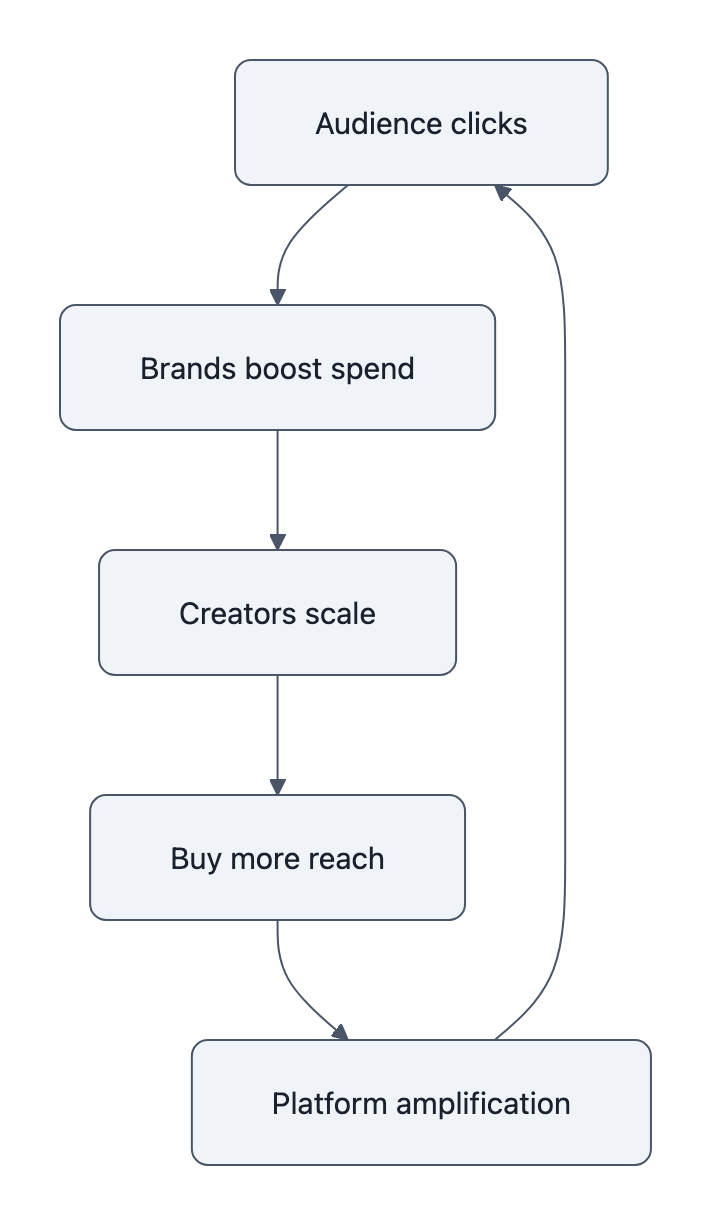
Think of the right-wing creator economy as a franchise model where ideology is the brand manual.
Step 1: Audience that clicks and buys at higher rates.
Step 2: Brands who see the numbers and are happy to tie themselves to that ideology.
Step 3: Creators who can now:
- charge premium CPMs for host-read ads
- hire editors, bookers, growth teams
- buy YouTube ads, cross-promotions, billboards
- launch merch, live tours, subscription clubs
User Mag’s analysis of this space points out that conservative influencers get CPMs left-wing YouTubers “couldn’t dream of.” That’s not just nicer studio decor, it’s a different physics of growth.
If you’re a small right-leaning creator, there’s an entire shelf of ready-made sponsors waiting: guns, survival kits, supplements, precious metals, “anti-woke” products. They don’t just tolerate your politics; they require it as part of the pitch.
If you’re a small left-leaning creator, your ideological alignment scares the mainstream brands (Bud Light PTSD) but doesn’t come with an equivalent niche sponsorship base. Your ads are generic, your rates are lower, and there’s no ideological premium.
Same audience size, different monetization. Over time, that compounds:
- High-ROI right-wing shows grow faster and buy more reach.
- Platforms and recommendation systems see high engagement and retention signals, and surface them more, the amplification of the right effect PNAS Nexus documents from another angle.
- Aspiring creators notice where the money is and calibrate toward that style and politics.
The flywheel isn’t that the algorithm “likes” conservatives. It’s that the market does, and the algorithm optimizes for what the market rewards.
What the ad-driven asymmetry explains (scams, reach, and misinformation)
Once you see the money gradient, a bunch of otherwise weird patterns around right-wing content online stop being mysterious.
Take scams. ProPublica documented how right-wing sites were flooded with fake celebrity ads, Oprah, Dolly Parton, Elon Musk, pushing dementia cures, crypto schemes, and miracle longevity secrets. These weren’t political persuasion campaigns. They were pure arbitrage: exploit a loyal, ideologically aligned audience for high-CPM garbage.
Why there? Because that audience:
- clicks ads at higher rates
- trusts “breaking news” frames and authority figures more in that context
- is clustered on sites that will tolerate sketchy ad networks if the checks clear
The Bad Ads study from UW shows something similar around the 2020 election: inflammatory political hooks used as funnels to sell commemorative coins, harvest emails, or drive you into even more ad-heavy sites. Politics was the bait; commercial extraction was the switch.
Is there misinformation in that mix? Absolutely, but notice who’s funding it. In many cases it’s not a dark-state propaganda machine; it’s a sketchy nutraceutical vendor who discovered that “Biden will BAN X” headlines massively outperform “New supplement study suggests modest benefit” as a click driver.
Now layer on reach.
Media Matters’ scan of 320 ideological shows found right-leaning properties with roughly 5x the total followers and double the YouTube views of left-leaning ones. PNAS Nexus found that even within progressive protest networks, links to right-leaning news sources got shared more.
If you treat that purely as an “ideas” story, the right has better memes, better outrage, better community, you miss that every additional unit of reach is monetized more efficiently. The structure encourages more supply.
That’s the same dynamic behind AI junk content farms: if a format turns low-quality posts into high RPM, you get more of those posts, not because the platform “likes” them, but because the ad dollars do. We’ve already looked at that feedback loop in the context of AI-generated right-wing content online; the politics are different, but the economic machinery is the same.
Why this matters: read the incentives, not the conspiracy
Here’s the key insight: if you fix the ad economics, a lot of the “algorithm bias” story collapses into something more boring and more solvable.
Platforms are optimizing for engagement and revenue. If one slice of the ideological spectrum delivers:
- more ad clicks per impression
- more purchases per click
- brands willing to pay a premium for ideological signaling
…then the entire stack, recommendation engines, creator tools, sponsorship marketplaces, tilts in that direction even if no one ever writes “boost conservatives” in a product spec.
That doesn’t mean algorithms are blameless. It does mean that yelling at ranking functions while the underlying market pays conservative CPMs at a huge premium is like yelling at the waiter while the kitchen keeps sending out salt.
If you want less scammy, less extreme, more balanced feeds, the pressure points are:
- advertisers who happily fund high-ROI outrage and scams
- ad networks that don’t distinguish between “political hook as persuasion” and “political hook as email-harvesting trap”
- creator funding structures that reward ideological lockstep more than factual accuracy
But step one is conceptual: stop treating the proliferation of right-wing content online as the result of a mysterious culture war machine, and start seeing it as the predictable outcome of a simple rule:
Whoever turns impressions into purchases most efficiently gets to decide what the internet talks about.
Key Takeaways
- Conservative audiences click sponsored ads significantly more than liberals, making them higher-value targets for advertisers.
- That higher advertising ROI flows into premium host-read rates and ideological brand deals for right-wing creators.
- The extra cash funds growth, leading to a self-reinforcing flywheel that amplifies right-wing content online beyond what audience size alone would predict.
- Scammy and misleading ads cluster on conservative sites because that’s where high-trust, high-click audiences deliver the best returns.
- The “amplification of the right” is less a secret algorithm setting and more an emergent property of who buys from ads.
Further Reading
- Your politics can affect whether you click on sponsored search results (Journal of Advertising), Davidson’s study showing conservative identity predicts higher sponsored-search click rates.
- Conservative YouTube Stars and the Marketing Boom, Bloomberg on the ad economics behind right-wing podcasting and YouTube shows.
- Right-Wing Websites Scam Loyal Followers With Phony Celebrity Pitches, ProPublica on scammy ad networks exploiting conservative audiences.
- The advantage of the right in social media news sharing (PNAS Nexus), Peer-reviewed evidence that right-leaning sources gain disproportionate visibility on social platforms.
- Bad Ads: Problematic Political Advertising on News and Media Websites, Measurement study of manipulative political hooks used to drive ad-driven landing pages.
In other words: if you follow the money, the feeds start making a lot more sense.