
At a warehouse in Southeast Asia, according to U.S. prosecutors, workers allegedly unpacked fake Supermicro servers and used a hair dryer to move serial‑number stickers from real machines onto dummies before an audit team arrived. That tiny, almost slapstick detail sits at the center of the Supermicro GPU smuggling indictment, and it tells you more about the future of AI than any policy speech about “responsible innovation.”
Here’s the thing: the scandal around Supermicro GPU smuggling is not mainly about one supposedly rogue cofounder or about China being scary. It’s about what happens when you combine liquid‑gold hardware (Nvidia GPUs), global logistics that run on trust and PDFs, and compliance processes that assume everyone is basically honest.
TL;DR
- The indictment is a blueprint for how to turn export controls into theater using transshipment, dummy hardware, and paperwork.
- The real driver isn’t ideology, it’s the economics of scarce AI compute, billions in upside for anyone who can slip GPUs across a border.
- As long as that incentive exists, enforcement will keep catching individuals while the system that made this almost inevitable stays intact.
Why Supermicro GPU smuggling matters now
OK so imagine: between 2024 and 2025, one Southeast Asian company buys around $2.5 billion of Supermicro AI servers, and a “substantial portion” allegedly ends up in China despite U.S. export controls meant to stop exactly that. Prosecutors say Supermicro cofounder Yih‑Shyan “Wally” Liaw, a Taiwan GM, and a broker built the pipeline, and in one three‑week burst in 2025, about $510 million in servers were diverted.
On Reddit, the story mostly lands as “wow, elaborate heist” and “China will get GPUs anyway.” Both miss the bigger point.
The key insight is this: once GPUs became the scarcest and most politicized resource in tech, the entire hardware supply chain turned into a temptation machine. You don’t need state‑sponsored espionage. A few insiders with access to purchase orders, freight labels, and compliance calendars can allegedly move the needle of the global AI race.
This case is the first time we get a high‑resolution look at how that might actually work in practice.
How the transshipment and dummy‑server scheme allegedly worked
Let’s strip the story down to the mechanics, the way you’d diagram a production line.
According to the indictment and DOJ press release:
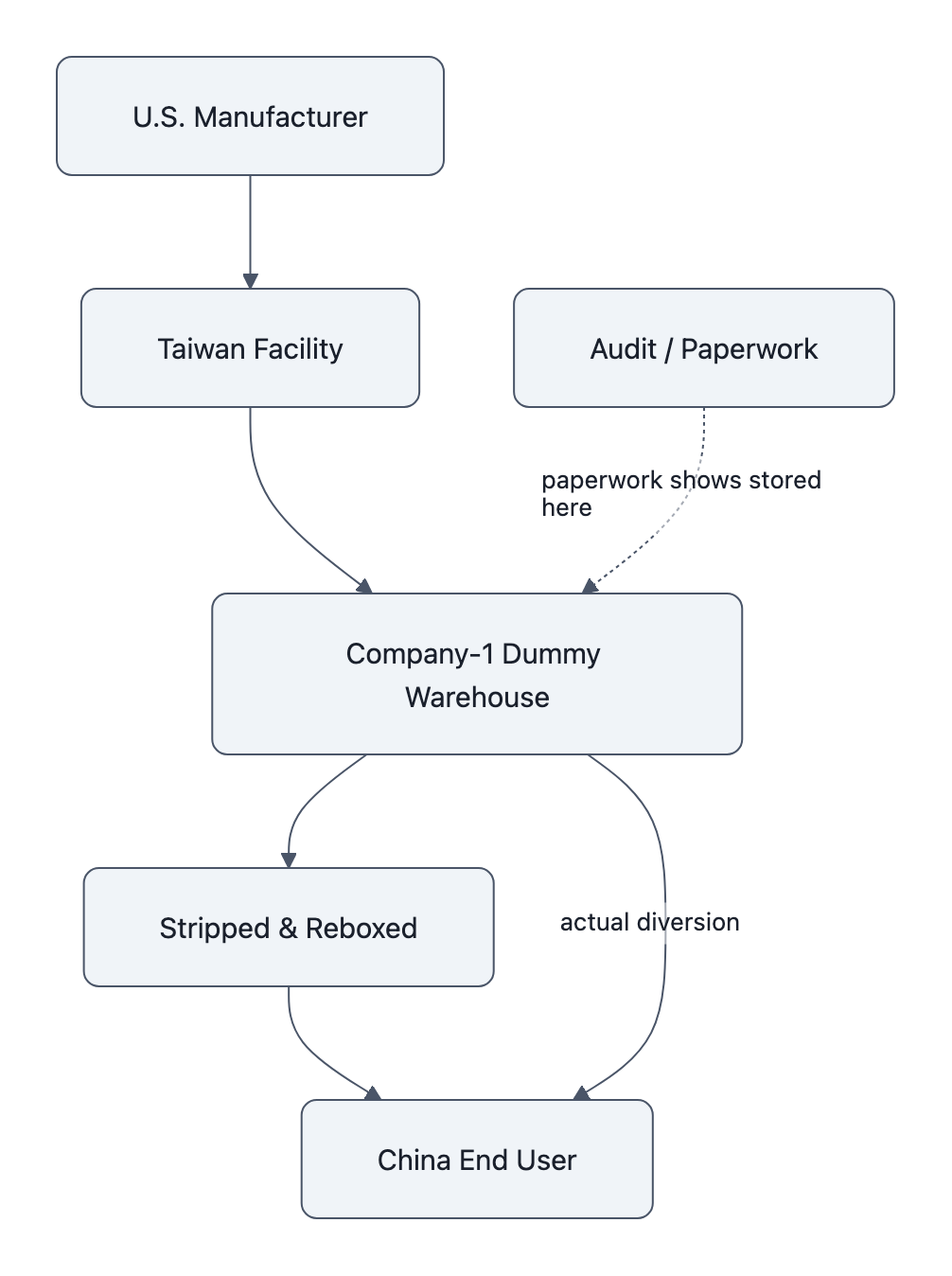
- Front‑end order: A Southeast Asian “Company‑1” places large orders with a U.S. manufacturer (identified in reporting as Supermicro) as the official end user.
- Normal manufacturing: Servers with controlled Nvidia GPUs are assembled in the U.S., then shipped to Supermicro facilities in Taiwan, then on to Company‑1 in Southeast Asia. On paper, everything’s compliant.
- Side door: Once Company‑1 receives the shipment, the alleged scheme kicks in: a logistics firm strips identifying packaging, reboxes the servers in unmarked cartons, and ships them onward to customers in China.
- Cover story: To satisfy internal audits and U.S. Commerce inspections, the defendants and Company‑1 executives allegedly:
- fabricated documents and emails to “prove” local end use,
- staged thousands of dummy servers in the warehouse as if this was where the real kit lived, and
- used tricks like that hair dryer to swap labels so serial‑number spot checks would pass.
Think of it like a shell game with racks instead of cups: the compliance team is checking the right serials in the right location, it’s just that the boxes under their hands aren’t the boxes that matter.
The clever part is not any one trick; it’s where the tricks are deployed.
They don’t hack customs databases or bribe port officials. They live entirely inside the “trusted” parts of the chain: a big OEM, an established overseas partner, a normal‑looking warehouse, and audit visits that can be carefully choreographed.
What this case reveals about AI compute markets and compliance incentives

Look, if you’ve ever watched a friend scalp concert tickets, you already understand the incentive structure here.
When the DOJ says these were “sensitive, controlled graphics processing units,” translate that to: each box on that pallet was worth more, in arbitrage terms, than many people’s annual salary. GPUs restricted from China don’t just hold their value, they appreciate the moment they cross the right border.
Now put yourself in three different pairs of shoes.
1. The Chinese AI startup.
You’re locked out of A100s, H100s, B200s by U.S. export rules. Domestic chips are improving but not quite there, and your competitors are hinting (quietly) they’ve “found sources.” You don’t need 100,000 illicit GPUs. Even 2,000 high‑end cards can tilt training runs for your next model. You will pay a steep premium.
2. The intermediary company.
On paper, you’re just a Southeast Asian buyer with a legitimate data‑center plan. In reality, you’re a throughput machine: take delivery of compliant servers, peel the identity off, push them across the line. Your margin is the gap between official and gray‑market GPU prices, and in a compute bubble, that gap is enormous.
3. The insider at a major OEM.
You see where the machines are built, where they’re shipped, which customers get licenses reviewed and which don’t. You also see quarterly revenue pressure, customer complaints about delayed shipments, and a market that rewards “creative” ways to keep orders flowing. If you believe export controls are a political overreaction, the moral barrier gets even lower.
In that triangle, export law is the only hard stop, and it’s enforced mostly through paperwork, site visits, and self‑reported end‑user checks.
That’s the structural vulnerability the Supermicro GPU smuggling indictment exposes: our control system is designed around declarations and inspections, but the money is made in choreography and staging.
Supermicro’s corporate statement stresses a “robust compliance program” and calls the alleged conduct a contravention of policy. That may all be true. It also illustrates the deeper problem: you can have strong rules on paper and still be one trusted partner and a warehouse of dummy kit away from losing track of billions in AI hardware.
Why export controls are brittle, and what to watch next
Export controls assume three things:
- You can identify sensitive items.
- You can monitor where they go.
- You can trust the people in the middle to tell the truth.
The Supermicro case pokes holes in #2 and #3 without ever touching #1.
You can stamp a GPU with a control classification; that’s the easy part. But once it’s inside a server, inside a container, inside a foreign warehouse that’s been staged to look right on camera, monitoring becomes theater. The inspector sees exactly what the paperwork says they should see, the system is optimized to confirm the story, not challenge it.
Now connect that to the broader AI race.
We already know, from stories about AI adoption in China, that domestic actors have strong incentives to close the compute gap by any means available. We also know, from NVIDIA’s own comments, that they won’t support illicit systems, but once the hardware’s over the line, many users don’t care about warranty tickets. A smuggled cluster that burns out in three years instead of five is still an upgrade over never getting one.
So what happens next?
A few likely patterns to watch:
- More “Company‑1s”. If this indictment is one pipeline, there are probably others experimenting with different mixes of transshipment hubs, shell buyers, and dummy‑asset tactics. The playbook is now public.
- Shifting pressure points. As controls tighten on top‑end GPUs, attention will move to “just‑below‑threshold” parts, multi‑hop shipments, and cloud‑based access to foreign compute rather than bare‑metal moves.
- Compliance as theater vs. engineering. Most current defenses are process‑based (forms, audits). Expect more technical ones: cryptographic attestation of where a server boots, telemetry that ties serial numbers to physical locations, maybe even “kill switch” style monitoring of restricted accelerators.
And, importantly, more enforcement aimed at individuals, like the Yih‑Shyan Liaw indictment, because that’s the lever prosecutors actually have. But personal deterrence only goes so far when the underlying economic equation still screams, “Find a way.”
If you want a preview of where this goes, reread the indictment details next to that Reddit comment about Supermicro GPU smuggling and “50k smuggled Nvidia GPUs.” The rumor mill already assumed these channels existed. Now we’ve seen one up close.
Key Takeaways
- The Supermicro GPU smuggling case is a systems failure, not just a crime story: scarce AI hardware plus paper‑based controls created a predictable incentive to cheat.
- The alleged scheme didn’t rely on exotic tricks, just transshipment, staged dummy servers, and fake paperwork deployed inside “trusted” parts of the supply chain.
- As long as GPUs function like financial derivatives for AI power, intermediaries and insiders will be tempted to arbitrage export rules.
- U.S. export controls can flag sensitive chips, but monitoring where they actually end up is brittle when inspections are easy to choreograph.
- Expect more cases targeting individuals while the real constraint, aligning economic incentives with compliance, remains unsolved.
Further Reading
- Three Charged With Conspiring To Unlawfully Divert U.S. Artificial Intelligence Technology To China, DOJ press release summarizing the charges and alleged scheme.
- Supermicro’s cofounder was just arrested for allegedly smuggling $2.5 billion in GPUs to China, Fortune’s narrative of the case, including dummy servers and timing details.
- AP News, Supermicro cofounder arrested in alleged GPU diversion, Concise wire summary of the indictment and arrests.
- Super Micro Computer Issues Statement on Action by U.S. Attorney’s Office, Supermicro’s official response and compliance framing.
In a few years, we may look back at this case the way early finance geeks look at the first derivatives blow‑ups: not as an outlier, but as the moment we should have realized that when you financialize compute, the real contest moves from chip design to the gray areas of global logistics.