
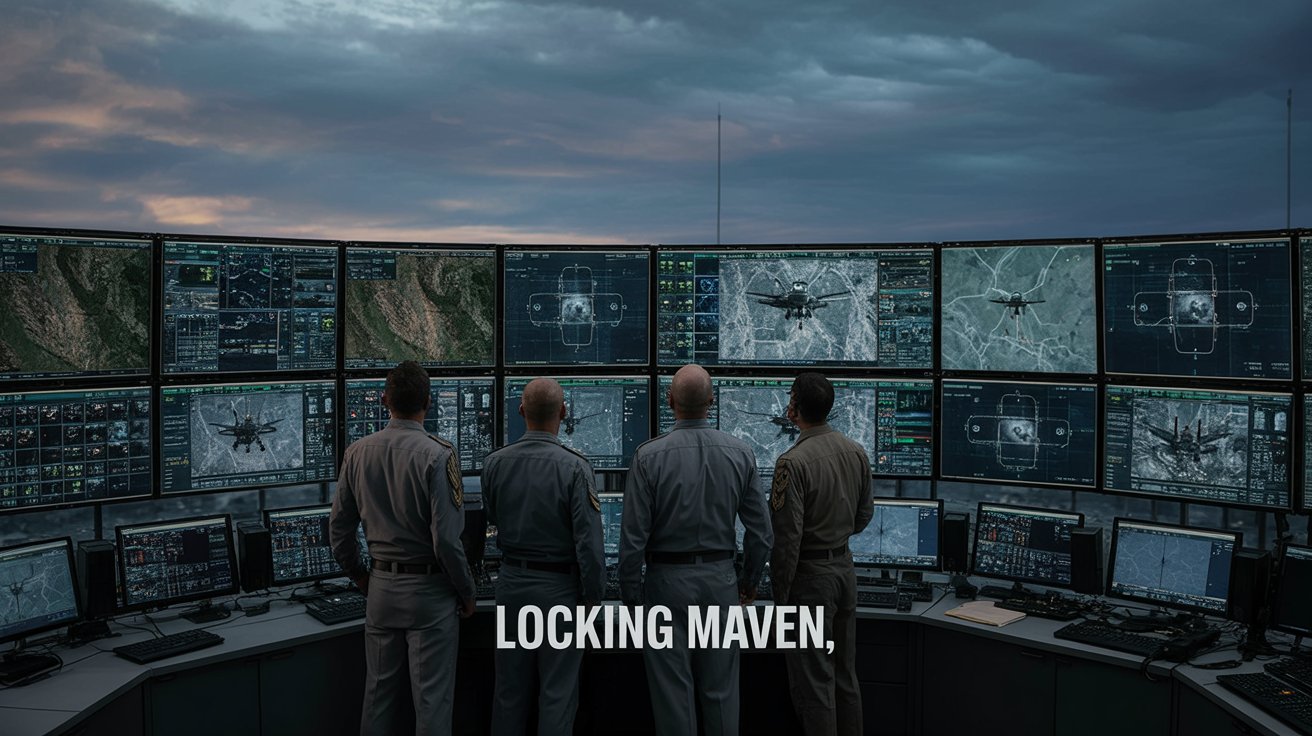
Palantir’s Maven Smart System just graduated from “AI experiment” to “the way the U.S. military fights wars.” A Pentagon memo ordered Maven made a formal program of record and moved it under the central AI office, cementing Pentagon Palantir AI as the default brain for command‑and‑control and AI weapons targeting.
TL;DR
- The memo doesn’t just bless a tool; it installs Palantir as the proprietary control plane for how the U.S. military sees, decides, and shoots.
- Once that control plane is locked as a program of record, the real risks are vendor lock‑in and invisible policy choices baked into the software, not just “rogue AI.”
- If you care about AI safety or war powers, the fight is now about auditability and accountability plumbing, not whether there’s “a human in the loop” on a slide.
What the memo actually changes for the Pentagon
Look, “program of record” sounds like paperwork, not power.
In reality, it’s the difference between “we’re trying this thing” and “this is the official way we do war.”
According to reporting on Deputy Defense Secretary Steve Feinberg’s March 9 letter, the memo does three concrete things:
- It designates Palantir’s Maven Smart System as a program of record, stable funding, standardized deployment, built into planning.
- It moves oversight from the National Geospatial‑Intelligence Agency to the Chief Digital and Artificial Intelligence Office, the central AI shop.
- It tasks the Army to run future contracting, turning Maven into an enterprise platform, not a niche intel experiment.
Reuters and defense trade outlets say the letter pitches this as giving warfighters tools to “detect, deter, and dominate our adversaries in all domains” and note Maven has already supported thousands of strikes against Iranian targets.
Here’s the thing: when you make something a program of record, you’re not just buying software.
You’re buying a way of deciding.
And that way of deciding now has Palantir sitting right in the middle of it.
Why Palantir’s Maven matters on the battlefield
OK so imagine you’re an operations officer in a command center.
Before Maven, your day is a mess of:
- drone video feeds
- satellite images
- radar tracks
- intel reports
- chat messages from units on the ground
Your job is to stitch this into a story: What’s happening? Where are the enemy systems? What can we hit, and with what? It’s labor‑intensive, slow, and full of human judgment calls.
Palantir Maven turns that pile into a dashboard.
It hoovers up data from drones, satellites, sensors, and intel reports, runs machine‑learning models on top, and shows you:
- boxes over vehicles it thinks are enemy armor
- color‑coded “threat” scores on buildings
- suggested target lists
- recommended weapons and timing options
At Palantir’s own event, a Pentagon official showed Maven identifying targets in the Middle East and bragged that what used to take hours now takes minutes.
On paper, nothing has changed about rules of engagement.
There’s still a human with legal authority to approve a strike. There’s still a checklist about collateral damage.
But in practice, the human is no longer deciding from scratch.
They’re editing a machine‑generated plan.
That’s a subtle but massive shift: the system defines the default, and the human has to justify deviating from it.
Once Maven is the official program of record, that “editor of the machine’s plan” mode becomes the institutional norm.
This is procurement and political power, not just tech
If this were purely about “best AI model wins,” you’d expect a dogfight between model labs and cloud giants.
That’s not what’s happening.
The Pentagon Palantir AI story only makes sense as procurement politics:
- The Defense Department wants an integrator that can plug in any model and run at “war speed.”
- Palantir built exactly that: a proprietary stack that can host Anthropic, OpenAI, open‑source models, whoever, behind a common command interface.
- DoD leadership has made it clear, publicly, that they’ll “shrug off any AI models that won’t allow you to fight wars,” as AP quoted Secretary Pete Hegseth.
When Anthropic balked at “all lawful uses” and warfighting applications, coverage from AP and Semafor reported that a Palantir executive flagged that reluctance as a risk, and Palantir’s position as the integrator became a feature, not a bug.
Palantir isn’t just supplying algorithms.
It’s supplying freedom from model vendors’ ethics.
That’s incredibly attractive if you’re trying to avoid the situation in our own earlier coverage of Anthropic rejecting Pentagon pressure: a single lab quietly constraining how you fight by refusing certain uses.
So the Pentagon solves the “Anthropic problem” by installing Palantir as the AI operating system and treating commodity models as swappable parts underneath.
From a procurement view, that’s elegant.
From a power view, it’s terrifying.
Because once one company becomes the control plane, every data model, workflow, and targeting rule gets encoded into their black box.
Switching later isn’t like changing cloud providers.
It’s like ripping out your nervous system.
The accountability gap: who answers when AI targets
You’ve probably heard the standard reassurance: “There will always be a human in the loop.”
That phrase does a lot of work.
Imagine a bad strike: an apartment building hit, dozens of civilians killed.
In today’s world, accountability can, at least in theory, trace back through:
- the commander who approved the strike
- the intel officer who assessed the target
- the process they followed
- the rules of engagement in force
- the government that set those rules
In an AI‑assisted Maven world, that chain quietly grows new links:
- the models that scored the target
- the data they were trained on
- the Palantir‑designed workflow that surfaced it as “high priority”
- the tuning choices that made the system more aggressive or conservative
- the configuration pushed by some program office six months earlier
Here’s the key insight: most of those new links are effectively invisible to outside scrutiny.
Even inside the system, they’re hard to interrogate.
Who owns the mistake if:
- the classifier mis‑labels a convoy of evacuees as enemy armor?
- the fusion algorithm over‑weights a faulty sensor?
- the UI buries a warning behind three clicks while highlighting a clean “Strike” button?
Is that the commander’s fault for trusting the dashboard?
The model vendor’s?
Palantir’s?
The memo that makes Maven a program of record doesn’t answer this.
It standardizes the use, not the blame.
We already saw a glimpse of this problem in debates after the Iran school strike and AI accountability: officials fell over themselves to say both that AI helped and that humans were ultimately responsible.
That rhetorical move will only get easier once “the system” is entrenched, and only harder to challenge when it’s wrapped in classification and proprietary code.
Why transparency and auditability are the real fight
Think of Maven not as a weapon, but as a spreadsheet that can kill people.
The danger isn’t that the spreadsheet exists.
It’s that no one outside the building can see:
- which formulas are in which cells
- who changed them
- what data they pulled from
- and how those changes affected decisions months later
“Human in the loop” is the wrong metric.
The right questions are painfully boring and extremely technical:
- Can investigators replay what the system showed at the moment of decision?
- Are the model versions, training data, and configuration changes logged in a way Congress or a court could ever see?
- Can another vendor, or an internal DoD team, realistically replace Palantir without losing that history?
If the answer to those is “no,” then we aren’t just locking in a vendor.
We’re locking out accountability.
And that’s the beautiful part of looking at this as a political‑economic choice instead of a sci‑fi one: it tells you exactly where to push.
Technologists who care about AI ethics inside and outside government shouldn’t only argue about whether to use AI in targeting.
They should be insisting that any program‑of‑record AI system ships with:
- standardized, exportable audit logs
- documented decision policies that can be reviewed by independent bodies
- interfaces that make dissent, not just acceptance, a first‑class action
Those sound like implementation details.
They’re not.
They’re the difference between software that shifts power toward unreviewable machine‑bureaucracy and software that still lets humans, years later, say: “Here is what happened, and who chose it.”
Key Takeaways
- Making Maven a program of record turns Palantir from a contractor into the military’s de facto AI control plane.
- The Pentagon chose Palantir not just for tech, but because it offers freedom from model vendors’ ethical limits, especially after the Anthropic dispute.
- Once embedded, Palantir’s stack creates massive vendor lock‑in, making it structurally hard to swap out without losing institutional memory.
- “Human in the loop” is a distraction; the real stakes are auditability and blame tracing when AI‑assisted targeting goes wrong.
- Technologists should focus pressure on transparency, logs, and replaceability in systems like Maven, the plumbing where accountability either lives or dies.
Further Reading
- Pentagon to adopt Palantir AI as core US military system, memo says (Reuters via Yahoo Finance), Reporting on the memo making Palantir’s Maven Smart System a program of record and moving it under the Pentagon AI office.
- Pentagon surges Palantir Maven Smart System contract spending (InsideDefense), Details on contract expansion and Maven’s role inside Project Maven and enterprise C2.
- DoD enterprise command and control plans (DefenseScoop), Context on how Maven fits into the Pentagon’s broader command‑and‑control ambitions.
- Palantir partnership is at heart of Anthropic-Pentagon rift (Semafor), How Palantir’s integrator role shaped the Anthropic dispute.
- Anthropic-Pentagon dispute reporting (AP), Coverage of Pentagon pressure on Anthropic and the politics of AI use in war.
The memo made one software stack the nervous system of U.S. military AI.
What happens next depends less on the models it calls and more on whether anyone outside that stack can ever see how it thinks.