
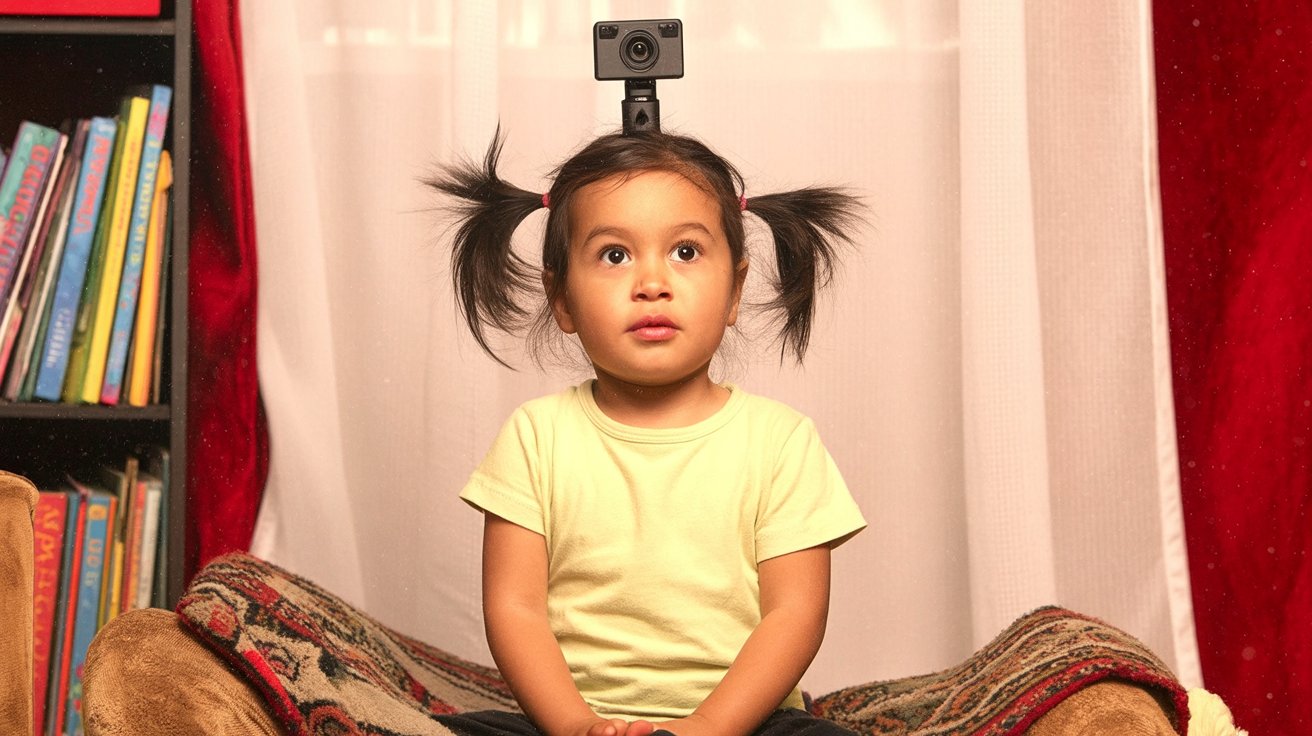
Most vision models get good by seeing absurd amounts of data. Zero-shot world models are interesting because they try a different bargain: less data, more structure. The new ZWM paper claims a model trained on a single child’s first-person visual experience can produce flexible physical understanding across multiple tasks without task-specific training.
That is a big claim. Some of it is confirmed by the paper itself: the April 11, 2026 arXiv preprint presents the method, the three-part design, and the benchmark results. Some of it is only plausible, not independently verified: there is no peer-reviewed publication yet, no mainstream reporting with external replication, and the Stanford NeuroAI Lab page lists the work as “in submission.”
I started out expecting another “AI learns like a baby” paper, which is usually a good way to smuggle in bad comparisons. The more interesting thing here is narrower and better: this may be a credible mechanism for getting zero-shot physical competence from human-scale developmental data. The child comparison helps motivate that. It also overreaches.
Why zero-shot world models matter now
The standard scaling story in AI is simple: if a model is bad at visual understanding, feed it more images and video. That has worked well enough that people sometimes treat data scale as the only serious path.
ZWM is interesting because it makes a different prediction. If the right internal structure matters enough, then a model should get useful physical understanding from a single developmental stream instead of internet-scale corpora. Not perfect understanding. Not AGI. Just competence that transfers.
That matters to generalists for two reasons.
First, data is becoming the expensive part. Training on giant scraped datasets is not only costly; it is also colliding with licensing, provenance, and synthetic-data problems. We have already seen how brittle the field gets when results are hard to reproduce or datasets are poorly documented, the AI reproducibility crisis is not an academic side issue anymore.
Second, if zero-shot world models work, they point to a different kind of capability gain. Not “the benchmark went up 2 points because the dataset got bigger,” but “the model learned reusable physical abstractions.” Those are much more valuable.
The paper’s core claim is plausible but not independently verified: a structured world model can narrow the gap between machine and child learning efficiency. The evidence for that is the benchmark suite and ablations in the preprint. The stronger claim, that this explains child cognition, is still a hypothesis.
What BabyZWM actually learns from a single child
“Trained on a single child” sounds like tabloid bait. It does not mean the model watches one toddler and becomes a toddler.
According to the paper and secondary summaries, BabyZWM is trained on first-person visual experience from one child, using egocentric video rather than labeled image classes. The paper frames this as developmental input: the stream of appearances, motion, occlusion, object persistence, and interaction opportunities that a child actually sees.
One secondary review cites 868 hours of first-person video, roughly described elsewhere as about three months of visual experience. That number is plausible but not primary-source verified in the abstract, so it should be treated carefully until the full dataset release lands. The GitHub repo says the code and datasets are planned for release by end-April 2026, which should make this easier to check.
What is verified in the paper abstract is the intended outcome: from that developmental stream, the model should learn depth, motion, object coherence, and interactions well enough to perform multiple physical understanding benchmarks with no task-specific training.
That “zero-shot” part matters. Ordinary supervised vision models are told what to predict: class labels, boxes, masks. Many self-supervised video models learn useful representations too, but often need downstream fine-tuning to do anything specific. ZWM claims something more ambitious: infer latent structure from video, then use approximate causal reasoning and compositional inference to answer new tasks directly.
That is the conceptual jump. Instead of learning labels, learn a compact machinery for “what persists, what moves, what causes what.”
The three design choices that make the model work
The paper says ZWM rests on three principles. This is where the article either becomes real or turns into vibes.
| Design choice | What the paper says it does | Why it matters |
|---|---|---|
| Sparse temporally-factored predictor | Decouples appearance from dynamics | Lets the model separate “what something looks like” from “how it changes” |
| Approximate causal inference | Supports zero-shot estimation | Tries to answer new physical questions without retraining on each task |
| Compositional inference | Combines simpler inferences into harder abilities | Makes transfer possible instead of learning every benchmark separately |
That first piece is the most concrete. A model that entangles appearance and dynamics too tightly tends to memorize surfaces. A red ball in one lighting condition becomes a different problem from a blue ball under another camera angle. If you separate appearance from dynamics, you have a chance to learn that round thing rolling behind another object still exists. Children appear to do this. Standard vision pipelines often do not.
The second and third pieces are more ambitious. The paper claims approximate causal inference and composition are what turn latent video structure into zero-shot capability. That is confirmed as the authors’ method claim, but the extent to which those modules really drive performance is only as good as the ablations. Until other groups reproduce the results, this is still one team’s evidence for its own mechanism.
Still, this is the part that made me update. I expected a fancy self-supervised video model with a developmental coat of paint. The design is more opinionated than that. Whether it is right is open. But at least it has the courtesy to be falsifiable.
What the benchmarks do and do not prove
The paper claims BabyZWM “matches state-of-the-art models on diverse visual-cognitive tasks” and “broadly recapitulates behavioral signatures of child development and builds brain-like internal representations.” That sentence contains three very different levels of evidence.
Strongest evidence: benchmark competence.
If the reported evaluations are sound, then the paper shows a model trained on human-scale developmental video can do surprisingly well on multiple physical understanding tasks without task-specific training. That is the real result.
Medium evidence: developmental similarity.
The claim that its performance patterns resemble child development is useful, but easy to oversell. Similar benchmark curves do not mean the model learns the way children learn. They mean there is some behavioral resemblance under the tested conditions. Useful, yes. Equivalent, no.
Weakest evidence: brain-like representations.
This kind of claim is common in neuro-inspired AI papers and often much softer than headlines suggest. “Brain-like” can mean correlations with neural data, representational similarity, or broad qualitative alignment. Interesting if true. Nowhere near settled.
The child comparison is doing two jobs at once. One job is fair: children are a sanity check for data efficiency and transfer. The other is much shakier: implying that because the training diet looks developmental, the resulting mechanism is child-like in a strong scientific sense. The skepticism on this point was unusually sensible. Human children do not start from random weights and a blank architecture; they inherit a lot of structure. Any “better than a child” framing quietly ignores a few hundred million years of pretraining.
There is another reason to be careful. The paper is a preprint, not a replicated standard. AI has a habit of turning one strong result into a genre before anyone checks the plumbing. We have seen similar inflation around benchmark narratives, including the tendency to mistake narrow zero-shot performance for general competence, the same basic confusion showed up in arguments around the ARC-AGI-3 human baseline. And if the field leans too hard on generated or self-reinforcing data later, the provenance problem comes back in the form of AI model collapse.
Why the real story is data efficiency, not baby-versus-machine theater
The most interesting result here is not “AI catches up to a child.” It is that zero-shot world models offer a specific bet against the brute-force consensus.
That bet is: if you build the right inductive biases into the model, explicit separation of appearance and dynamics, causal estimation, compositional reasoning, you may not need internet-scale data to get flexible visual competence. If that holds up, it changes research priorities. You spend less time scaling generic representation learning and more time asking what structure the model needs to infer the world from a continuous stream.
That is a much better story than the headline version. It is also a much harder one to fake. Either the mechanism reproduces across datasets and labs, or it doesn’t.
Right now, the evidence says this is promising and specific, not proven and general.
Key Takeaways
- Verified: the ZWM paper proposes a structured model for zero-shot physical understanding from first-person developmental video and reports strong benchmark results in a 2026 arXiv preprint.
- Plausible but unverified: the model may substantially narrow the data-efficiency gap between AI and children, but there is no independent replication yet.
- The important idea is not that AI “beat” a child; it is that visual competence may depend on model structure as much as dataset scale.
- Child comparisons are useful as a data-efficiency reference point, but misleading when they imply equivalent learning mechanisms.
- The next real test is simple: can other labs reproduce the results once the code and dataset release happens?
Further Reading
- Zero-shot World Models Are Developmentally Efficient Learners, Primary paper abstract and method framing from the authors.
- awwkl/ZWM GitHub repository, Official code repository with release timing for code and training datasets.
- Hugging Face paper page: Zero-shot World Models Are Developmentally Efficient Learners, Convenient summary page reflecting the paper’s abstract and community notes.
- Moonlight review of Zero-shot World Models Are Developmentally Efficient Learners, Secondary summary that includes a specific training-data figure, useful as a lead but not primary evidence.
- Stanford NeuroAI Lab publications page, Shows the paper listed as in submission, which matters for judging publication status.
The field has spent years acting as if “more data” was the same thing as “more understanding.” Zero-shot world models are interesting because they make a cleaner claim: maybe the missing ingredient was structure all along.