

OpenAI revenue is still the number people reach for when they want a leaderboard. But the cleaner frame is different: Anthropic appears to be building a different kind of AI business, one centered on enterprise customers, safety positioning, and less dependence on mass-market fame.
That distinction matters because public discussion keeps collapsing three separate things into one scorecard: revenue, valuation, and brand recognition. The available sources here do not show that Anthropic has passed OpenAI on valuation or revenue. They do show why Anthropic can look strong anyway.
Why Anthropic’s Enterprise Focus Changes The Revenue Conversation
The strategic frame is revenue mix versus public visibility. A company can be less famous and still look formidable if it is optimized for business spending rather than consumer attention.
Anthropic’s own Claude for Enterprise page makes that positioning unusually explicit. It leads with enterprise workflows, secure connections to company knowledge, and business use cases rather than a mass-market assistant pitch.
That is a different motion from a consumer product becoming a household verb. Enterprise buyers care about access controls, internal knowledge retrieval, and whether a tool can slot into existing company work. Anthropic is selling into that budget line.
A small detail on the same page is revealing: Anthropic highlights Lyft reducing customer support time by 87% with Claude. That is not consumer marketing. It is a procurement story, aimed at managers who sign contracts after seeing labor savings and workflow gains.
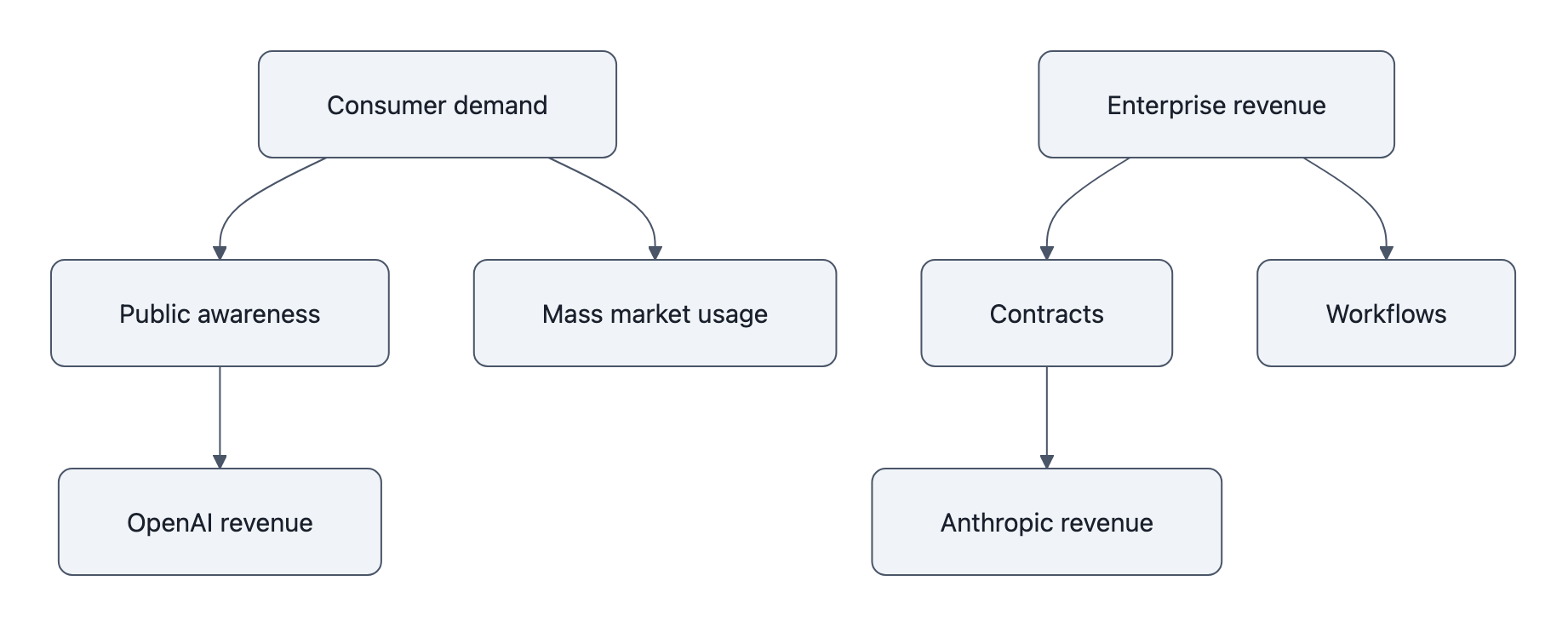
This is why claims about OpenAI revenue often miss the interesting part. Two AI companies can generate money through very different channels. One can dominate public awareness while the other builds a quieter base of higher-touch business accounts.
That difference also helps explain why Anthropic shows up so often in discussions about workplace AI adoption and developer workflows, including in comparisons like our look at Claude vs ChatGPT. The products overlap, but the go-to-market emphasis is not the same.
OpenAI Still Has The Stronger Consumer Brand
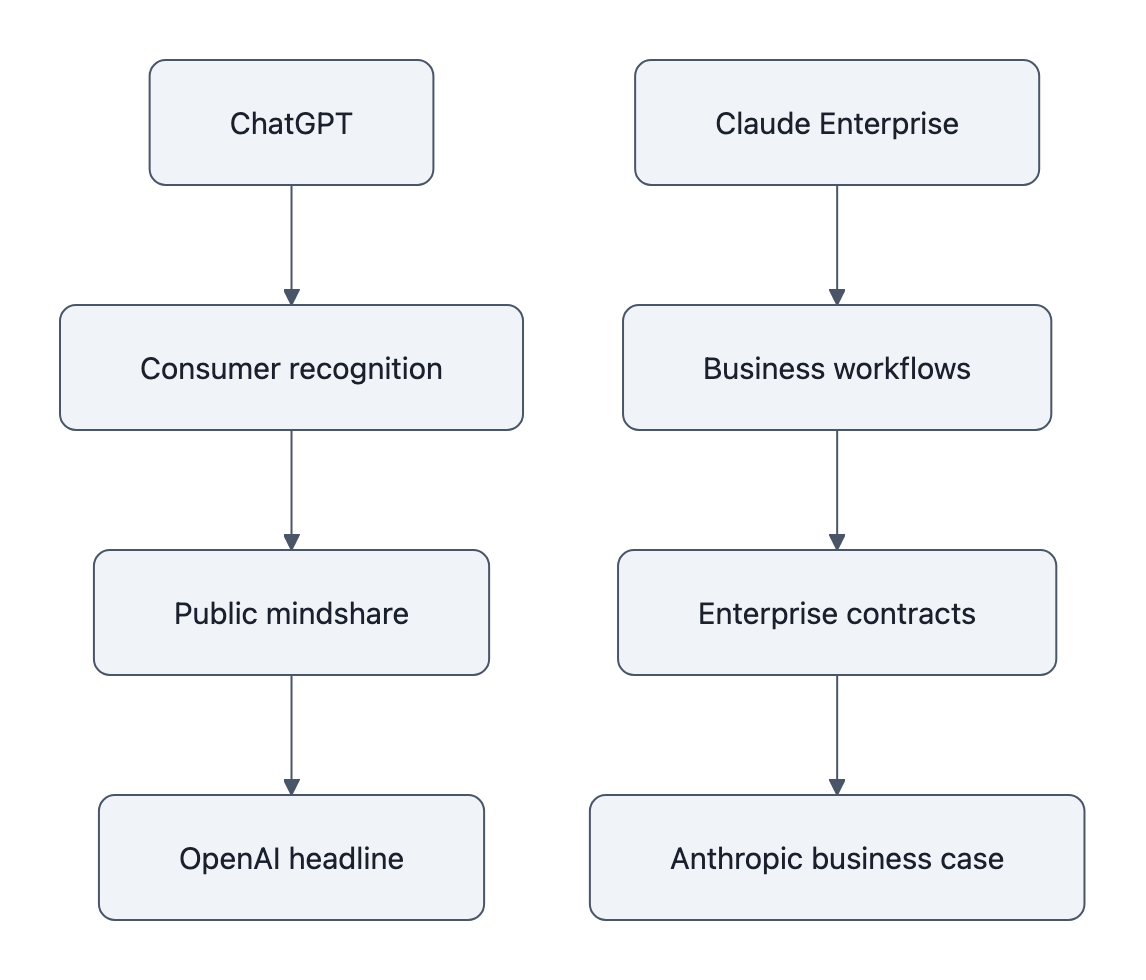
On public recognition, the gap is much easier to support. The Reuters Institute’s 2025 report says ChatGPT is by far the most widely recognised generative AI system.
That matters because brand recognition and revenue are related, but they are not interchangeable. ChatGPT gave OpenAI something Anthropic does not have at the same scale: a consumer brand that functions as category shorthand.
When people talk about AI in casual conversation, they usually say “ChatGPT,” not “Claude.” That creates distribution all by itself. It also makes OpenAI revenue a more natural headline than Anthropic’s business performance, because consumer familiarity drives media attention.
Anthropic’s relative lack of consumer fame should not be confused with weakness. It means the company is playing a different game. OpenAI owns more of the public mindshare; Anthropic is visibly pitching itself to organizations that care more about internal deployment than mass recognition.
There is a second-order effect here. Consumer fame tends to distort how outsiders judge company strength. A company with the stronger household brand often gets treated as if it must also lead every business metric. That is exactly the shortcut readers should avoid.
What Anthropic’s Public Messaging Reveals About Its Business Model
Anthropic’s homepage is unusually consistent about one thing: safety is not a side note. The company foregrounds “AI to serve humanity’s long-term well-being,” links to its Responsible Scaling Policy, and frames Claude as “a space to think” with “No ads. No sponsored content.”
That messaging is branding, but it is also customer selection. Safety language, governance language, and enterprise product pages all point toward buyers who want a lower-drama procurement story: controlled deployment, business use cases, and an AI vendor that talks like a risk committee can live with it.
This is the part many leaderboard arguments miss. Anthropic’s safety posture is not just philosophy; it is part of the sales motion. For an enterprise customer, especially one connecting internal company knowledge, trust signals can be part of the product.
That does not mean the strategy is frictionless. Enterprise-first companies often run harder into account controls, permissions, and support expectations. You can see how quickly trust becomes operational, not abstract, in situations like reported Anthropic bans. Once your buyer is a business, reliability and account handling become part of the value proposition.
Why Valuation Claims Need Caution When Revenue Is Not Public
Here is the part worth stating plainly: the source set does not support the claim that Anthropic has overtaken OpenAI in valuation or revenue. Those claims were investigated and dropped.
That leaves a narrower, better argument. Anthropic’s enterprise positioning explains why some observers may feel like it is winning, especially inside technical teams and business deployments, without needing any unsupported claim about beating OpenAI revenue or surpassing OpenAI’s valuation.
This is a common category error in AI coverage. People see strong enterprise adoption, a credible product, and a clear safety brand, then translate that into assumptions about top-line revenue or private-market value. But those are separate measurements, and neither company’s full numbers are public in a way that lets this comparison be made cleanly from the cited sources.
A better way to read the chessboard is this: OpenAI has the stronger consumer brand because ChatGPT is the public face of generative AI; Anthropic has built a more overt enterprise-first narrative through Claude Enterprise and safety-centered positioning. Both can be true at once.
That also changes how to read future reporting on AI company revenue. If a headline treats consumer mindshare as proof of enterprise dominance, or treats enterprise credibility as proof of overall revenue leadership, it is probably compressing too much into one metric. Our earlier coverage of OpenAI revenue 2026 is useful here precisely because revenue stories need source discipline, not vibes.
Key Takeaways
- Anthropic’s verified public positioning is enterprise-first, centered on Claude for Enterprise, secure company knowledge access, and business use cases.
- Reuters Institute reports that ChatGPT is by far the most widely recognised generative AI system, giving OpenAI a stronger consumer brand.
- The available sources do not support claims that Anthropic has overtaken OpenAI in valuation or revenue.
- Anthropic’s safety-heavy messaging appears tightly linked to its business model, especially for enterprise customers evaluating risk and trust.
- The real comparison is not a simple leaderboard: OpenAI revenue, Anthropic’s enterprise motion, and ChatGPT brand recognition describe different kinds of strength.
Further Reading
- Anthropic home, Anthropic’s homepage shows its safety framing, Claude releases, and overall company positioning.
- Claude for Enterprise, Anthropic’s enterprise page highlights business workflows, secure knowledge connections, and customer examples like Lyft.
- Reuters Institute generative AI and news report 2025, Includes the supported brand-recognition comparison showing ChatGPT’s public awareness lead.
- OpenAI revenue 2026, NovaKnown’s earlier coverage of OpenAI’s revenue trajectory and what can actually be supported.
- Claude vs ChatGPT, A product-level comparison that helps explain why the companies can feel closer in practice than in public mindshare.
The open question is whether Anthropic’s enterprise-first model will eventually produce a clearer public metric advantage, or simply a quieter, more durable one.