
The White House wants frontier AI model access before the rest of the market gets it. That is the day’s clearest power move, even if the final order trims the review window to 30 days and keeps the program nominally voluntary.
White House frontier AI access lands at 30 days

The White House issued an executive order on June 2 saying the federal government should get access to “covered frontier models” for up to 30 days before they are released to other trusted partners or the public, according to the White House order. The administration frames the program around cybersecurity testing and says access should come with confidentiality, insider-risk, IP protection, use restrictions, and nondisclosure safeguards.
The important narrowing is in the timeline and the legal posture. Earlier May reporting from Axios described a draft with a 90-day window; same-day reporting from TechCrunch said the final order cut that to 30 days and explicitly rejected a mandatory licensing, preclearance, or permitting regime. Reuters, via syndicated coverage, described the submission process as voluntary. Voluntary is doing a lot of work here, but the policy foothold is now on paper.
Adafruit pauses publishing after Flux counsel letter

Adafruit said on June 1 that it received a demand letter at 10:38 p.m. ET on May 22 from Jonathan F. Lenzner of Fenwick & West, acting on behalf of Defy Gravity, Inc., doing business as Flux, according to Adafruit’s blog post. Adafruit said the letter demanded it not publish an article about Flux, alleging false and potentially defamatory claims and raising claims under the Computer Fraud and Abuse Act. Adafruit also said it has temporarily stopped publishing on its blog while it considers next steps.
The public record is one-sided for now. Adafruit says it only accessed information that Flux’s own systems exposed through a server misconfiguration and describes that work as responsible disclosure. Flux’s own site confirms it is an AI PCB design startup, markets itself as “the first AI intern for PCBs,” and said on February 27 that it raised $37 million. I did not find a direct public response from Flux in the materials reviewed, which leaves the dispute at an awkward stage: the legal threat is public, the rebuttal is public, and the company accused of overreacting is not yet publicly speaking.
ASSERT makes AI behavior tests readable

Microsoft unveiled ASSERT on June 2, an open-source framework that turns plain-language descriptions of desired AI behavior into structured tests, scored runs, and regression checks, according to TechCrunch. Microsoft says ASSERT can convert goals, policies, and intended behaviors into acceptable and unacceptable patterns, generate scenarios and test cases, run them against a target system, and score the results. It can also record intermediate actions and tool calls so developers can inspect where an agent failed.
That matters because Microsoft is aiming this at product teams, not just eval specialists. Sarah Bird, Microsoft’s chief product officer of Responsible AI, told TechCrunch that evaluations are “absolutely critical” and that trustworthy systems need many more application-specific checks. Bird said ASSERT can be used during development, after deployment, and for continuous monitoring. If that workflow holds up, AI evals start to look less like bespoke research and more like normal software QA.
Gmail pushes deeper into personalized writing help
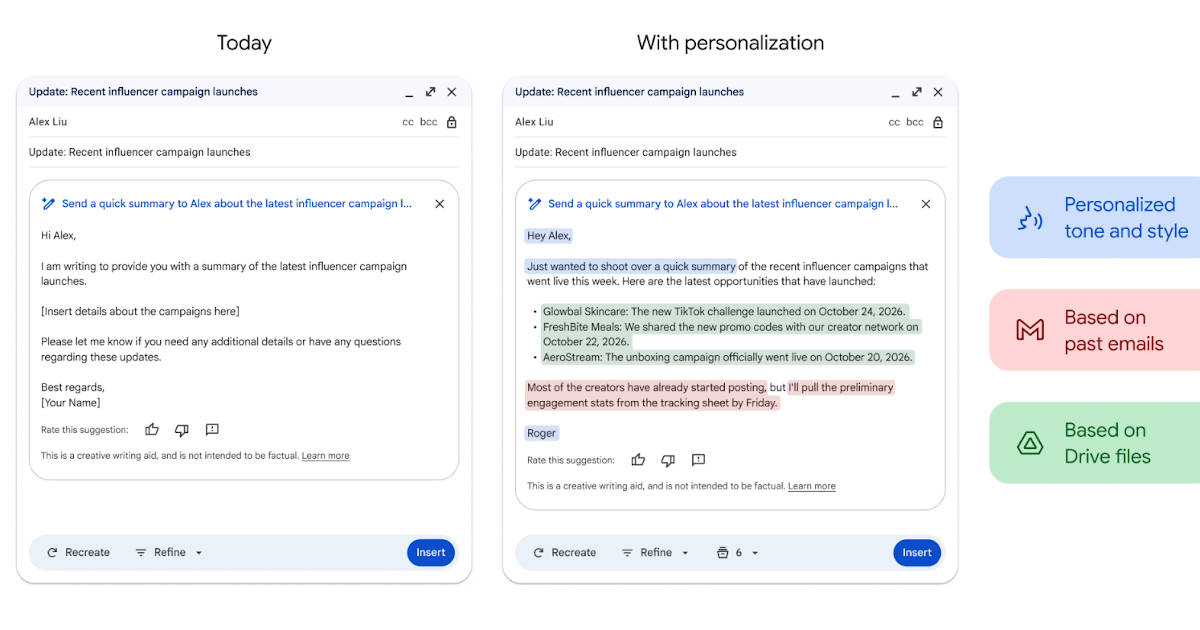
Google’s Gmail team has been making Help Me Write more embedded and more personal. In a May 7 Workspace Updates post, Google said the rollout began May 5 and that Gmail can now pull context from Google Drive and Gmail, while also using prior writing to match a user’s tone and style. Google’s January 8 Gmail post had already positioned Help Me Write, Suggested Replies, and Proofread as part of the product’s “Gemini era,” per Google’s blog.
What is solid here is the product direction, not a verified churn story. Google says these features are meant to reduce app switching and save time, and in an April 7 privacy post it said it does not train foundational models, including Gemini, on personal emails. What I did not find is evidence from Google, Reuters, Bloomberg, The Verge, or Ars Technica showing users are leaving Gmail because of the prompts. The backlash exists as anecdote; the rollout is the documented fact.
Source: workspaceupdates.googleblog.com
Microsoft coding push leaves little room over Qwen

Microsoft is clearly investing in in-house coding and agentic models, but the exact benchmark claim driving this discussion is not fully verifiable from the source set here. The Hacker News thread points to a Microsoft MAI-Code-1-Flash model card and claims MAI-Code-1-Flash at 137B parameters with 5B active scored 51% on SWE-bench Pro, versus 49.5% for Qwen3.6-35B-A3B. I could not confirm that comparison from a stable primary Microsoft page in the materials reviewed.
What is supported is the broader competitive picture. Microsoft’s Copilot page says the product is powered by models from GitHub, OpenAI, and Microsoft, according to Azure’s official product page, while Microsoft Research has separately emphasized smaller-model agentic experiences, including Fara1.5 based on Qwen 3.5. On the other side, Qwen’s official blog is pushing Qwen3-Coder as an open coding model with a 480B-parameter MoE and 35B active parameters. The clean takeaway is narrower than the pitch: Microsoft is pushing harder on coding models, and open competitors like Qwen are close enough that efficiency is now part of the story.
The common thread was not bigger models. It was who gets to inspect, constrain, or operationalize them first.
Sources
- White House wants 30-day access to frontier AI, whitehouse.gov
- AI PCB startup sent Adafruit a legal threat, blog.adafruit.com
- Microsoft wants AI behavior tests written in plain English, techcrunch.com
- Gmail’s AI writing prompts are pushing users out, workspaceupdates.googleblog.com
- Microsoft’s 137B coding model barely beats Qwen, azure.microsoft.com
Related reading
- DeepSeek Tests Open Model Economics; Foreign Coauthors (2026-05-23)
- Daraxonrasib Resets Pancreatic Cancer Math; SoftBank Bets Big on French Compute; Palo Alto Bug Hits Live Networks (2026-06-01)