
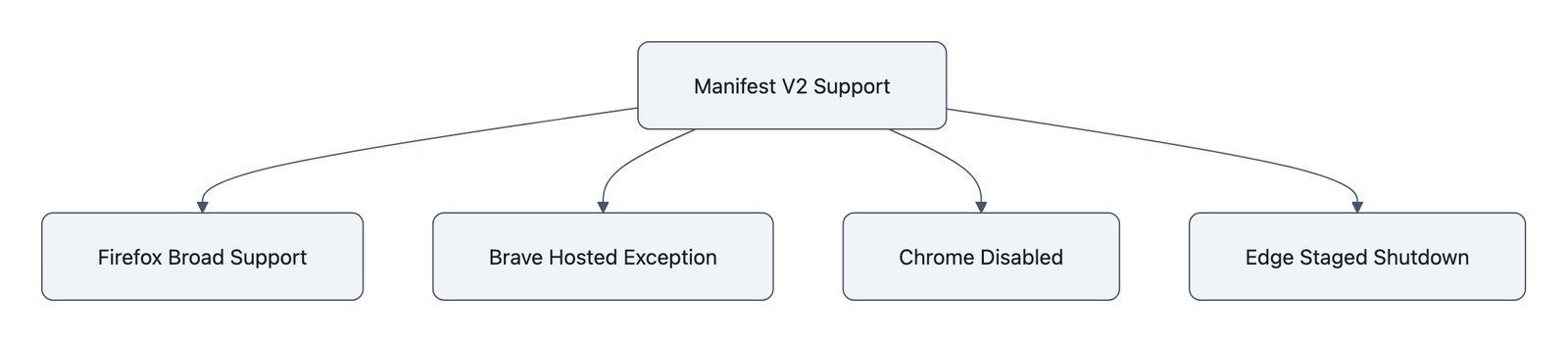
Firefox is not the only major browser where users can still run full uBlock Origin. Firefox retains broad, ordinary Manifest V2 support for the extension, while Brave separately hosts its own Manifest V2 build of uBlock Origin as a curated exception.
That distinction became sharper after Microsoft began Edge’s staged Manifest V2 transition on August 7, 2026. Edge has started warning users and will gradually disable old extensions through the end of 2026; enterprise deprecation is planned for early 2027.
Firefox publicly reaffirmed its position on August 10. As reported by PCWorld, Firefox said:
“Our support for uBlock Origin isn’t going anywhere.”
, Firefox, August 10, 2026
That makes Firefox the clearest mainstream home for the full blocker: users install it normally, rather than relying on a browser-specific carve-out. But calling it the sole major-browser option leaves out Brave.
The split comes down to extension architecture. Manifest V2 is the older extension format that gave blockers broad control over web requests. Manifest V3 is its successor, promoted by browser makers as a more secure and performant foundation, but it has pushed content blockers toward more constrained designs.
The full uBlock Origin project blocks ads, trackers, popups, malware sites, coin miners, and anti-blocker scripts, with extra filter lists, host-file support, and custom filtering rules. Its own documentation says that uBlock Origin works best on Firefox. The Manifest V3 alternative, uBlock Origin Lite, remains available on Chromium browsers but has fewer features and less successful ad blocking, PCWorld noted.
Brave’s hosted uBlock Origin exception
Brave has kept a narrow escape hatch. Since version 1.81, Brave has hosted four Manifest V2 extensions on its own backend: uBlock Origin, AdGuard, NoScript, and uMatrix. They are separate from Chrome Web Store versions, and users must enable them through brave://settings/extensions/v2.
| Browser | Full Manifest V2 uBlock Origin status |
|---|---|
| Firefox | Broad, normal extension support |
| Brave | Brave-hosted exception, enabled separately |
| Chrome | Disabled for Chrome 139+ users |
| Microsoft Edge | Staged shutdown began in August 2026 |
Brave’s system is not normal compatibility preserved indefinitely. The company describes it as limited, best-effort support, contingent on continued cooperation from each extension’s authors. It covers only those four curated extensions, not arbitrary old Manifest V2 add-ons.
Brave also argues that its built-in Shields protection does not depend on either Manifest V2 or Manifest V3 because it is patched directly into the Chromium codebase. Shields block ads and trackers without an extension, Brave says, but the available sources do not provide an independent, current measurement comparing Shields, uBlock Origin Lite, and full uBlock Origin for blocking coverage, tracker protection, or site breakage.
Chrome’s cutoff is already further along. Google says Manifest V2 was disabled for all Chrome 139-and-newer users on July 24, 2025. Its remaining Manifest V2 listings are due to leave the Chrome Web Store on August 31, 2026, the same removal date listed on uBlock Origin’s project page.
Microsoft is catching up, but its rollout is not complete. The Microsoft Edge team says 95% of the top Manifest V2 extensions in Edge Add-ons have moved to Manifest V3. It identified 58 MV2 extensions with meaningful use and said only three lack a publicly available MV3 counterpart.
Microsoft’s claim that most extensions moved without lost customer functionality is Microsoft’s own assessment. It does not establish feature parity for uBlock Origin, whose value is precisely in functions that its Lite version does not fully reproduce.
For now, Edge users may still have time before their installed extension is switched off: notices began with a subset of users in August, first in Canary, Dev, and Beta channels, then gradually in Stable. Firefox users do not need that timetable; Brave users need a special settings page. That is the practical difference between a browser that still supports Manifest V2 and one that has preserved four artifacts from it.
Key Takeaways
- Firefox remains the only major browser with broad, ordinary Manifest V2 extension compatibility.
- Brave still distributes a Brave-hosted Manifest V2 version of full uBlock Origin as a limited exception.
- Brave’s exception covers uBlock Origin, AdGuard, NoScript, and uMatrix, enabled through a separate settings page.
- Microsoft Edge began its staged Manifest V2 shutdown in August 2026 and targets consumer completion by the end of 2026.
- Chrome disabled Manifest V2 for Chrome 139-and-newer users in July 2025.
Further Reading
- Firefox is now the last major browser that still supports uBlock Origin, PCWorld’s account of Firefox’s public support statement and Edge’s migration.
- What Manifest V3 means for Brave Shields and the use of extensions in the Brave browser, Brave’s policy on Shields and its hosted Manifest V2 extensions.
- Moving the Microsoft Edge extensions ecosystem forward with Manifest Version 3, Microsoft’s staged Edge transition plan.
- Manifest V2 support timeline, Google’s Chrome Manifest V2 retirement schedule.
- uBlock Origin, The project’s documentation and installation guidance.