

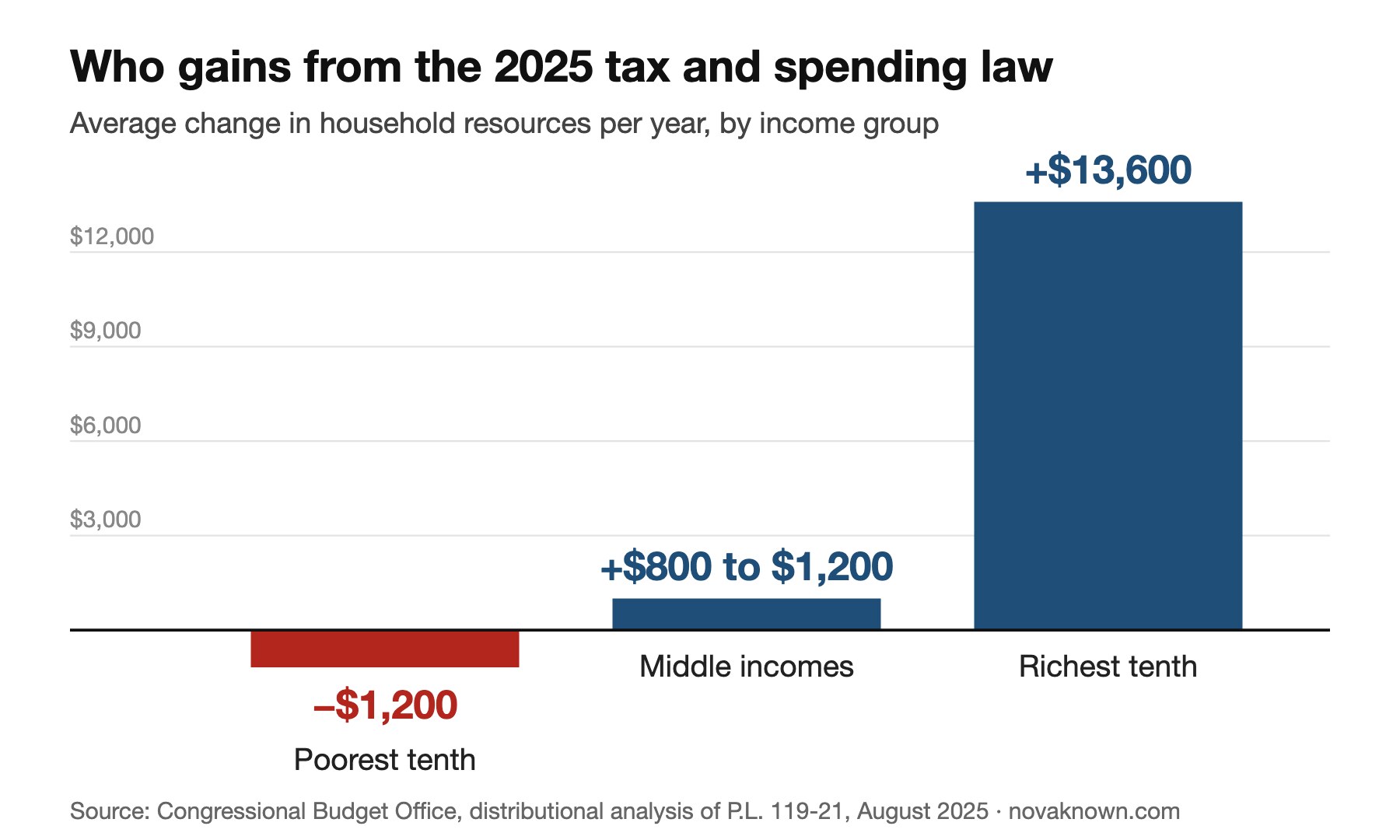
Donald Trump made immigration his most-advertised issue in 2024. In office he signed a law that gives America’s richest tenth of households $13,600 a year and takes about $1,200 a year from the poorest tenth, according to the Congressional Budget Office. Parties running the same campaign in Britain, Germany and Australia show the same pattern in their money. Reform UK’s biggest donor has given £22.7m. The AfD’s tax plan is worth €40,572 a year to each German in the top 1%. One Nation took an A$1.5m jet from a Gina Rinehart company.
The campaigns tell voters that migrants are the reason life got harder. The budgets and the donor registers show who benefits from that message.
The pressure people feel is real, and so were the record years. In Britain, net migration (arrivals minus departures) reached about 906,000 in the year to June 2023. Concern rose along with it. Politicians connect migration to the strain people feel at home: in New Zealand, NZ First leader Winston Peters blames migrants for pressure on housing and jobs. The useful test is what happened to that concern once the numbers turned.
Britain thought migration was rising while it fell by three-quarters
By the ONS’s count, net migration fell to about 204,000 in the year to June 2025. For calendar 2025 it was 171,000, a level last seen in early 2021. Work arrivals from outside the EU fell 47%.
Worry went the other way. In September 2025, 51% of Britons named immigration as a top issue. That was the highest level since October 2015 and double the figure two years earlier. It came more than two years after the fall began. Among Reform UK supporters the figure was 86%.
Net migration fell from about 906,000 to 171,000, and concern about it doubled.
Most people believed the opposite of what was happening. A British Future and Ipsos survey of 3,003 people in June and July 2025 found that 56% thought immigration had gone up over the previous year, when net migration had more than halved. Only 16% expected it to fall over the next year. 38% expected it to rise.
One route did grow. Small-boat arrivals rose 13% in 2025, to 41,472, up from 36,816. People in the same British Future survey also guessed that asylum makes up 33% of immigration. The real share is about 14%. So the smallest part of the system was growing, while total migration was falling, and the public believed that small part was more than twice its actual size.

Net migration fell from about 906,000 to 171,000, and concern about it doubled.
Concern has eased since the peak, to 42% in August 2026. Immigration is still the issue Britons name most often, with net migration at 171,000.
Britain is typical in overestimating. Across ten countries in 2023, people guessed immigrants were 24% of the population when the real figure was 12%. They guessed the Muslim share at 17%. The real share was 3%.
Research shows media coverage moves those beliefs, and moves votes too:
- Before Switzerland’s 2009 referendum banning minarets, papers over-reported crimes by immigrants. That coverage added about 5 points to the Yes vote.
- When the Associated Press stopped using “illegal immigrant”, readers of papers that ran its copy grew less supportive of restrictive policy.
- In 2014-15, the Daily Mail framed migrants as a threat to welfare or health in 42% of its migration stories, and The Sun in 26%, against an EU average of 9%.
- During the 2016 EU referendum campaign, 89% of 99 immigration front pages were negative, and more than half came from the Express, Mail and Sun.
Migrants and prison in four countries
The claim that migrants bring crime is old. In 1891, Senator Henry Cabot Lodge argued for closing the US border, warning that Italian immigrants were:
“members of the Mafia, a secret society… using murder as a means of maintaining its discipline.”
Over the next 150 years, congressional speeches about immigration mentioned crime twice as often as speeches on other topics. Here is what each country’s own records show today.
| Country | Migrants compared with locals |
|---|---|
| Australia | About a third as likely to be in prison. 31.5% of the population, 14% of prisoners (ABS, June 2024) |
| United States | 60% less likely to be locked up, in every decade for 150 years (NBER, 2023) |
| United Kingdom | Less likely to be in prison, and less likely again once age is taken into account. 13.5% of adults, 12.1% of prisoners (June 2025) |
| Germany | More migrants did not bring more crime. Districts where the foreign share rose saw no rise in crime, including homicide and sexual assault (ifo, 2025) |
New Zealand publishes no prison figures by country of birth.
The overall gap holds among immigrants who are citizens and among those resident for ten years or more.
In the UK, non-citizens are under-represented by even more once their younger age is taken into account, and the count includes tourists who are not in the comparison population.
America then ran the test. The administration deported 320,000 people in fiscal 2025, while CBP enforcement actions at the border fell 83% to 391,000. The campaign had promised to go after criminals. The share of ICE arrestees with a prior criminal conviction fell from 66% to 38%.
That fall is not just a bigger total diluting the share. USAFacts counts 365,500 ICE book-ins in 2025, up 29.7% on 2024. Applying its percentages to those totals:
- People booked in with a conviction fell from about 186,000 to about 139,000.
- People with no conviction rose from about 96,000 to about 227,000.
ICE arrested more people overall, and fewer of the criminals it had promised to target.
$13,600 a year for the top tenth: who the fear pays
United States. Trump’s campaign ran 237,400 immigration ad airings against Harris’s 29,225. Then came the 2025 law:
- The top tenth gains $13,600 a year.
- Middle-income households gain $800 to $1,200.
- The bottom tenth loses 3.1% of its resources.
- Medicaid and SNAP cuts take about $900bn from households.
- The Medicaid cuts leave about 10 million more people uninsured by 2034.
On top of the law, tariffs cost the poorest households about three times as much as the richest, as a share of income.
The donors did well too. The SEC sued Coinbase in June 2023. The inaugural fund then raised a record $239m, with Ripple giving about $4.9m and Coinbase, Kraken and Circle $1m each. On 27 February 2025, about five weeks after the inauguration, the SEC moved to dismiss the Coinbase case with prejudice, meaning it can never be brought again. The SEC’s explanation was that dismissal would “facilitate the Commission’s ongoing efforts to reform and renew its regulatory approach to the crypto industry.”
United Kingdom. For 14 years the Conservatives promised to cut net migration to the tens of thousands. Under their own post-Brexit system, it reached about 906,000.
Their tax and benefit changes from 2010 to 2024 cost the poorest tenth about £2,000 a year, over 15% of their income. Households with children lost £2,200 a year in benefits on average. The richest tenth also lost, slightly more in pounds but about 1.7% of their income. So the bottom paid the most as a share of what it had. The clearest gift to the top came from Liz Truss: her 2022 mini-budget sent 45% of its gains to the richest 5%, according to Resolution Foundation analysis reported by City AM.
Reform UK now carries the immigration banner, and the big money followed it. Christopher Harborne has given £22.7m of the £36.1m Reform has declared since 2019, by The Nerve’s count. Of that, £15m came after the 2024 election. Before Reform, Harborne gave more than £1.5m to the Conservatives and £1m to Boris Johnson. The money moved to whichever party was carrying the issue.
Harborne is believed to hold about 13% of Tether, the stablecoin company. BitMEX co-founder Ben Delo gave Reform £4m in April, 75% of everything it raised that quarter, according to Electoral Commission records. That brings Delo to £8m this year. Delo pleaded guilty to US anti-money-laundering violations in 2022, and Trump pardoned him in 2025. Britain banned crypto donations in March.
The scale is new. In 2025, Reform took about £22.9m in donations, against £15m for the Conservatives and £6.5m for Labour. That included a single £9m gift from Harborne. The Standards Commissioner is separately weighing whether Nigel Farage should have declared a £5m personal gift from Harborne.
Farage, responding to a separate Channel 4 sting over polling money, said Reform had “taken no illegal money.” For the big gifts, that is true. British law lets one man supply most of a party’s declared donations.
What Reform proposes points the same way as its donors. It wants to cut inheritance tax, where about half the gains would go to the richest 1% of estates, according to IFS analysis as reported in the press.
Germany. The DIW economic institute, in an analysis by Stefan Bach, found the AfD’s tax plan is worth €40,572 a year to each person in the top 1%, against €1,069 for each person in the bottom half. The plan abolishes inheritance tax and carbon pricing. It also opposes reviving the wealth tax, which Germany has not levied since 1997.
The bottom half’s gain is 5.1% of their income, against 8% for the top 1%.
The catch is the cost: €181.2bn a year, still €136.5bn after DIW counts growth effects. DIW says that drives up deficits. Someone has to pay for that through borrowing or cuts. The AfD won 38% of workers and 34% of the unemployed in 2025, so its own base would carry much of that cost.
Its donors have arrived. AfD big-donor money went from about €500,000 over 2020-24 to over €5m in 2025, 95% of it from three donors. The largest gift was a suspected straw-man donation that Austrian authorities traced to billionaire Henning Conle. The Bundestag administration confiscated it, and the AfD is contesting the decision.
The watchdog LobbyControl reads the surge as wealthy people and companies positioning themselves for the AfD to enter state governments. Taxpayers top it up. Germany’s party funding rules mean the state cannot pay a party more than it raises privately. Because of that limit, the AfD missed out on over €45m in state funding since 2015. Under those rules, every private euro it now raises brings in a matching euro of public money.
Australia. In May 2026, a Rinehart company gave One Nation a Cirrus G7 jet worth A$1.5m, Reuters reported. Hancock executives Adam Giles and Ian Plimer gave A$500,000 each, five times the previous record single donation. Stockbroker Angus Aitken gave A$1.1m and described the trend himself:
“The biggest change…is the groundswell of business and wealthy people supporting One Nation.”
One Nation advertises a cap of 130,000 migrants a year. Its own MP, David Farley, puts it differently: “130,000 plus a minimum of 100,000 on rotating programs”. The exempt programmes cover:
- about 40,000 Pacific farm and meat workers
- 68,000 to 70,000 aged-care nurses
- tradespeople and backpackers
That puts the real figure at 230,000 or more, above Labor’s forecast of 225,000. The headline number for voters leaves out at least 100,000 people brought in for employers.

Its parliamentary record leans the same way. One Nation voted to restore the construction-industry watchdog unions had fought in November 2016. In 2018 it backed an income tax package that sent about 72% of its benefit to the top 20%. That same year it blocked the big-company tax cut.
New Zealand runs the sequence in reverse: the money came first, and the fear is being switched on now. The coalition restored landlords’ mortgage-interest deductions at a cost of $2.9b over four years, more than $800m over National’s own budget, while ministries faced cuts.
Donors linked to fast-track projects have given over $1m since 2022. That includes about $400,000 to National and NZ First in 2025, against $8,620 to Labour. Seven of the 23 approved projects are donor-linked. Researcher Max Rashbrooke called it “very troubling in terms of the public’s confidence in politics.”
In September 2026, Peters promised NZ First would “substantially reduce non-essential immigration”. There is little to reduce. Net migration was 20,500 in the year to August 2026. A net gain of 58,752 citizens of other countries was largely offset by 38,249 New Zealanders leaving.
Voters were not asking for the pledge. In February 2026, only 8% of New Zealanders put immigration in their top three concerns, which ranked it 11th. 53% said immigration makes the country stronger, and 43% said the numbers were about right.
The pitch also reaches some migrants. Trump won 47% of naturalised citizens and 48% of Hispanic voters. In Germany, the AfD leads among Polish-origin voters at 33%, while Russian-origin voters back the SPD at 43% against 14% for the AfD.
One Nation polls 24% overall, 36% among South African-born and 30% among Italian-born voters. Its support among Australian-born voters (25%) is higher than among UK-born (23%), and it falls to 9% among Asian-born, 8% among Indian-born and 5% among Chinese-born voters. The support is concentrated among European and South African migrants, not migrants generally.
Across the five countries, the pattern is consistent. The fear runs ahead of the numbers. Migrants turn out to be less likely to be in prison than the people being told to fear them. The tax plans and donor registers point the same way: up. The worry is real, but the cause it is pinned on is not, and the people who profit from that gap fund the campaigns that keep it open.
The same arrangement is now running everywhere:
- In the US, the poorest tenth is losing about $1,200 a year under a law already in force.
- In Britain, Reform out-raises every other party on one donor’s £22.7m.
- In Germany, the AfD’s new donor money is matched by the state.
- In Australia, One Nation polls 24% with a cap that exempts at least 100,000 people.
New Zealand votes on 7 November. Voters there ranked immigration 11th among their worries. NZ First, one of the two parties that took about $400,000 from fast-track-linked donors last year, is the one now asking them to worry about migrants.
Further Reading
- Law-Abiding Immigrants: The Incarceration Gap Between Immigrants and the US-born, 1870-2020, Abramitzky et al., NBER working paper on 150 years of incarceration data.
- Ipsos: Public concern about immigration reaches highest level in a decade, the September 2025 peak of 51%.
- Ipsos: Immigration remains Britain’s biggest issue, 2026 Issues Index data showing concern easing to 42%.
- British Future: Immigration falling but public still thinks it is going up, Ipsos tracker on what Britons believe about migration trends.
- ONS: Long-term international migration, provisional, year ending December 2025, official UK net migration figures.
- Home Office: How many people come to the UK via illegal entry routes, small-boat arrivals in 2025.
- Full Fact: The net migration target was never likely to have been met, the Conservatives’ “tens of thousands” pledge.
- InPublishing: Brexit and discrimination in the UK press, immigration front pages in the 2016 referendum campaign.
- Migration Observatory: Migrants, convictions and the prison population, UK prisoner nationality data and its limits.
- ifo Institute: More foreigners do not increase Germany’s crime rate, district-level police data, 2018-23.
- ABS: Prisoners in Australia, 2024, prisoner counts by country of birth.
- USAFacts: Immigration enforcement data brief for Congress, deportations, border actions and arrestee records.
- Fox Business: Harris campaign, allies spent more than $1.4B on political ads in losing race against Trump, AdImpact airing counts by issue.
- CBO: Distributional Effects of Public Law 119-21, the budget office’s analysis by household decile.
- Thomson Reuters: CBO analyzes distributional effects of budget act, summary of CBO’s findings, including Medicaid and SNAP cuts.
- KFF: Allocating CBO’s estimates of federal Medicaid spending reductions across the states, what the Medicaid cuts mean for coverage.
- Yale Budget Lab: Combined distributional effects of the One Big Beautiful Bill Act and tariffs, the law and tariffs together.
- Sherwood: Ripple tops crypto company donations to Trump’s inauguration, the record inaugural fund.
- The Block: Coinbase case officially dropped by SEC, the February 2025 dismissal.
- IFS: The distributional impact of tax and benefit reforms since 2010, who lost under Conservative governments.
- IFS: Families with children hit hardest by tax and benefit changes since 2010, losses for households with children.
- Public Finance: report on the IFS analysis of reforms since 2010, losses by income group as a share of income.
- The Nerve: analysis of Reform UK’s funding and former Conservative donors, Harborne and Reform’s other major backers.
- Decrypt: BitMEX Co-Founder Ben Delo Gives Farage’s Reform UK Another £4 Million, Electoral Commission records and the crypto donation ban.
- UnHerd: Tory donations fall to lowest level since, 2025 donation totals by party.
- DeSmog: Tethered-How the White House is helping Reform’s finances, Harborne’s reported Tether stake.
- DIW aktuell 106: Steuerreformvorschläge der Parteien, Stefan Bach’s analysis of the German parties’ tax plans.
- LobbyControl: Parteispenden 2025-AfD-Großspenden explodieren, large donations to German parties, 2024-25, and the AfD’s state funding.
- Analysis of the 2025 Bundestag election (Infratest dimap data), vote shares by occupation.
- Konrad-Adenauer-Stiftung: Wahlverhalten von Menschen mit Migrationshintergrund, voting by migration background in Germany.
- Reuters via Arab News: report on wealthy donors switching to One Nation, the Rinehart jet and record donations.
- NE Times: One Nation’s real migration plans revealed to be bigger than Labor’s, the cap and its carve-outs.
- The Conversation: Turnbull government secures ABCC but suffers sudden defeat on backpacker tax, the 2016 ABCC vote.
- The New Daily: report on One Nation and the 2018 tax cuts, One Nation’s 2018 tax votes.
- Roy Morgan: Voting intentions by country of birth, September 2026, One Nation support by birthplace.
- Cardiff University: British media coverage of migrant crisis amongst the most aggressive in EU, the 2014-15 coverage study.
- Couttenier, Hatte, Thoenig & Vlachos: research paper on media coverage of immigrant crime and the Swiss minaret vote, how crime coverage moved a referendum.
- Djourelova, American Economic Review (2023): Persuasion through slanted language, the AP’s “illegal immigrant” change.
- Alesina, Miano & Stantcheva: Immigration and Redistribution, how far people overestimate immigrant numbers.
- Ipsos: Perils of Perception 2023, ten-country survey of guessed and real population shares.
- RNZ via ODT: Political donations linked to fast-track applications revealed, donor-linked fast-track projects.
- 1News: Cuts to public services as landlords await $2.9b tax break, the interest deductibility cost.
- interest.co.nz: Winston Peters on reducing non-essential immigration, NZ First’s immigration pledge.
- interest.co.nz: Net population gain from migration in the August year, Stats NZ migration figures to August 2026.
- National Tribune: Stats NZ international migration release, 14 October, arrivals and departures by citizenship.
- The Spinoff: Our politicians are really fired up on immigration-but what about voters?, what New Zealanders actually worry about.
- Pew Research: Behind Trump’s 2024 victory, naturalised citizens’ and Hispanic votes.
- Electoral Commission NZ: 2026 general election, election date and details.