
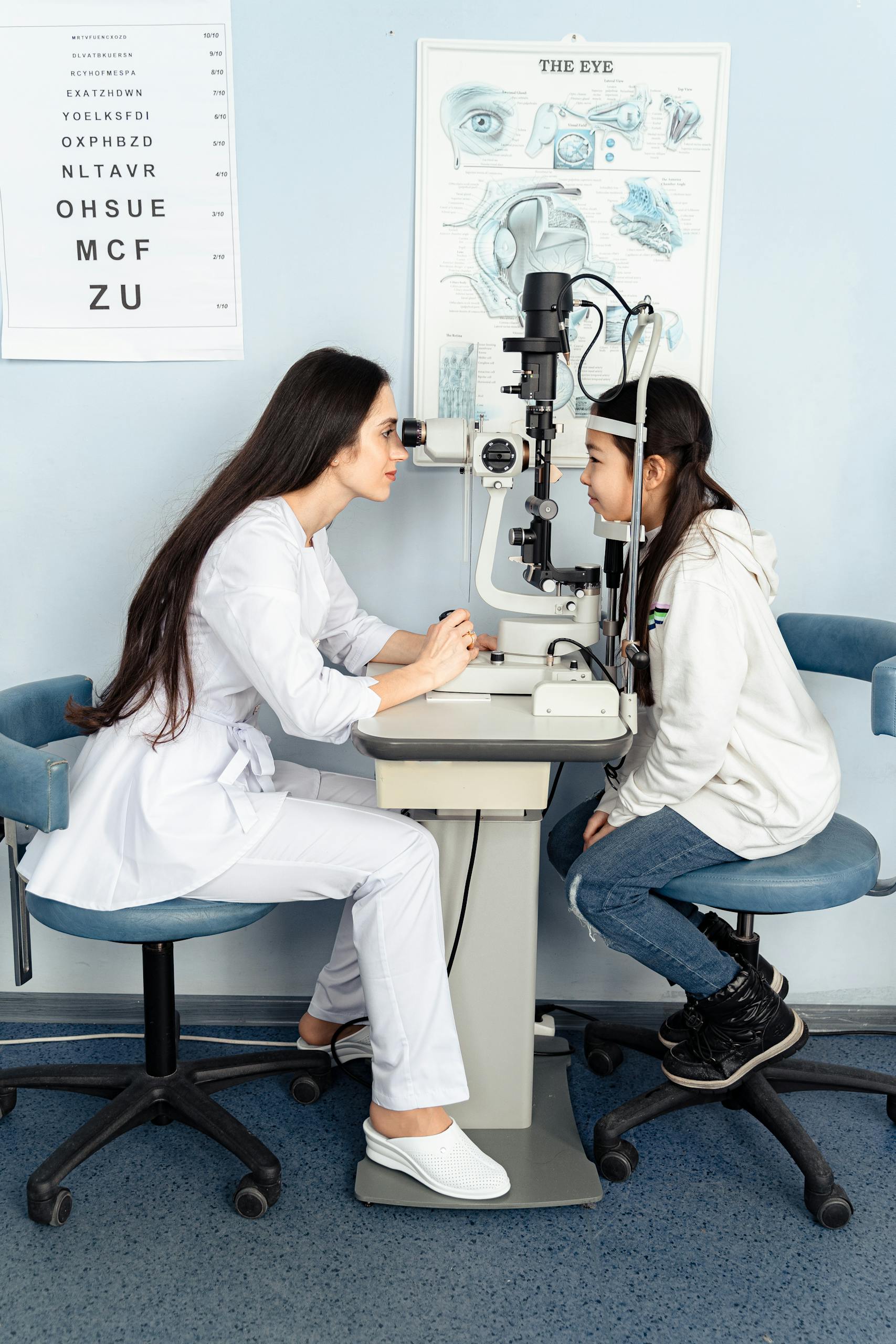
Optometrists determine your glasses prescription by measuring how your eye focuses light and then balancing that error with lenses until the image is sharply focused on the retina. They begin with an objective measurement using an autorefractor or retinoscopy, then fine tune it with a phoropter while you compare lenses (“Which is clearer, 1 or 2?”). Little math is needed during the exam; the optics are standardized and expressed in diopters, and most calculations are handled by the instruments and lens lab.
What is a glasses prescription?
A glasses prescription describes how much optical power is needed to move the focus of incoming light onto your retina. Power is measured in diopters (D). Nearsightedness (myopia) uses negative numbers, farsightedness (hyperopia) uses positive numbers, and astigmatism adds a direction-specific correction.
Diopter: a unit of lens power equal to 1 divided by focal length in meters (for example, a −2.00 D lens has a focal length of −0.5 m).
Typical fields include:
- Sphere (SPH): overall power for myopia or hyperopia.
- Cylinder (CYL): additional power to correct astigmatism.
- Axis: the orientation (0–180 degrees) of astigmatism correction.
- ADD: extra magnifying power for near work in bifocals/progressives (presbyopia).
- Prism (if present): alignment correction for eye teaming.
For background on refractive errors, see the U.S. National Eye Institute’s overview of refractive errors.
How do optometrists measure a prescription?
The process blends objective measurements with your subjective responses:
- Autorefraction (objective): a pretest device estimates your refraction without feedback. It is fast and provides a starting point.
- Retinoscopy (objective): the clinician shines a moving light and watches the reflex from your retina, adding lenses until the reflex is neutralized, which indicates focus on the retina.
- Subjective refraction (phoropter): you compare lenses to refine sphere, cylinder, and axis, often using a Jackson cross-cylinder to dial in astigmatism. The doctor may perform binocular balance to keep both eyes relaxed and aligned.
- Near add (if needed): for presbyopia, near power is measured to set the ADD.
Retinoscopy remains a gold-standard starting point, especially when autorefractor readings are unreliable or the patient cannot give consistent responses. See AAO’s EyeWiki overview of retinoscopy.
How does an autorefractor work?
An autorefractor sends infrared light into the eye and analyzes the returning reflection pattern while it changes focus to find when the retinal image is sharp. Measurements are taken in multiple meridians to estimate sphere, cylinder, and axis, providing an objective refraction that clinicians then refine subjectively. See autorefractor for technical details.
Autorefractors provide a fast, objective starting point, but studies show they can overestimate myopia if accommodation is active; clinicians may rely on retinoscopy or use cycloplegia in children to relax focusing for accuracy.
Because accommodation (the eye’s focusing effort) can mask hyperopia or induce extra minus power, doctors may use strategies to relax it: dim targets, fogging lenses, or cycloplegic drops in pediatric exams.
Why do they ask “Which is better, 1 or 2?”
This is subjective refraction. Your responses optimize clarity under real viewing conditions and fine tune the axis and strength of astigmatism correction. The lenses are flipped quickly to discourage you from accommodating and to capture your relaxed, consistent preference. If two choices look the same, it is helpful to say so; equality is useful information.
The underlying optics are grounded in Snell’s law and thin-lens formulas, but the clinical method is procedural, not a math quiz. The phoropter and software handle the arithmetic, and the final result is recorded in standardized format. For a plain-language guide, see AAO’s How to Read Your Eyeglass Prescription.
Is there a lot of math involved?
During the exam, very little. Behind the scenes, optics math ensures the lenses you receive match the prescription and fit your frames and face. Examples include:
- Transposition: converting between plus- and minus-cylinder notation.
- Prism and decentration: aligning optical centers to your pupils to avoid unwanted prism.
<liVertex distance compensation: adjusting power when high prescriptions (about ±4.00 D or greater) move from the phoropter to glasses or contact lenses.
Clinicians and labs use established formulas and standards; patients do not need to calculate any of this.
What about pupillary distance and lens fitting?
Pupillary distance (PD) is the distance between your pupils. Opticians use it to center lenses so you look through the correct point, minimizing distortion and unwanted prism. Incorrect PD can make glasses feel “off,” especially with higher powers or progressives. A trained measurement is best, though calibrated apps can be acceptable for simple single-vision orders. See the Cleveland Clinic’s explainer on pupillary distance.
Limitations and special cases
- Children and accommodative patients: cycloplegic drops may be used to relax focus for accurate readings.
- Ocular surface or media issues: dry eye, cataract, or irregular corneas (for example, keratoconus) can reduce reliability of autorefractors and make subjective choices harder; retinoscopy is especially valuable here.
- Contacts vs glasses: contact lens powers may differ from glasses at higher prescriptions due to vertex distance and lens position on the eye.
Bottom line: your prescription is found by objectively locating where your eye wants to focus light, then subjectively fine tuning so the final correction matches how you see best.