
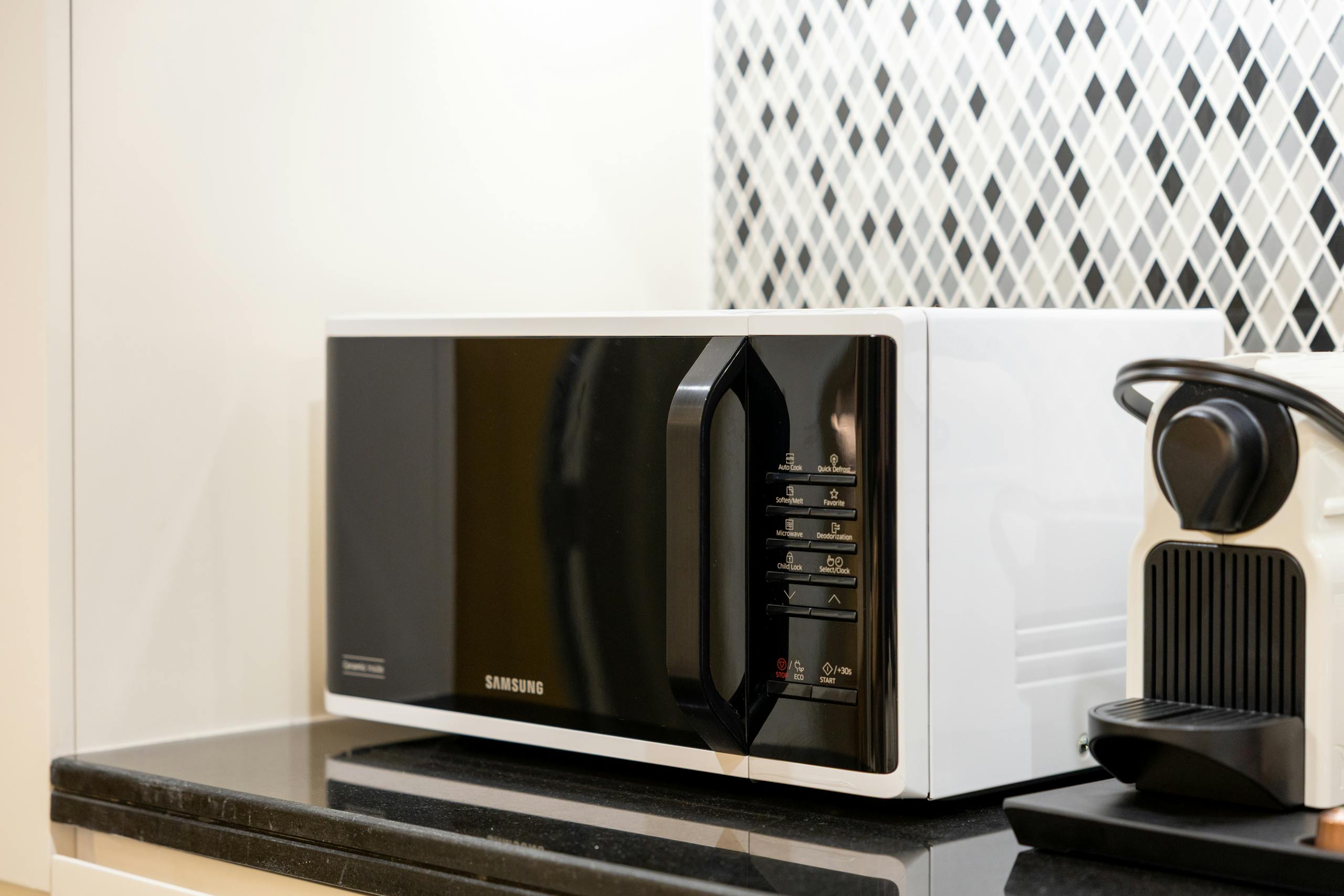
No. A microwave oven at Australia’s Parkes Observatory produced look‑alike signals called perytons when its door was opened mid cycle, but it did not cause fast radio bursts. Fast radio bursts are genuine astrophysical events discovered in 2007 and now detected by the hundreds across multiple telescopes, with strong evidence linking at least some of them to magnetars, highly magnetized neutron stars.
What happened at the Parkes radio telescope?
Between the late 1990s and early 2010s, the Parkes 64‑meter dish occasionally recorded millisecond radio bursts that looked unusual. In 2015, researchers traced these particular events, called perytons, to a staff microwave oven. When the oven door was opened before the timer finished, the magnetron shutting down emitted a brief sweep of radio noise that the telescope picked up around 1.4 GHz (Petroff et al., 2015).
Perytons appeared in all 13 beams of the Parkes multibeam receiver, clustered around daytime hours, and were reproducible by opening the staff microwave door early, all pointing to a local, man‑made source (MNRAS study).
This episode did not take 17 years of dedicated sleuthing. Rather, the 2015 study examined years of archival detections to understand the pattern, then ran controlled tests that pinpointed the cause. In parallel, Parkes and other facilities were advancing real‑time searches for genuine fast radio bursts, including the first live detection reported in 2015 (Royal Astronomical Society press release).
What are perytons in radio astronomy?
Perytons are short, broadband radio transients originating on Earth that can superficially resemble astronomical bursts. They are not astrophysical. At Parkes they were produced by a microwave oven’s magnetron as power was cut with the door opened prematurely.
The shutdown transient from the magnetron created a chirped radio signal near 1.1–1.5 GHz, overlapping the L‑band used for pulsar and FRB searches, which explains why a sensitive telescope could see it (Petroff et al., 2015).
Are fast radio bursts real, and how do we know?
Yes. Fast radio bursts (FRBs) are millisecond radio flashes with dispersion signatures indicating travel through distant, ionized plasma. The first was identified at Parkes in 2007 from 2001 archival data, and since then thousands have been found worldwide (FRB overview).
- Extragalactic distances: Several FRBs have been precisely localized to host galaxies using interferometers, proving a cosmic origin (Nature 2017 localization).
- Large sample sizes: The CHIME telescope alone reported over 500 FRBs in its first catalog, including many repeaters (CHIME/FRB Catalog).
- Physical origin: In April 2020, a magnetar in our own Galaxy, SGR 1935+2154, produced an FRB‑like radio burst, strongly supporting magnetars as one source class (Nature 2020).
A typical FRB can release in a millisecond as much energy as the Sun emits in about three days, yet arrives at Earth far weaker than a cell phone would appear from the Moon (FRB overview).
What is the difference between perytons and fast radio bursts?
- Origin: Perytons are terrestrial interference, for example microwave ovens. FRBs are astrophysical, often billions of light‑years away.
- Beam pattern: Perytons hit all beams of a multibeam receiver at once, signaling a near‑field source. FRBs usually appear in a single beam or a subset consistent with a sky location.
- Timing and context: Perytons clustered around local daytime and mealtimes at Parkes. FRBs occur at all hours and are seen by many observatories worldwide.
- Dispersion and localization: FRBs show dispersion measures and sky localizations consistent with extragalactic hosts. Perytons do not localize on the sky and fail interferometric distance checks.
- Reproducibility: Perytons could be triggered on demand by opening the microwave early. FRBs cannot be reproduced by lab hardware, though some sources repeat unpredictably in space.
Why does this matter for radio astronomy?
Radio telescopes are exquisitely sensitive, so even small on‑site emissions can masquerade as celestial signals. The Parkes peryton story is a case study in radio‑frequency interference control and in scientific validation: researchers used instrument diagnostics, multi‑beam behavior, time‑of‑day statistics, and controlled experiments to eliminate a terrestrial culprit, while independent evidence confirmed that FRBs are astrophysical.
Modern observatories enforce strict RFI policies, such as shielding, hard‑wired networking, continuous spectrum monitoring, and bans on consumer electronics near antennas, to protect faint signals from the cosmos.