
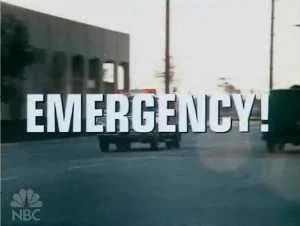
Yes. The Emergency! TV show did not invent paramedics, but it powerfully accelerated the growth of modern EMS in the United States by popularizing advanced prehospital care, legitimizing paramedics to the public and hospitals, and helping win political and budget support in the 1970s. The series was produced with the Los Angeles County Fire Department and physicians, so it depicted real techniques and communication protocols that communities then sought to emulate.
What is the Emergency! TV show?
Emergency! was a prime-time NBC drama that aired from 1972 to 1977, following firefighter-paramedics Johnny Gage and Roy DeSoto of L.A. County’s Squad 51 and their receiving hospital, the fictional Rampart General. Created by Robert Cinader with producer Jack Webb, the show partnered with the LA County Fire Department and Harbor General Hospital, now Harbor-UCLA Medical Center, to base storylines and procedures on real calls and protocols. The production showcased field defibrillation, IV therapy, drug administration, telemetry, and physician-directed care via radio, which were new to most viewers.
How did the Emergency! TV show influence EMS?
The show became a weekly public demonstration of what paramedics could do, at a time when few U.S. cities had them. Its influence worked in several concrete ways:
- Public awareness and demand: Viewers saw cardiac arrests, trauma, and pediatric emergencies managed on scene with advanced skills, then asked local officials why their community did not have the same service. Smithsonian reporting credits the series with helping “create the paramedic” in the public mind and spurring adoption in new regions (Smithsonian Magazine).
- Legitimacy for hospitals and physicians: By depicting continuous radio medical control and handoffs to ER teams, it normalized physician oversight of field care. This made hospital administrators more receptive to partnering with fledgling programs.
- Recruitment and training culture: The series glamorized a new professional identity, drawing applicants and supporting a shared language for techniques and gear that mirrored real protocols of the day.
- Policy momentum: The visibility of the show dovetailed with federal and state policy, amplifying support for funding and system building during a pivotal decade.
The 1970s saw rapid EMS expansion, with public enthusiasm and political will boosted by mass media depictions of life-saving field care, notably Emergency!
What actually created modern EMS?
Modern EMS emerged from research, policy, and pilot programs that predated the show, which Emergency! then popularized:
- 1966 national wake-up call: The National Academy of Sciences report “Accidental Death and Disability” quantified preventable trauma deaths and called for trained ambulance personnel, standards, and communications (National Academies Press, NHTSA EMS history).
- Early paramedic pioneers: Cities like Los Angeles, Seattle, Pittsburgh, and Miami ran pilot programs for advanced prehospital care under physician direction in the late 1960s and early 1970s. In Los Angeles County, cardiologist J. Michael Criley trained firefighters at Harbor General, and California’s Wedworth-Townsend Paramedic Act of 1970 authorized paramedic practice under medical control, as documented by the LA County Fire Museum.
- National standards and funding: The U.S. Department of Transportation issued EMT and paramedic curricula in the early 1970s, and Congress passed the Emergency Medical Services Systems Act of 1973, which financed regional EMS systems, communications, and training (NHTSA EMS history).
The 1966 “Accidental Death and Disability” report is widely credited with catalyzing the U.S. EMS movement, setting the stage for paramedic programs that mass media later made visible.
What did Emergency! get right, and what were its limits?
Accuracy: The production employed technical advisors from L.A. County and Harbor General, filmed at real stations, and featured then-current interventions like Ringer’s lactate, D5W, lidocaine, defibrillation, splinting, and radio telemetry to physicians at Rampart. These depictions were aligned with contemporary protocols and helped standardize expectations across audiences.
Limits: As a network drama, it simplified scenes, compressed timelines, and emphasized dramatic resuscitations over mundane care or adverse outcomes. It could not replace formal curricula, local medical control, or regulatory processes that define scope of practice. The show’s Los Angeles setting also reflected resources not universally available in rural systems.
Why does this matter for paramedic history and today’s EMS?
Emergency! remains a cultural touchstone that helped transform “ambulance transport” into Emergency Medical Services in the public imagination. Its legacy shows how accurate, aspirational media can accelerate adoption of evidence-informed systems when paired with policy, funding, and medical leadership. Many EMS professionals still cite the series as an inspiration to enter the field, and historians of paramedic history view it as an unusually effective bridge between pioneering pilots and national scale-up.