
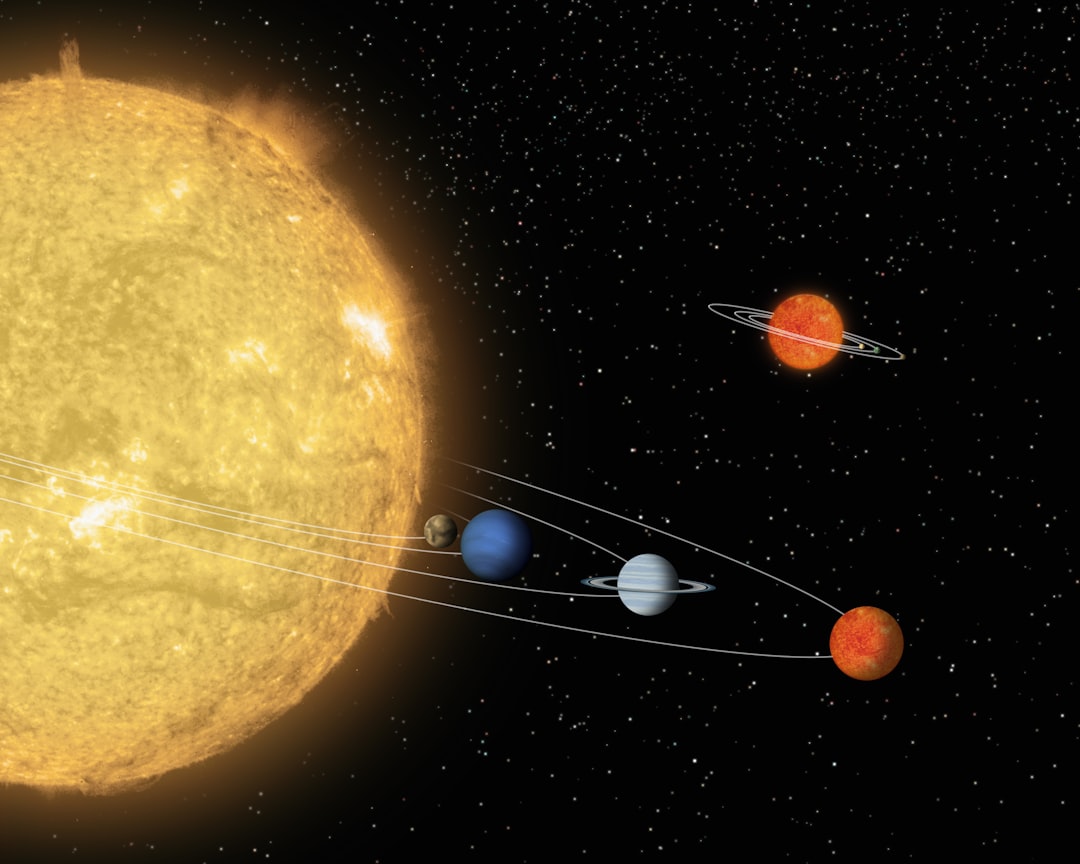
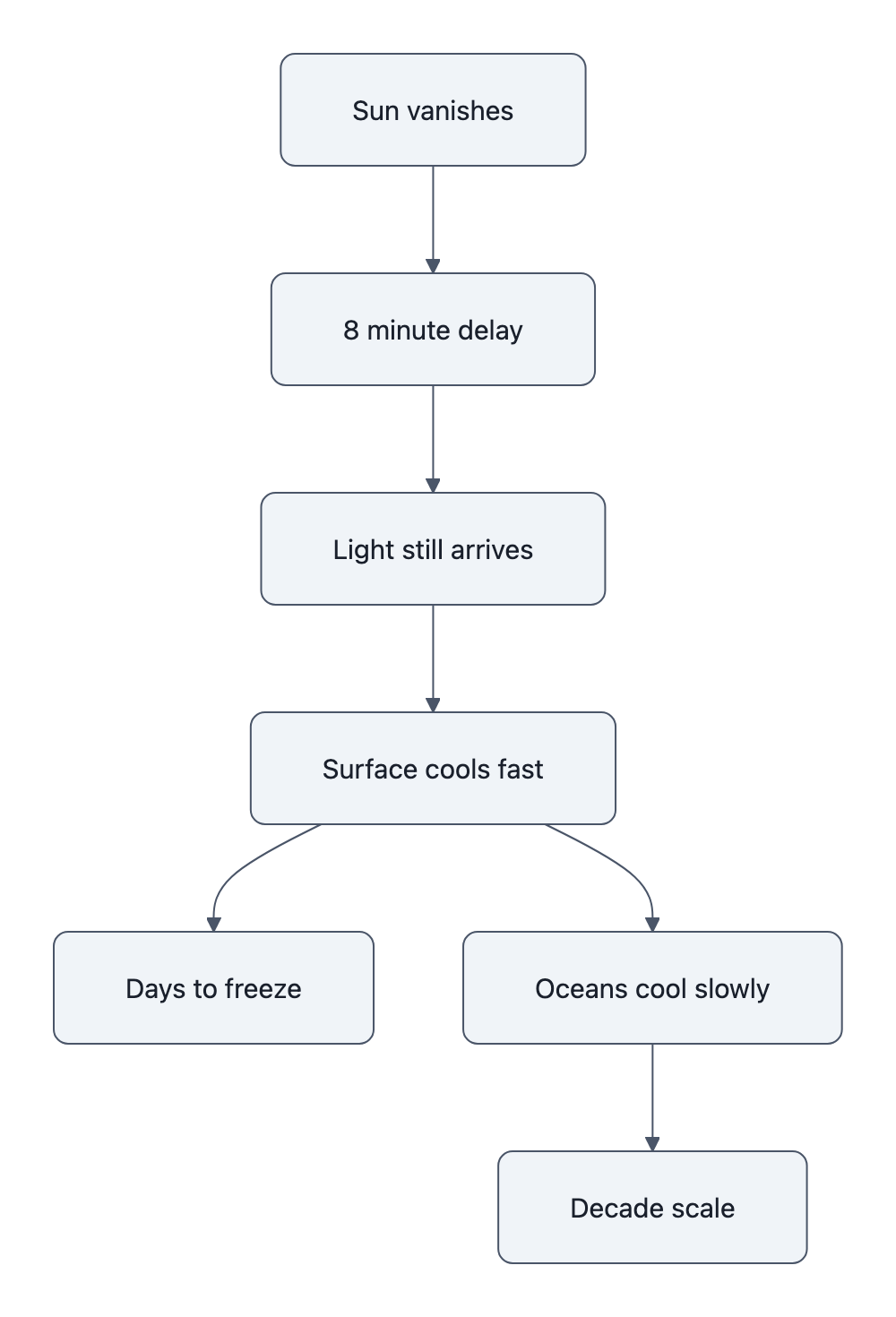
Earth would go dark after about 8 minutes 20 seconds, and the surface would fall below freezing within days, not instantly, because the oceans and atmosphere store a huge amount of heat while Earth’s interior still leaks a small amount of geothermal energy. Sunlight takes roughly eight minutes to reach Earth, and NASA notes that gravity changes also propagate at the speed of light, so Earth would keep moving normally for that same brief window before flying off on a straight tangential path if the Sun’s mass vanished too.
The short version is brutal at the surface and slower everywhere else: land and air would cool fast enough to wreck surface ecosystems in days, but the ocean would act like a planetary thermal battery. According to a 2002 Geophysical Research Letters abstract, it would take at least a decade for the ocean to cool to seawater’s freezing point after a large sudden loss of sunlight.
The first 8 minutes and 20 seconds
For about 8 minutes 20 seconds, nothing changes on Earth in any observable way because that is how long light from the Sun takes to arrive from 1 astronomical unit away. The sky would still look normal, daylight would continue, and solar heating would still be arriving because we would still be receiving the last photons already in transit.
After that, the Sun would vanish from the sky, and Earth would stop receiving the energy source that drives almost all surface climate. NASA describes the solar energy reaching the top of Earth’s atmosphere as about 1,361 watts per square meter, which works out to a global average of about 340 watts per square meter spread over the whole planet.
If the Sun’s mass disappeared along with its light, Earth would also leave its orbit at that same moment and continue moving in a straight line tangent to its old path, because changes in gravity travel at light speed. If only the sunlight vanished while the Sun’s mass somehow remained, Earth would stay in orbit but still freeze.
How fast the surface cools
The surface would not drop to deep-space temperatures in hours, but it would cool quickly enough to become deadly almost immediately for exposed life. In a recent synthesis, Live Science quoted Massachusetts Institute of Technology atmospheric scientist Timothy Cronin saying the planet’s average surface temperature would fall below the freezing point of water in about a week.
That matches the broad physics: Earth keeps radiating heat to space, but once sunlight stops, there is no meaningful incoming energy to replace it. NASA’s overview of Earth’s energy budget explains that the modern climate exists because incoming solar energy and outgoing heat are close to balance. Remove the input, and the budget stops balancing.
A useful reference point is Earth’s effective temperature, the temperature the planet would have from space if it simply absorbed sunlight and radiated heat without today’s greenhouse warming. NASA gives that value as about −20°C, while the standard textbook blackbody estimate is often quoted as 255 K, or −18°C. Neither is a forecast for a suddenly sunless Earth; they are reference states showing that the present-day surface is warmer than simple radiative balance because the atmosphere traps heat.
The first days would therefore look less like a movie instant-freeze and more like a power outage in a gigantic brick building in winter. The heaters are off, but the walls are still warm. The exact day-by-day curve depends on clouds, atmospheric changes, ocean mixing, and other assumptions, so published estimates vary, but the overall picture does not: days to freeze at the surface, much longer for the ocean.
Why the oceans and Earth’s interior slow the freeze
The main reason Earth does not flash-freeze is water’s high heat capacity. NASA explains that the ocean absorbs, stores, and redistributes enormous amounts of heat, and that water warms and cools more slowly than land because it can hold so much energy before its temperature changes much. The ocean has taken up more than 90% of the excess heat trapped by recent global warming, and NOAA’s overview of ocean heat content makes the same point: the ocean is the climate system’s giant heat reservoir.
That reservoir matters here because the atmosphere is thin compared with the ocean. Air can cool fast. The ocean cannot. The best source in this brief for the long tail is the 2002 Geophysical Research Letters abstract, which says the ocean heat reservoir would strongly buffer the collapse in temperature and that it would take at least a decade for the ocean to cool to seawater’s freezing point after a sudden large drop in sunlight. That is an abstract, not a freely accessible full paper, so the exact model setup is not fully visible here.
Even then, “the ocean freezes” does not mean “every ocean becomes solid from top to bottom.” Ice forms at the top because the surface loses heat to space first, while deeper water can remain liquid for much longer beneath an insulating ice shell. That is why the likely long-term survivors are not forests, crops, or surface plankton, but deep marine and subsurface ecosystems that live without direct sunlight.
Earth also has a second, much smaller heat source: its interior. The average geothermal heat flux is only about 0.065 watts per square meter, according to the U.S. Geological Survey benchmark cited in a Yellowstone Lake hydrothermal explainer. That is tiny beside the Sun’s average 340 watts per square meter at Earth, but it is not zero. In special places such as deep-sea hydrothermal vents, volcanic systems, and the deep subsurface, geothermal and chemical energy can support liquid water and life long after the surface has become hostile.
Surface ecosystems would fail quickly because photosynthesis would stop almost at once. By contrast, hydrothermal-vent communities and deep subsurface microbes already live on chemical energy rather than sunlight, so those refuges could persist far longer.
In the very long run, the surface would settle toward a far colder state set mostly by geothermal leakage rather than sunlight. That is not a human-survivable climate; it is a dark planet with an ice-locked surface and isolated liquid-water pockets where internal heat still wins locally.
Key Takeaways
- Earth would keep looking normal for about 8 minutes 20 seconds after the Sun vanished because that is how long sunlight and gravity changes take to reach us.
- The surface would likely fall below freezing within days to about a week, not instantly, because the atmosphere and especially the oceans store a great deal of heat.
- The ocean would cool much more slowly than the air and land, with a 2002 modeling abstract estimating at least a decade to reach seawater’s freezing point after a sudden loss of sunlight.
- Earth’s geothermal heat is far too weak to replace the Sun globally, but it can keep local subsurface and hydrothermal environments warmer and, in some cases, liquid.
- Surface life would collapse quickly, while deep-ocean and subsurface ecosystems could last far longer because they do not depend directly on sunlight.
Frequently Asked Questions
How long would it take us to notice the Sun was gone?
It would take about 8 minutes 20 seconds. That is the travel time for sunlight from the Sun to Earth, so we would keep seeing and feeling the last light already on its way here until that delay ran out.
Would Earth leave its orbit immediately?
Not immediately. If the Sun’s mass vanished along with its light, Earth would continue orbiting as usual for about 8 minutes, then move off in a straight tangential path because changes in gravity also travel at the speed of light.
Would Earth freeze solid overnight?
No. The air and land would cool fast, but the oceans hold enormous stored heat and cool much more slowly. The top of the ocean would freeze first, while deeper liquid water could remain underneath for much longer.
Could humans survive if the Sun disappeared?
Not on the surface without extreme artificial habitats and energy supplies. Crops, weather, and the food web would fail quickly, so any longer-term survival would depend on sheltered, engineered environments or geothermal refuges rather than normal outdoor life.
References
- NASA Science, What is a light-year?
- NASA Science, Time Travel: Observing Cosmic History
- NASA/JPL GRACE-FO, What is Gravity?
- NASA Science, Climate and Earth’s Energy Budget
- Geophysical Research Letters, 2002, Vulnerability of climate on Earth to sudden changes in insolation
- NOAA Climate.gov, Climate Change: Ocean Heat Content
- USGS, How much heat is emitted by hydrothermal areas on the floor of Yellowstone Lake?
Further Reading
- What is a light-year? – NASA Science, A clear NASA explainer on light-travel time from the Sun to Earth.
- Climate and Earth’s Energy Budget – NASA Science, The key reference for solar input, outgoing heat, and Earth’s effective temperature.
- Vulnerability of climate on Earth to sudden changes in insolation – Geophysical Research Letters, A short but important source on how ocean heat buffers sudden cooling.
- Ocean Warming – Earth Indicator – NASA Science, Why the ocean stores so much heat.
- What would happen to Earth if the Sun suddenly vanished? | Live Science, A recent reported synthesis with expert quotes on short-term consequences.
Last reviewed: 2026-06