
Fish cannot breathe out of water because their gills are specialized to extract oxygen from water, not air. Out of water, the delicate gill filaments collapse and dry, which destroys the large, moist surface area needed for diffusion and stops effective ventilation across the gills. As a result, gas exchange fails even though the surrounding air is rich in oxygen.
How do fish gills work?
Gills are made of arches that support feathery filaments and thousands of tiny plates called lamellae. Blood flows through dense capillaries in these lamellae beneath a very thin, moist membrane. As water is pumped from the mouth to the operculum, oxygen diffuses from the water into the blood while carbon dioxide diffuses out. Many fishes use a countercurrent flow, where water and blood move in opposite directions, which maintains a strong gradient for oxygen uptake along the entire lamella.
Gills are respiratory organs that expose a very large, moist surface area to flowing water so dissolved oxygen can diffuse into the blood (Encyclopaedia Britannica).
Because of countercurrent exchange and continuous flow across the gills, fish can extract oxygen efficiently from water despite its low oxygen content compared with air. An open physiology text details how the buccal, mouth, and opercular pumps create that one way water flow across the lamellae and why the thinness of the epithelial barrier is critical for diffusion efficiency (OpenStax Biology).
At 20 degrees Celsius, air is about 21 percent oxygen, while water saturated with oxygen holds roughly 9 milligrams per liter, orders of magnitude less by volume (USGS Water Science School).
Why can’t fish breathe out of water?
The failure is mechanical and physiological, not due to a lack of oxygen in air. Several things happen at once when a fish leaves water:
- Gill collapse and lost surface area. In water, buoyancy and flow keep the thin lamellae separated. In air, surface tension and the absence of support cause the lamellae to stick together, which collapses the structure and removes most of the functional surface for gas exchange (Britannica).
- Drying of the exchange surface. Diffusion requires a thin, moist film. Out of water the gill epithelium dries quickly, which thickens the boundary layer and sharply reduces diffusion rates (OpenStax Biology).
- Ventilation failure. Fish respiratory pumps are designed to move water, not air. Without a continuous water flow from the mouth to the operculum, the countercurrent system cannot run and oxygen uptake stalls.
- Waste removal is compromised. Most fishes excrete nitrogenous waste primarily as ammonia across the gills. Out of water, that excretion pathway is lost and toxic metabolites can build up quickly (Britannica, Excretion).
Countercurrent exchange in fish gills keeps blood meeting water that is always richer in oxygen, which maximizes diffusion along the full length of the lamellae (OpenStax Biology).
Together these effects mean a stranded fish will suffocate despite being surrounded by oxygen rich air. The limiting factor is maintaining a large, wet, well ventilated surface for diffusion, which gills provide only when immersed.
Do any fish breathe air?
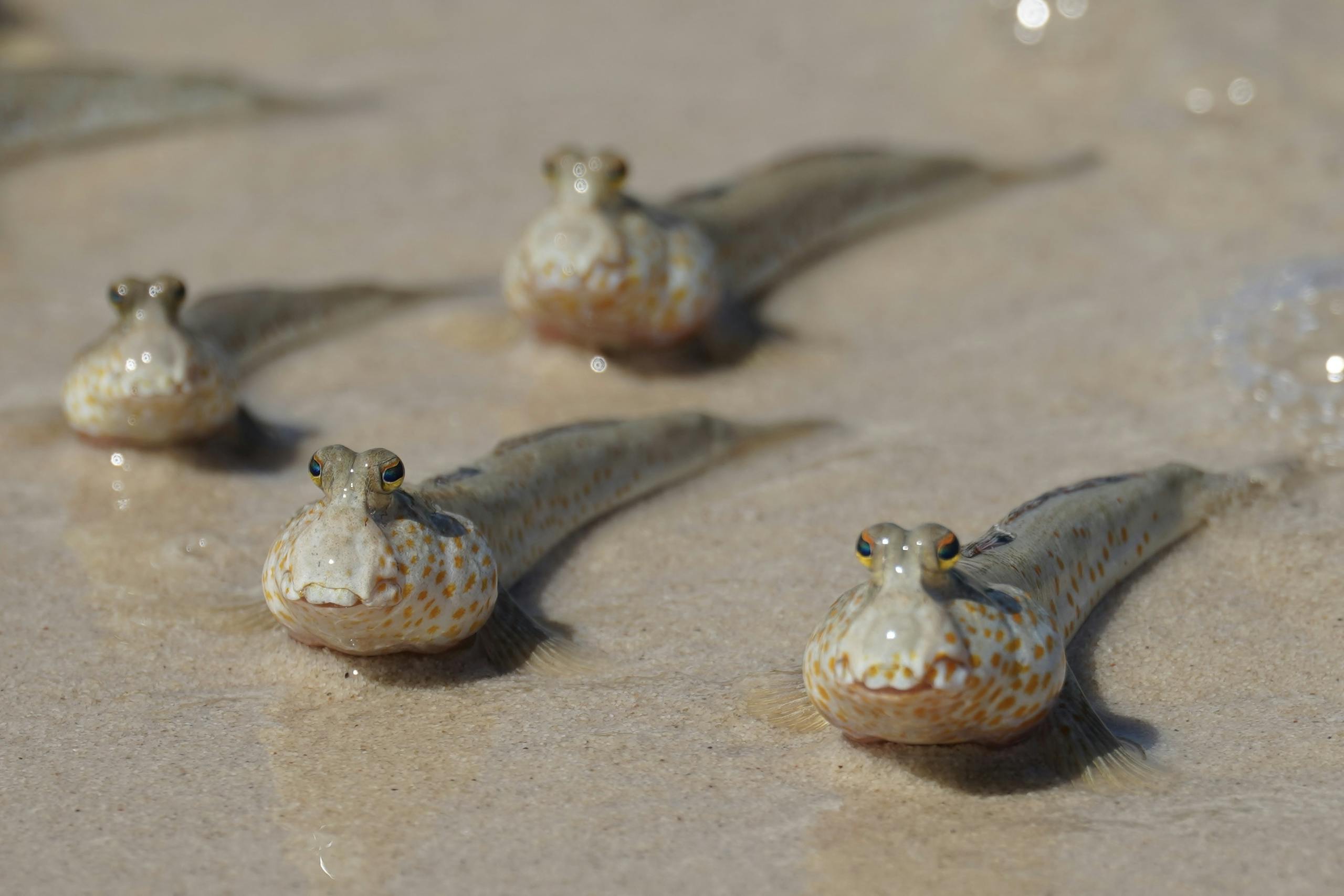
Yes, several lineages evolved air breathing, but they do so with special adaptations and still depend on moisture. Lungfish have true lungs and breathe air directly, which lets them survive in stagnant or seasonally dry waters (Britannica, Lungfish). Other fishes use modified organs for air breathing, for example a vascularized swim bladder in gars, bowfin, tarpon, and arapaima (Britannica, Swim bladder). Labyrinth fishes such as bettas and gouramis possess a labyrinth organ above the gills to gulp air (Britannica, Labyrinth fish). Mudskippers combine reinforced gills with gas exchange through moist skin and the mouth lining, which is why they can move on land when kept wet (Britannica, Mudskipper).
Even these species typically need moist surfaces and often periodic access to water to clear wastes and prevent desiccation. Most other fishes lack such adaptations and cannot use air for respiration.
Does humidity or wetness help a stranded fish?
High humidity or keeping gills wet can delay drying, so a fish may survive slightly longer than in dry air. However, the key problems of gill collapse and the lack of water flow remain. Without immersion and ventilation, oxygen uptake and waste removal are still inadequate for most species. The only effective remedy is rapid return to water.
What does this mean for aquariums and conservation?
Minimize air exposure during handling and release. Keep fish submerged when possible, use wet hands or gloves to protect the skin and gills, and ensure water is well oxygenated rather than relying on air space above the surface. For recreational fishing, agencies recommend keeping fish in the water for unhooking and supporting them facing into gentle flow before release (NOAA Fisheries best practices).