
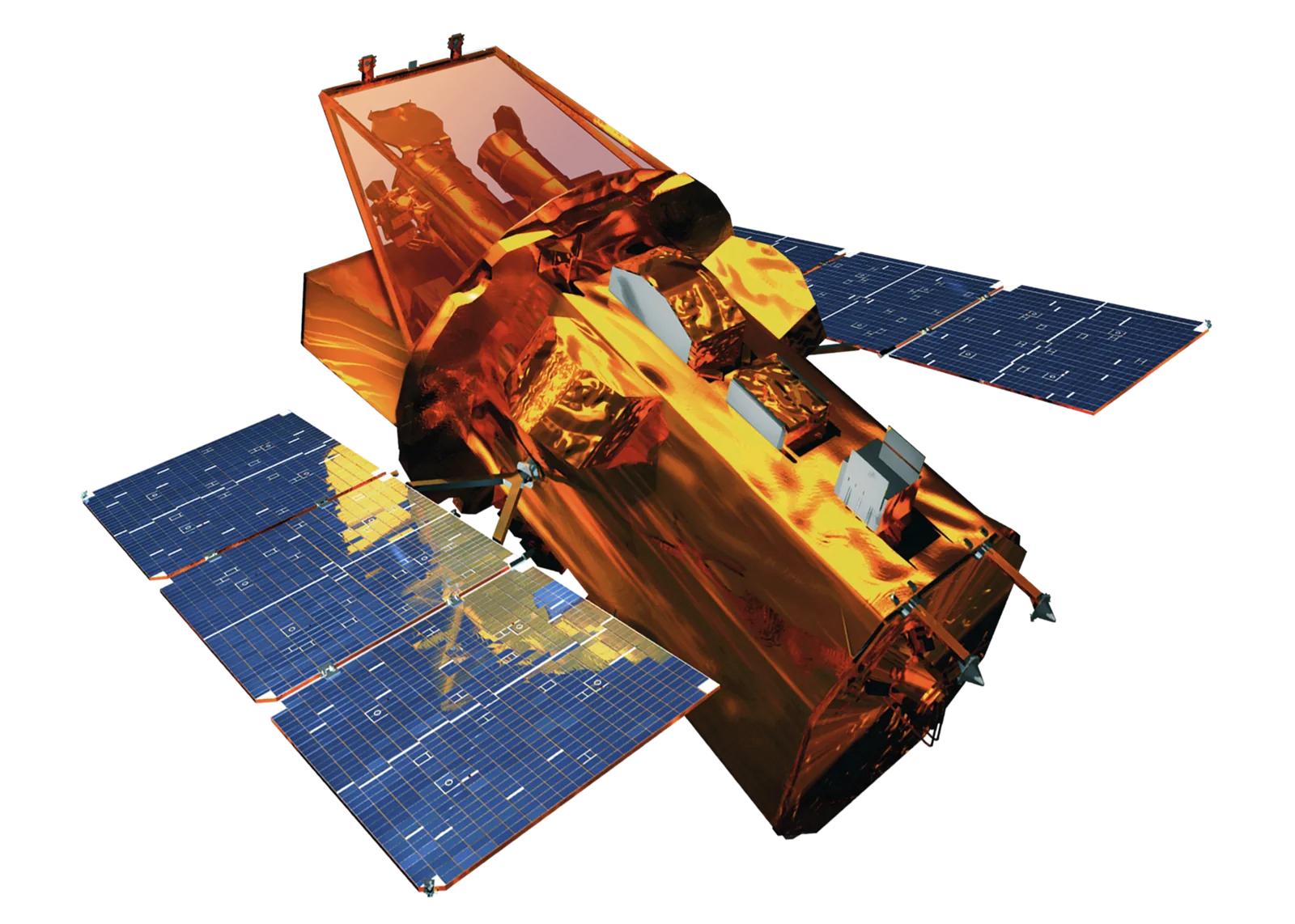
NASA’s Neil Gehrels Swift Observatory is now being targeted for an orbital rescue after Katalyst Space’s LINK spacecraft launched on July 3, 2026 to try to rendezvous with it, grapple it, and raise it to a safer orbit over the next several months. The mission exists because Swift’s orbit has been decaying faster after increased solar activity boosted atmospheric drag, and NASA says the telescope could re-enter in fall 2026 without help, while AP specifically reported October 2026.
Swift launched on November 20, 2004 to detect gamma-ray bursts and rapidly point its instruments toward them, and it has spent more than two decades as a working astrophysics observatory rather than a piece of serviceable orbital hardware. That matters here because Swift was not designed to be serviced in orbit, so LINK will be trying to capture a spacecraft that never expected a visitor.
Swift’s orbit is decaying faster because solar activity increased atmospheric drag
NASA’s own fact sheet says Swift has entered rapid orbital decay because increased solar activity has heated and expanded Earth’s upper atmosphere. In low Earth orbit, that means more drag; space is not empty enough to be forgiving.
The urgency is not theoretical. NASA’s boost-mission page says recent solar storms accelerated Swift’s orbital decay, and AP reported Swift was orbiting about 364 miles above Earth at launch. Left alone, the observatory is expected to come down on a near-term schedule, with NASA materials pointing to fall 2026 and AP narrowing that to October 2026.
Swift is still scientifically useful enough that NASA chose not to simply let the clock run out. In a September 2025 contract announcement, the agency awarded Katalyst Space Technologies $30 million for the attempt, framing it as both a way to preserve Swift and a demonstration of commercial in-orbit servicing.
LINK launched on July 3 to rendezvous, grapple Swift, and raise it over several months
The rescue vehicle is Katalyst Space’s privately built LINK spacecraft, and NASA confirmed it launched on July 3, 2026. That date matters because NASA timeline materials published before launch had cited June 2026, but the mission slipped a little before getting off the pad.
AP reported the launch took place from the Marshall Islands, while Space.com identified the launch vehicle as Northrop Grumman’s air-launched Pegasus XL. The plan is not a quick docking. AP said the approach alone is expected to take about a month, and NASA says the full boost campaign will unfold over several months.
Space.com reported that LINK carries robotic arms, which it is supposed to use after rendezvous to secure Swift and begin the orbit-raising work. AP reported the target is a roughly 150-mile boost, enough to move the telescope back into a more durable orbit and buy it more operating time.
The key uncertainty is simple: LINK has launched, but it has not yet grappled Swift. NASA is trying to do the orbital equivalent of catching a falling appliance with chopsticks, except both objects are moving at orbital velocity and one of them was never built for capture.
A successful rescue would set a precedent for commercial servicing of unprepared government spacecraft
NASA says a successful mission would be the first commercial robotic capture of an uncrewed NASA spacecraft not designed for servicing. That is the real novelty here. Satellite servicing is not new in the abstract, but servicing a government science spacecraft that lacks purpose-built docking interfaces is a different class of problem.
“If successful, this will be the first time a commercial company has robotically captured a NASA spacecraft that was never designed to be serviced in orbit,” NASA says on the mission page.
That precedent is why the $30 million price tag looks modest by space standards. Swift has been operating since 2004, and NASA is using a comparatively small contract to test whether commercial partners can extend the life of older public spacecraft instead of replacing them outright or accepting uncontrolled loss.
The mission also doubles as a stress test for a broader idea: whether agencies can outsource some orbital maintenance to specialist firms. If LINK succeeds, the result is not just a saved telescope. Commercial servicing of legacy government spacecraft becomes much easier to argue for when there is a working example in orbit rather than a concept slide.
The next milestone is the rendezvous attempt, which AP reported should come after roughly a month of approach operations. After that, NASA expects the orbit-raising campaign to continue over several months.
Key Takeaways
- Katalyst Space’s
LINKspacecraft launched on July 3, 2026 to try to rescue NASA’s Neil Gehrels Swift Observatory. - Swift’s orbit is decaying faster because increased solar activity expanded the upper atmosphere and increased drag.
- Without help, NASA materials say Swift could re-enter in fall 2026, while AP specifically reported October 2026.
- NASA awarded Katalyst Space $30 million in 2025 for a mission meant both to save Swift and demonstrate commercial satellite servicing.
- If LINK succeeds, NASA says it would be the first commercial robotic capture of an uncrewed NASA spacecraft that was not designed for servicing.
Further Reading
- Swift Boost Mission, NASA’s mission hub for the July 3 launch, the rescue plan, and the servicing goal.
- NASA Awards Company to Attempt Swift Spacecraft Orbit Boost, NASA’s contract announcement with the $30 million award and mission rationale.
- Swift Boost NASA Facts, NASA fact sheet on Swift’s orbital decay and re-entry timeline without a boost.
- The Swift Spacecraft, NASA background on Swift’s 2004 launch and science mission.
- Rescue mission launches to save NASA telescope that’s falling back to Earth, AP’s independent report on the launch, altitude, and planned boost.