
ChatGPT and Perplexity cited articles from the Hanover Institute for Public Policy in Politico’s tests of questions about Gaza, anti-Zionism and antisemitism, Politico reported on August 14, 2026. The site had disclosed work connected to Piro Inc., a U.S. contractor registered to work on an Israeli government-backed communications initiative.
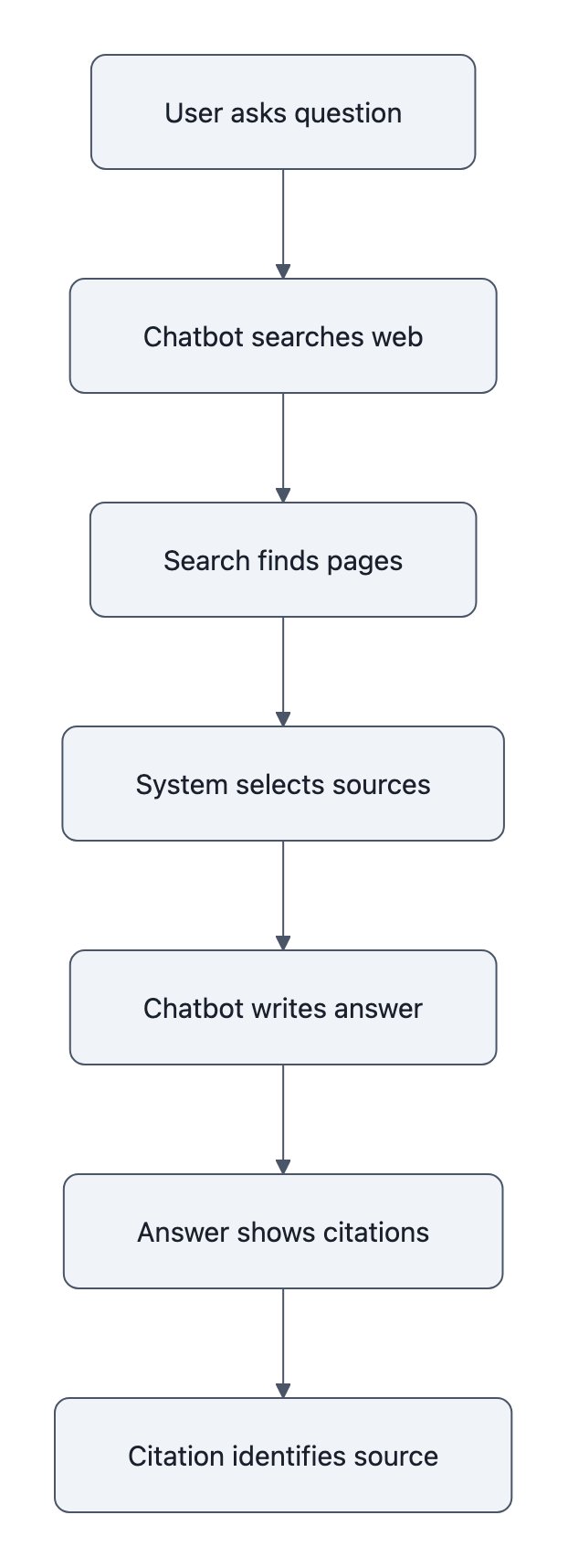
When a person asks a search-enabled chatbot a question, the service can fetch web pages and attach them as sources to its answer. ChatGPT Search retrieves web results and can show inline citations, while Perplexity says its answers link citations to original sources. A citation shows that a source surfaced in that response; it does not show that either company retrained its model, sold placement, or changed ranking rules for Israel.
Politico’s reported tests establish only that Hanover material appeared in particular responses at that time. They do not establish how frequently ChatGPT or Perplexity cites the site, or whether the results persist.
The money trail is more specific than claims of a single $1 million AI-content project. A July 29 FARA exhibit filed by Piro records a $100,000 “Fact-Based Content Initiative” dated July 20, 2026, and a distinct $900,000 “Digital Storytelling Pilot” dated April 30, 2026. The filing does not identify the later $100,000 initiative as a line item in the earlier pilot.
The $100,000 fact-based-content work order and the separate $900,000 pilot
Piro registered under the Foreign Agents Registration Act to work for Havas Media Germany, which the filing says was acting for Israel’s Government Advertising Agency, LaPam. The exhibit identifies the ultimate initiative as being on behalf of Israel’s Foreign Ministry. That chain of clients and principals appears in Piro’s registration documents.
The July work order budgets two $50,000 installments for research, editorial development, production and distribution planning under the fact-based-content initiative. The filing characterizes the planned material as accurate and supported by sources; that is Piro’s description in a registration document, not an independent check of every eventual claim.
The same exhibit also contains the April digital-storytelling pilot, whose $900,000 budget is separate from the $100,000 work order. The two documents sit in one filing, but they are not documented as one $1 million project. Adding them may be arithmetically tempting, but the record does not say the fact-based-content work was part of the pilot.
| Work order | Budget documented in Piro’s filing |
|---|---|
| April 30 Digital Storytelling Pilot | $900,000 |
| July 20 Fact-Based Content Initiative | $100,000 |

The FARA exhibit does not explicitly name the Hanover Institute in the quoted work-order language. Politico, however, reported that Hanover disclosed the Piro relationship and that its tests produced ChatGPT and Perplexity answers citing Hanover pages. That makes the connection material to how search-driven AI answers can pick up content-distribution campaigns, but it does not prove preferential treatment by either AI company.
Piro told Politico it had been hired to put documented material before the public.
“Piro was hired to place accurate, documented facts into the public record.”
, Piro, as quoted by Politico
Politico reported that Havas Media, Hanover, LaPam and the Israeli Embassy did not respond to its requests for comment. Piro’s statement is therefore the contractor’s account of the campaign’s purpose, while the most concrete public evidence is the filing’s scope and budgets.
The episode is less evidence of an AI system being secretly “changed” than of something more ordinary: search products can repeat whatever the web has made available and sufficiently visible. A source citation is a breadcrumb, not a receipt.
Key Takeaways
- Politico reported that ChatGPT and Perplexity cited Hanover Institute material in tests involving Gaza, anti-Zionism and antisemitism.
- Piro’s FARA filing identifies work for Havas Media Germany on behalf of Israel’s Government Advertising Agency, LaPam.
- The filing records a $100,000 fact-based-content initiative dated July 20, 2026.
- The filing separately records a $900,000 digital-storytelling pilot dated April 30, 2026.
- Neither a chatbot citation nor a content campaign demonstrates that OpenAI or Perplexity changed a model or accepted payment.
Further Reading
- Piro, Inc. FARA Exhibit B filing, registration no. 7732, DOJ filing detailing Piro’s client chain and the two separate work orders.
- Politico Influence: “Israeli PR wants to answer your ChatGPT questions”, Report on Politico’s chatbot citation tests and Hanover’s disclosure.
- ChatGPT search for Enterprise and Edu, OpenAI documentation on web retrieval and inline citations.
- How does Perplexity work?, Perplexity documentation on source citations.