

Texas’s education board rejected Alpha School’s proposed charter on June 27, 2025. Afterward, Education Commissioner Mike Morath and his agency helped Alpha affiliates reach public school districts: officials and affiliates approached at least 10 districts, and three launched pilots. Alpha could put its learning software in classrooms through district agreements without another charter vote.
Alpha School is a private school chain whose TimeBack platform delivers academic lessons through software. Its proposed Texas charter, Valenta Academy, would have used Alpha’s model of teaching core subjects in two hours a day. The pilots use the software as extra help instead. That is a narrower use, but it gives Alpha access to public school students after the board voted down its plan to run a school.
The State Board of Education voted 10-3 against Valenta Academy, which Morath had recommended. Members questioned screen time, AI-led teaching and Alpha’s claims of rapid improvement. Districts could still choose to try its tool.
Public-record emails obtained by ProPublica and The Texas Tribune show how the district route developed. In September 2025, Morath agreed to a follow-up discussion with Alpha associates about using the program in Texas schools. He later offered to connect an Alpha leader with Houston superintendent Mike Miles, whom he had appointed to lead the district, and proposed coordinating campus visits.
“The Superintendent of H.I.S.D. would also like to do a site visit, so I’ll connect y’all separately.”
, Mike Morath, Texas education commissioner, in an email obtained by ProPublica and The Texas Tribune
Agency staff kept working with Alpha associates. By April 2026, Texas Education Agency official Michael Strange was drafting a one-page pilot explanation to share with districts. Five districts confirmed they were approached but did not pursue agreements. Houston, Fort Davis and Aldine did launch pilots.

The districts are trying different uses. Fort Davis is offering reading and math help to kindergarten-through-eighth-grade students who need it. Aldine plans math support for roughly 300 middle-school students across four campuses. Houston is testing the platform at two elementary schools with students who already have strong scores. None is adopting Alpha’s full school-day model, and pilot outcomes have not been reported.
The agency says it has no formal partnership with Alpha and that districts made their own decisions. Fort Davis and Aldine leaders told the newsrooms that agency recommendations of potential partners were not unusual. Those decisions remain the districts’ responsibility; the emails show that state officials helped put this particular vendor before them.
Houston says the pilot costs the district nothing, but it has asked the Texas attorney general to withhold its contract from the reporters. The reporting gives no pilot costs for Fort Davis or Aldine.
Alpha’s results in public charter schools
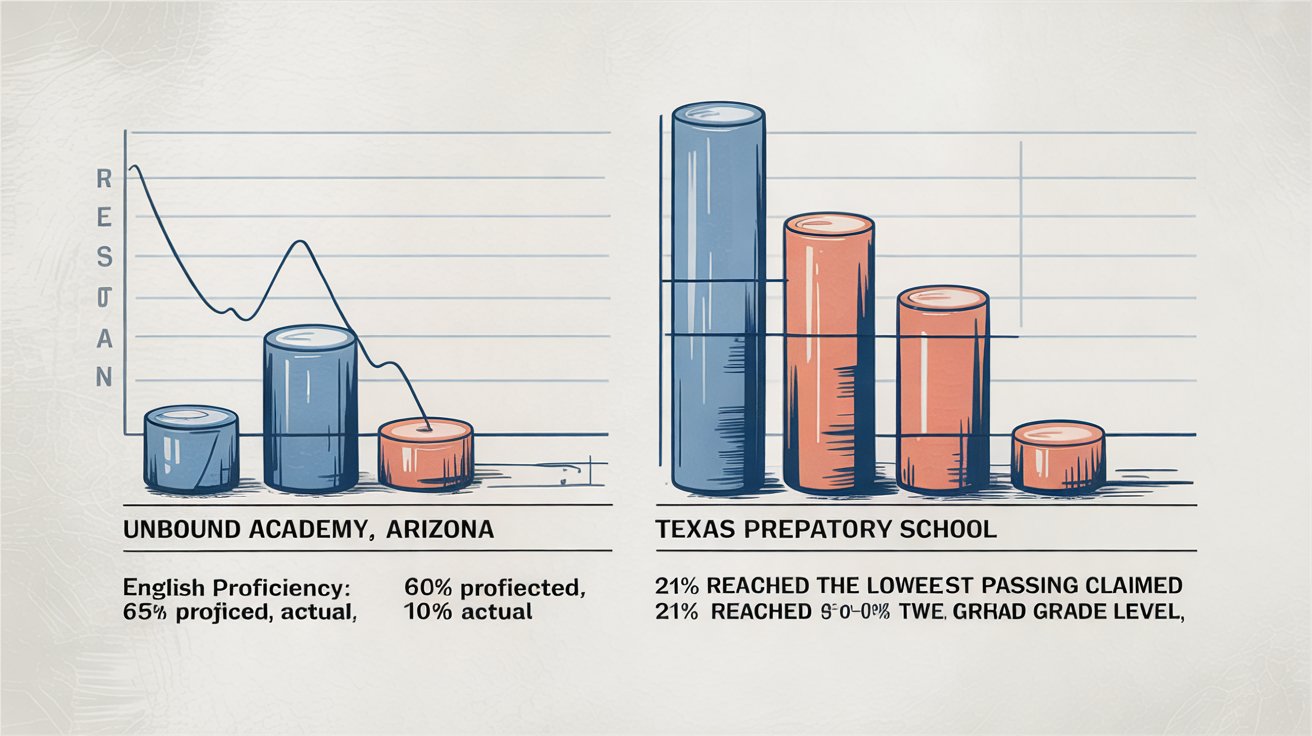
The pilots also put Alpha’s claims up against results from public-school settings. At Texas Preparatory School, a charter that partnered with Alpha, an Alpha representative told state officials that 50% to 60% of students were passing state exams. The 2025 state results showed 21% reached the lowest passing category; none reached grade level. Texas gave the charter its third consecutive F rating.
At Arizona’s Alpha-affiliated Unbound Academy, preliminary first-year results showed 28% of students proficient in English, against a 65% projection. In math, 10% were proficient, against a 60% projection.
David DeMatthews, a University of Texas at Austin education professor who was not involved in the pilots, questioned the agency’s promotion of a product without publicly demonstrated success in public or charter schools. He pointed to the different needs of students who struggle academically, the very students Fort Davis and Aldine intend to serve.
“That raises questions about whether TEA is serving its public interest and is being transparent and accountable to us.”
, David DeMatthews, University of Texas at Austin
The board rejected Alpha’s bid to run a Texas charter. The agency then helped it reach districts by another route. Whether the narrower pilots help students is a question the districts’ results, not the introductions that secured them, will have to answer.
Further Reading
- How Texas Helped a Private School Chain’s AI Tool Get Into Public School, Public-record investigation of the agency’s assistance and the district pilots.
- TEA Announces 2025 Charter School Decisions, State notice confirming the board’s Valenta Academy decision.
- Texas rejected an AI-driven school’s bid to open a charter, Reporting on Alpha-affiliated schools’ test results and charter applications.
- HISD will use ‘AI-powered education’ Alpha platform at 2 elementary schools, Local reporting on Houston’s planned use and stated pilot cost.