

The president’s eldest son has had money in both of America’s big betting-market companies while his father’s regulators sued a dozen states to stop them treating those companies as gambling. Kalshi handed Donald Trump Jr. about $300,000 in shares when he became an adviser in early 2025. His venture firm, 1789 Capital, has since put $300 million into Polymarket, Kalshi’s main rival.
Kalshi and Polymarket run prediction markets. These are apps where you buy a contract that pays out if something happens, such as a candidate winning, the Fed cutting rates, or a team winning by a set margin. Most of the money is in sports: Pew counted sports at 78% to 81% of Kalshi’s trading volume each month from May to July 2026. States say those contracts are sports bets sold without a gambling license. The companies say they are swaps, a federal financial contract that only the Commodity Futures Trading Commission (CFTC) can police. If the companies are right, states lose the power to license and tax them. The Trump administration’s CFTC has taken the companies’ side.
Kalshi ended Trump Jr.’s advisory contract on November 12. It has not said whether he still holds the shares.
Shares from Kalshi, briefs from the CFTC
Kalshi CEO Tarek Mansour announced the appointment on January 13, 2025, a week before the inauguration. In a post the same day, Trump Jr. said his family had watched Kalshi’s odds on election night at Mar-a-Lago:
“I immediately knew I had to contribute to their mission.”
The Financial Times reported that the shares were granted when Kalshi was valued at under $2 billion, and Trump Jr. put in none of his own money. Kalshi was valued at $22 billion in May 2026 and $40 billion on October 29. It is reportedly in talks at $65 billion. Before dilution, a $300,000 slice of a company worth just under $2 billion would be worth roughly $6 million at $40 billion. The FT reports the stake has been heavily diluted.
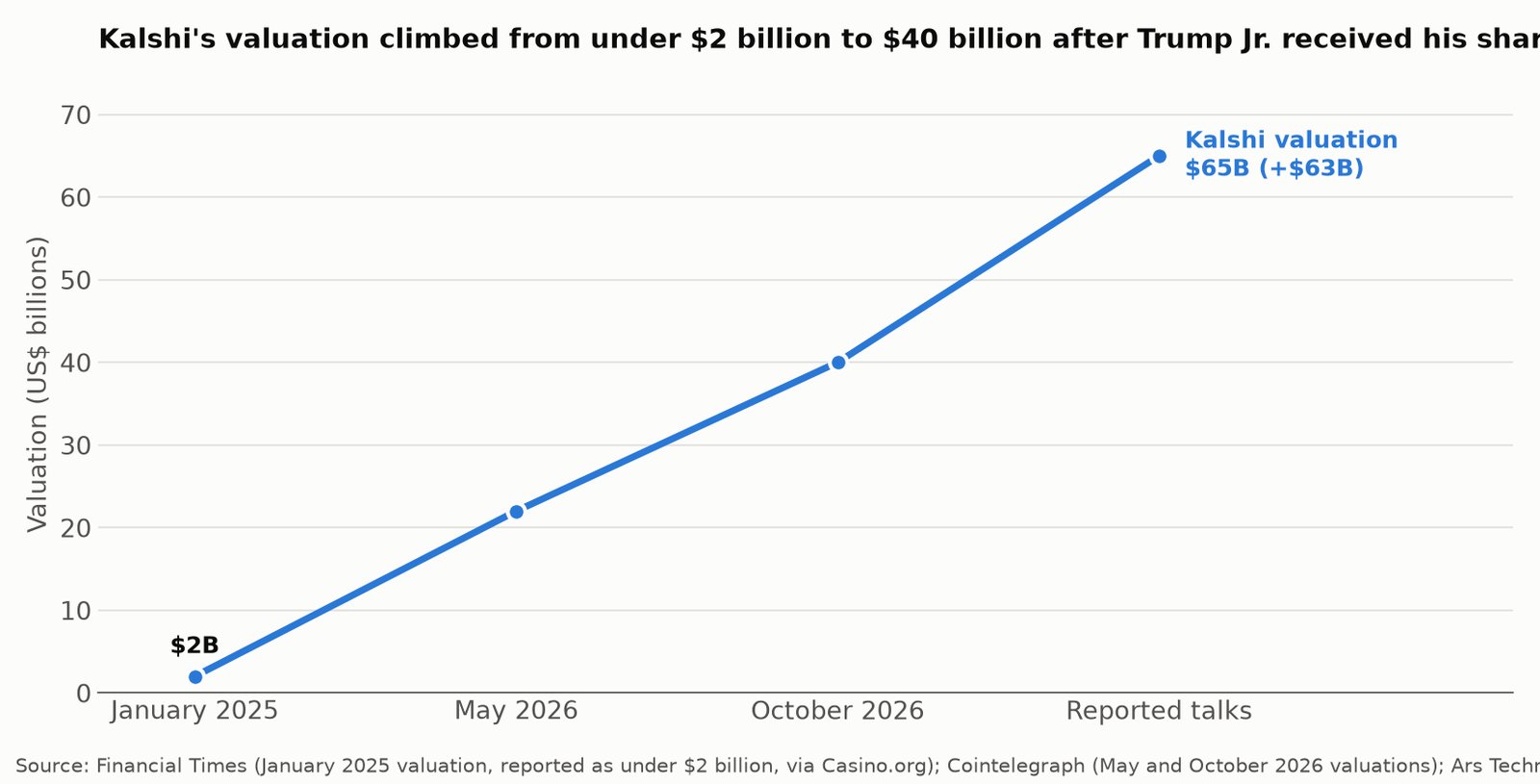
While he held those shares, his father’s government took Kalshi’s side. The CFTC’s decisions run through Chairman Michael Selig, a Trump appointee who is reportedly the commission’s only sitting member.
- On May 12, 2026, the CFTC filed a friend-of-the-court brief on Kalshi’s side in its appeal against Ohio. Selig said the lower court “took an improperly narrow view of the Commission’s jurisdiction.”
- In August, New York sued Kalshi and sought more than $36 billion in damages. The CFTC used emergency powers to keep Kalshi trading in the state.
- On November 12, the CFTC and the Justice Department sued Arkansas to stop the case the state had filed against Kalshi eight days earlier.
- A day later they sued Louisiana, the twelfth state to face a federal suit. Louisiana’s attorney general, Liz Murrill, called Selig an “obsequious standard bearer” for prediction markets.
Murrill also said what the states stand to lose:
“Kalshi’s and the other operators’ attempts to make up new words to evade state gambling laws, regulators, and taxes are not fooling anyone.”
The White House worked on the states directly. According to the New York Times, the Office of Intergovernmental Affairs, which handles the White House’s dealings with state governments, gave North Carolina lawmakers the federal position on state regulation.
The CFTC says its suits defend the whole industry, and a spokesman told the Times the states “picked themselves.” Louisiana’s court order covers 31 operators, Polymarket among them. So a ruling for the industry pays Kalshi and Polymarket together.
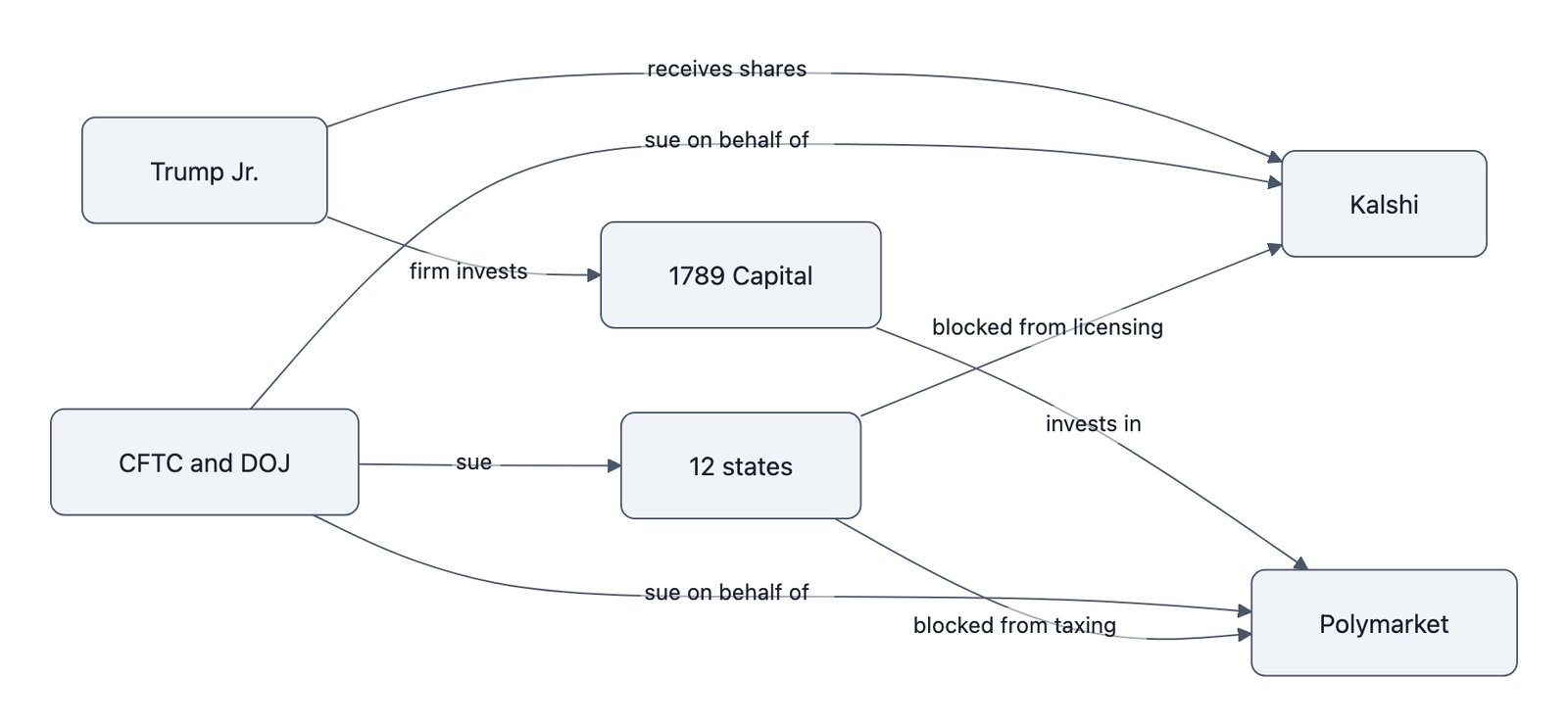
The $300 million bet on the rival
Polymarket had been barred from US customers under a 2022 settlement with the Biden administration. In July 2025, six months into the new administration, it said the DOJ and CFTC had closed their investigations. It then bought QCEX, a CFTC-licensed exchange, for $112 million, which gave it a licensed route back into the country.
On August 26, 2025, 1789 Capital announced an investment Axios put at “double-digit millions,” and Trump Jr. joined Polymarket’s advisory board. “The U.S. needs to access this important platform,” he said. His spokesman said the new role “doesn’t change anything regarding Don’s role with Kalshi.” On November 25, 2025, Polymarket said it had received CFTC approval to return to the US.
In August 2026, 1789 put $300 million into a roughly $1 billion round at a valuation of about $21 billion. Covers reports that came on top of roughly $200 million already invested.
Kalshi says it dropped him over that investment and his “role on its advisory board,” because “advising two competitors in a growing sector was complicating things.” He had sat on Polymarket’s advisory board since August 2025, yet Kalshi kept him for 15 more months. The role ended after a different run of events:
- October: Mansour told MS Now that Trump Jr. was “an optics issue.”
- November 9: Senators Elizabeth Warren and Jeff Merkley wrote to the White House naming his stakes in both companies.
- November 10: Politico reported that the CFTC had privately warned Kalshi of possibly imminent charges for failing to notify the agency about dozens of contracts. Kalshi spokesperson Elisabeth Diana called it a procedural error.
- November 12: The advisory role ended.
Through all of it, Kalshi was in funding talks at $65 billion.
What Kalshi’s CEO said, and what the dates show
Mansour’s defense on MS Now was timing: “The key thing is we did it before the election. It is not a political decision, and it still isn’t.” Kalshi named Trump Jr. an adviser on January 13, 2025, ten weeks after the election Mansour says it preceded. Trump Jr.’s own post dates his decision to election night.
Mansour added, “We never had any policy regulatory involvement,” and Kalshi describes Trump Jr.’s work as marketing to his 10 million followers. In March 2026, according to the Times, Trump Jr. pitched prediction markets to Republican state attorneys general at a closed-door retreat in New Orleans. His spokesman says he “does not interface with the federal government on behalf of any company he invests in or advises.” The pitch the Times documented went to the state officials who prosecute these companies.
Kalshi named Trump Jr. an adviser on January 13, 2025, ten weeks after the election Mansour says it preceded.
One part of Kalshi’s account holds up. Its breakthrough came before he arrived, and it came against a CFTC that was fighting it. As Thomson Reuters reported, a federal judge, Jia Cobb, ruled for Kalshi in its suit against the CFTC in September 2024. On October 2, 2024, a federal appeals court in Washington let its election contracts go live, under the Biden administration.
The federal help since then has lost in the federal appeals courts. The Ninth Circuit in August and the Sixth Circuit, unanimously, on September 25 both ruled that states can regulate sports contracts. The Sixth Circuit held that Kalshi had not shown its sports contracts meet the legal definition of a swap, which rejected the position the CFTC had argued. As of November 14, according to the litigation tracker GamblingLawsuits, Kalshi had lost injunction bids in seven states. It was barred by court order in Nevada, Michigan, Washington, Louisiana and on two California tribal reservations. It also faced the criminal charges Utah filed against the company and its co-founders on October 28.
Losing in court does not undo the arrangement. The son pitched the business to the state officials who prosecute it, and his firm put its bigger money into the competitor the same government had let back in. Every step left the family’s money riding on the federal position winning.
The senators’ letter, to White House Counsel Will Scharf, also cited a White House aide fined $172,539.02 for betting on Kalshi on what the president would say, and said “the White House continues to take no meaningful action.”
The house it says it doesn’t have
Kalshi’s defence against the states rests on one claim: it is not a bookmaker, because it never takes the other side of a bet. It is “peer-to-peer,” and it has suggested it has no stake in whether users win or lose. Its own structure says otherwise.
- Kalshi owns the exchange, its clearinghouse and a trading arm, Kalshi Trading, that trades on the same exchange and often takes the other side of customers’ bets. Kalshi does not disclose how many bets it makes there.
- A proposed class action filed in November 2025 alleges the trading arm bets against consumers.
- Kalshi told Sportico its trading arm has “no asymmetrical trading advantage” and is “one of many ‘peers.'” Then, in a letter to the CFTC in October 2026, it agreed that its structure creates potential “risks” that new rules should address, which it had not acknowledged before. It offered to cap the trading arm at 5% of exchange volume a quarter, and said it currently makes up about 1.5%.
The rules that would govern that conflict are being written by the same commission that is suing the states to protect Kalshi and its rivals.
Kalshi’s one appellate win against a state, a 2-1 Third Circuit ruling in April, is now before the Supreme Court on New Jersey’s petition. If the justices take it, Ars expects the administration to weigh in on Kalshi’s behalf. A win would pay off for 1789’s Polymarket stake. It would also pay Trump Jr. personally through Kalshi, if he still holds the shares Kalshi won’t discuss.
Further Reading
- Kalshi ditches Trump Jr. as advisor; CEO admitted “optics” weren’t good, Kalshi’s statements, the FT equity figures, Mansour’s interview and the Warren-Merkley letter.
- Trump Jr And White House Both Lobbied States Over Prediction Markets, The New York Times findings on the New Orleans pitch and the White House’s contact with North Carolina.
- Donald Trump Jr. Kalshi and Polymarket roles, The August 2025 Polymarket announcement and his spokesman’s response.
- Appeals court rules states can regulate sports prediction markets, The Sixth Circuit ruling, the split with the Third Circuit and New Jersey’s Supreme Court petition.
- Donald Trump Jr.’s Advisory Role with Kalshi Ends, The end of the contract, 1789’s total Polymarket investment and the dilution report.