
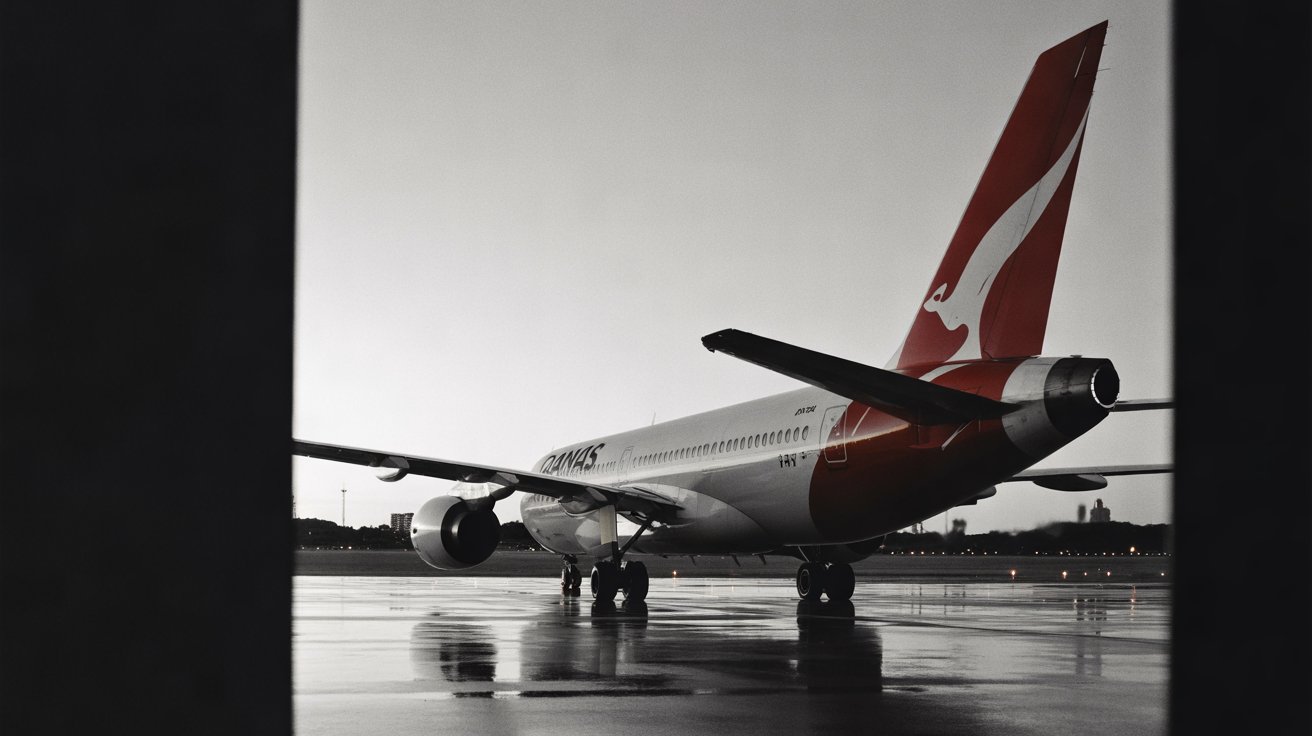
Qantas is cutting about 850 office jobs in Australia and handing the work to consulting firm Accenture, which will do it mostly with its teams in India. Finance, procurement, HR and marketing go first. That is about 3% of the airline’s 28,000-strong Australian workforce, and the first changes are due by mid-2027.
Someone in Sydney who pays supplier invoices or runs a marketing campaign loses the job, and someone on a contractor’s team in India does the same work for the airline at lower cost. The software comes later. Qantas’s own statement says the work will only “in time” be transformed with AI. Accenture gets a multi-year contract. Shareholders sent the stock up 6.34% to A$9.90 on the day, a rise that cheaper oil also helped. The bill lands on 850 workers, most of them based in Sydney, according to the Australian Services Union (ASU).
The financial press has already filed this under AI. The Australian Financial Review’s Chanticleer column ran it as “Qantas just showed you how AI will kill white-collar jobs“. The column describes a two-step in which companies offshore the jobs first and automate them later. It calls that pattern “becoming a common sight in corporate Australia.”
Only the first step exists on paper. This is how Qantas itself describes where the work goes:
“delivered mostly by its teams in India and some in Australia, and in time be transformed further with automation and AI”, Qantas statement, via Mediaweek
Read in order, that sentence sends the jobs to India now and brings in the AI at some later date it does not name. Qantas has disclosed no contract value, no savings figure, and no split between roles replaced by software and roles moved offshore. That means nobody outside the two companies can check the cost case. What Qantas signed is an outsourcing deal with an AI clause attached.

The airline does have a real technology problem. Chief executive Vanessa Hudson points to more than 1,000 legacy applications “that were never designed to work together”. Qantas says it spends more than A$1bn a year on technology, and that Accenture is making an undisclosed upfront investment in its data platforms. On data and AI skills, Hudson said “we cannot hire at the pace this work needs”.
That is an argument for buying AI expertise. It does not explain moving the procurement desk to India. Hudson also says Accenture has done this same work for “other airlines”, which makes it a standard outsourcing product rather than a new technology.
Qantas says it will hire thousands more people in Australia, on top of the thousands of operational roles it says it has already added. Operational roles are frontline jobs. They are not the finance, procurement, HR and marketing desks being cut. Qantas also says it will redeploy as many affected staff as it can, but it has given no number. And it used the same “thousands of operational roles” line in August, while it was denying the deal it has now signed.
What Qantas told the union in August
Three months ago, the AFR reported that Qantas’s “Project iQ” with Accenture could move up to 1,000 marketing, finance and HR roles to India. Qantas confirmed early talks but said “no formal agreement is in place and no decisions have been made”. ASU national secretary Scott Cowen said Qantas had told the union “there is no plan to offshore any Australian jobs.” Breaking that, he said, would be “a deep breach of trust.”
Cowen now gives a narrower account: “We were told at the time that there was no plan for 1,000 jobs to be offshored.” The deal Qantas signed covers 850. Qantas now says “We have never given assurances to the union that some jobs wouldn’t move offshore”.
In May, Hudson told a Macquarie investor conference that AI was about more than cutting staff:
“I don’t think it’s the right thing to only think about the value that AI can give is through headcount reduction.”, Vanessa Hudson, May 2026
Coles and Telstra ran the same Accenture play
Accenture has sold this arrangement before, and the jobs went to India each time. In August, Coles moved “several hundreds” of roles, mostly to India, through its own Accenture deal, and said why: “Maintaining our cost leadership is critical.” Telstra billed its A$700m Accenture venture as “agentic AI”. When it proposed about 209 redundancies in February, the work moved partly to the venture’s team in India, and Telstra said it had “not proposed that any roles be replaced by AI.”
The same shift is happening outside Accenture. Woolworths is moving hundreds of roles to India and Southeast Asia, and NAB and Officeworks made similar offshoring moves this year. In July, a federal government report found “no evidence to date of broad labour market upheaval” from generative AI. That matches how AI job displacement is actually showing up: as a label on cuts made for other reasons, as with Block’s AI-branded layoffs and Canva’s layoffs, which were also blamed on AI.
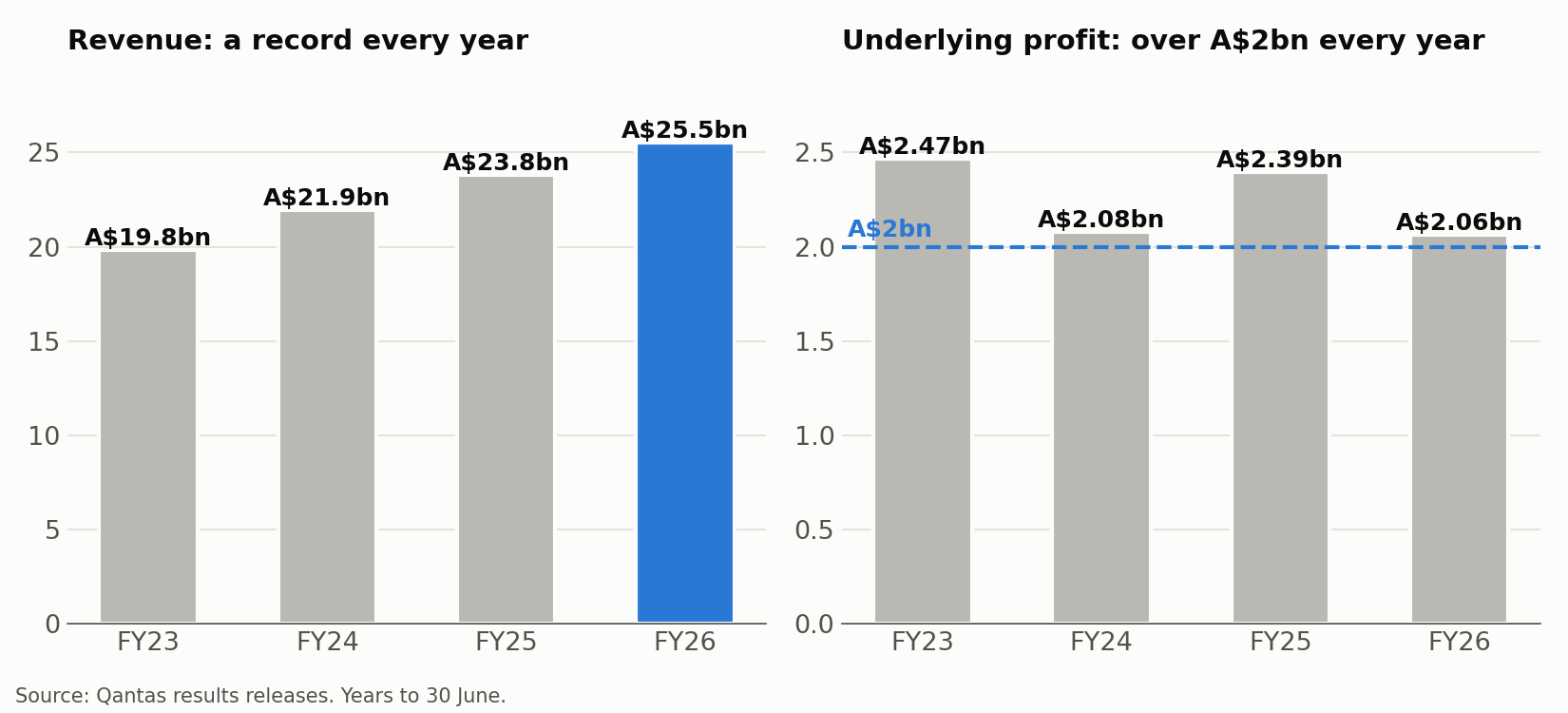
Qantas is under real financial pressure. FY26 underlying profit before tax fell 13.8% to A$2.06bn. Its second-half fuel bill rose A$610m, the Middle East conflict cost A$420m, and a planned A$150m buy-back was scrapped.
The pressure has limits, though. A$2.06bn is almost exactly FY24’s A$2,078m, which Qantas called a strong result. The airline also declared A$600m in FY26 dividends on the same day it cancelled the buy-back.
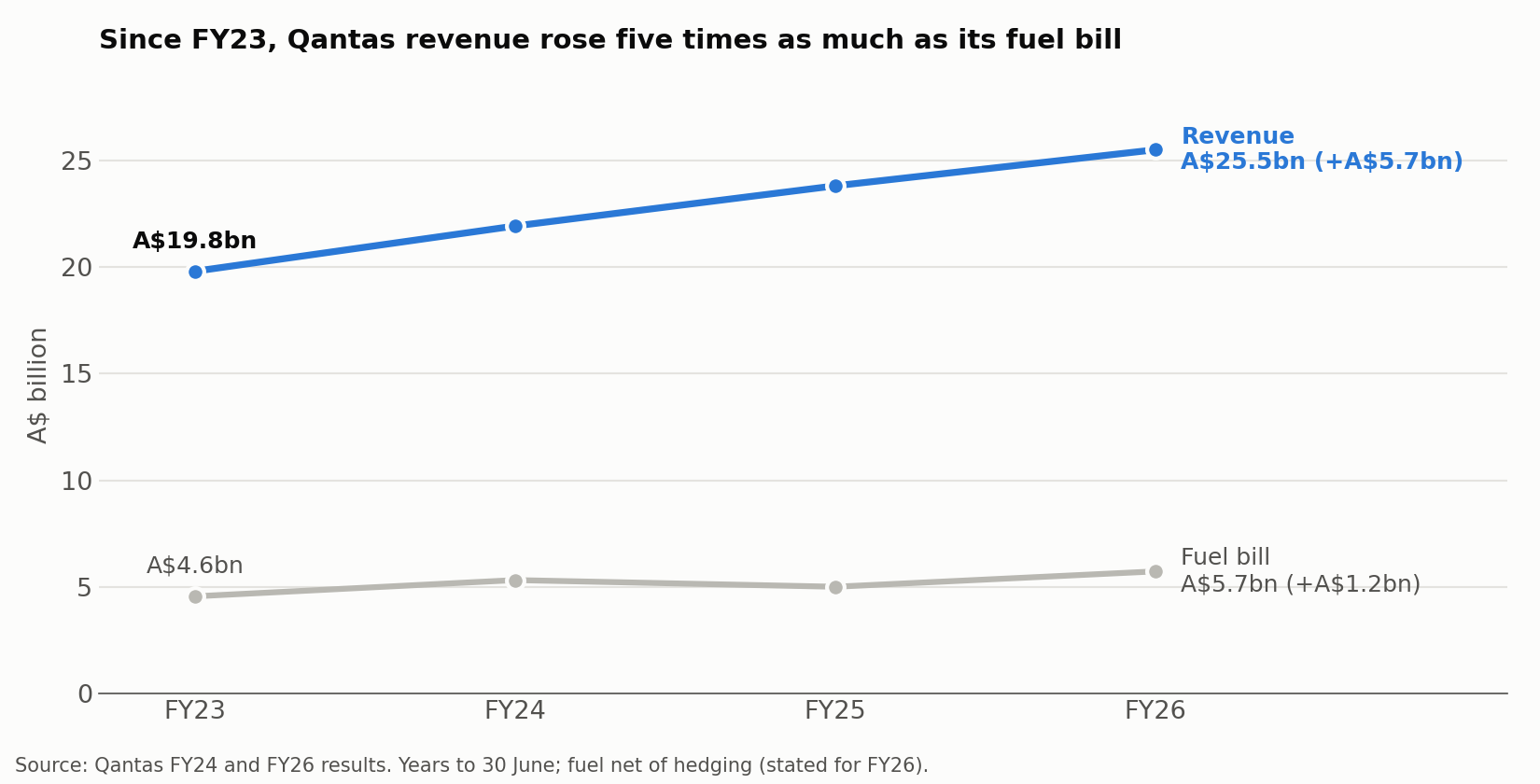
Fuel does not explain this deal. In FY26 its fuel bill rose A$721 million and its revenue rose A$1.7 billion, to a record A$25.5 billion. Since FY23, revenue is up A$5.7 billion and the fuel bill A$1.2 billion, according to Qantas’s own results. Project iQ was reported before the fuel estimate rose. Coles, Telstra, Woolworths and NAB do not buy jet fuel, yet they made the same move in the same year. Coles named the actual driver: cost. On this record, Accenture is selling corporate Australia a way to swap local wages for cheaper ones, and Qantas is its latest buyer.
What Qantas has already taken
When Covid grounded the fleet, taxpayers kept Qantas alive: A$856 million in JobKeeper wage subsidies and more than A$1 billion in other support, none of it repaid. In the same months it illegally sacked about 1,800 ground workers, a decision the High Court upheld and a judge called “a carefully planned act”. It cost Qantas A$120 million in compensation and a A$90 million penalty. It then sold tickets on 70,543 flights it had already cancelled (a A$100 million penalty), and tried to let A$570 million of customers’ Covid credits expire.
Since returning to profit, Qantas has made more than A$2 billion a year on revenue that has hit a record every year, reaching A$25.5 billion in FY26. It controls about two-thirds of domestic flying, and the competition regulator says barriers to entry have “helped to stave off competition”. Since 2023 it has paid shareholders about A$3.7 billion in buy-backs and dividends, while cutting 850 jobs to save money.
Reuters describes finance, procurement, HR and marketing as the “first phase”. Project iQ was scoped at up to 1,000 roles, and AI Weekly reports a seven-year term. That makes the 850 jobs phase one of a seven-year contract that was scoped larger, and the AI it was sold on still has no date.
Further Reading
- Qantas outsources 850 roles to Accenture in AI overhaul, Mediaweek’s report, carrying Qantas’s statement that the work goes to India first and AI comes “in time”.
- Qantas to cut 850 corporate jobs as it moves roles overseas in Accenture deal, ABC on the timeline, affected functions and the union’s response.
- Qantas denies 1,000 job outsourcing reports, Information Age on Project iQ and what Qantas told the union in August.
- Telstra to axe 800 more jobs, move some roles to India, the A$700m Accenture “AI” joint venture and where its job cuts went.
- Qantas just showed you how AI will kill white-collar jobs, the AFR Chanticleer column that framed the deal as AI.