

Intruders got into FinCEN, the Treasury bureau that collects banks’ reports on suspicious customers, and the bureau took some of its systems offline. In the roughly 32 hours after FinCEN announced it, the public code repository of Sam Corcos merged about 60 pull requests (proposed changes accepted into the code) into Legatum, his clone of Civilization VI. Corcos is Treasury’s chief information officer, and his office is in charge of Treasury’s cybersecurity. One of the changes added theme music for the Aztecs. Meanwhile, Catherine Rampell wrote on X that the system banks use to upload suspicious-activity reports in bulk had been down for more than 24 hours, so banks were filing them one at a time. Those reports feed criminal, tax and national-security investigations.
People then posted public complaints on the project telling Corcos to deal with the breach. The project responded by adding an AI moderator that closes “off-topic” posts. It closed one titled “Cyber security breach and E-Filing shutdown” 14 seconds after it was filed. The game, for the record, is pretty good.
FinCEN posted its notice on its Bank Secrecy Act filing site on the evening of November 24. The Bank Secrecy Act is the 1970 law underneath US anti-money-laundering rules. The notice said an “unauthorized party gained access to a limited subset of its systems” and that some systems had been taken offline as a precaution. The filing site stays up, some services may be unavailable, and deadlines are extended. A FinCEN order dated the same day waives deadlines temporarily because the outage is “hindering filers’ ability to adhere to reporting obligations.” The affected channel is the batch system that large filers use, and batch filings due from November 18 to December 29 now have until December 30. That is a lot of paper: institutions filed about 4.7 million suspicious-activity reports in fiscal 2024, roughly 12,900 a day.
FinCEN has not said how the intruders got in, how long they stayed, who they were, or whether anything was taken. A spokesperson told The Record that the FBI and CISA, the federal cybersecurity agency, are involved. The spokesperson also said there is no evidence of a breach of the Bank Secrecy Act or beneficial-ownership databases, meaning the records of who really owns companies. So the intruders reached the unit that holds the reports, and by FinCEN’s account they did not reach the reports themselves.
Sixty pull requests and a bot that closes complaints
Corcos co-founded Levels, a glucose-monitoring startup backed by Andreessen Horowitz. 404 Media reports that he came to Treasury as a hire of DOGE, Elon Musk’s cost-cutting office, and became CIO. Treasury’s leadership page lists an acting chief information security officer and an associate CIO for cybersecurity operations, both reporting to him. In August he also took three acting jobs at the General Services Administration, so when the breach came he held four senior posts.
Legatum 0.1.0 went public on November 22. We counted merged pull requests from the start of November 25 (UTC) to 07:38 UTC on November 26 and found 60. Among them:
- “Sound: music in a Mesoamerican style for the Aztecs”
- “Sound: a gunpowder-age soldier falls with a cry, a machine with a blast”
- “Breakable Walls (rules 62): a Walls bar that never regrows, Civ-style”
This was the project’s usual pace. It had merged 114 pull requests from November 22 to 24, before the notice, at about the same rate. Legatum is vibe-coded, meaning it is built by telling AI agents what you want and letting them write the code. When economist Alex Tabarrok asked about it, Corcos replied on X:
the computers are doing it on their own. Mostly Opus 5.5 orchestrating a bunch of iterative loops.
Opus 5.5 is one of Anthropic’s Claude models. The README says the game is “built largely with AI coding agents” and publishes CLAUDE.md, the instruction file the agents follow. Corcos’s replies on the tracker carry a “Generated by Claude Code” footer. The steady pace fits his account, but he is not only watching: 404 Media reported commits showing him giving Claude design notes, including, as The Outpost relays it, “I like Chariot archers for egypt, their current special unit is lame.” Egypt was already winning 21.4% of simulated games.
Rampell’s complaint was simple:
The Treasury CIO appears to have spent the past three days vibecoding a Civilization game clone instead of working on this major Treasury database cyber breach. As I type this, his Claude code is literally adding theme music
On November 10, Corcos had backed the General Services Administration mandate that federal workers send regular updates on what they did: “I believe it is reasonable to ask employees what they are working on. In the private sector, we call this a daily standup.” Rampell asked whether taxpayers were paying for his Claude credits. Corcos did not answer, and Treasury did not respond to 404 Media.
The public held its own standup on the project’s issue tracker, its list of public bug reports. An issue titled “Stop vibecoding and get back to work.” was opened at 14:14 UTC on November 25 and closed five minutes later, before any bot existed. Thirteen minutes after it was filed, a pull request appeared to “Close clearly off-topic issues and PRs when they are opened (two weeks)”. It merged 27 minutes after the complaint. The change uses a GitHub Models classifier, an AI model that sorts posts, to close anything it rates off-topic with at least 90% confidence. It skips trusted authors, adds a label and posts a reply: “This tracker is for bugs and ideas about the Legatum game.” It switches itself off after two weeks, roughly the length of a news cycle. Follow-ups the same day hid off-topic comments and added a keyword fallback for when the AI service failed.
Then it got to work:
- “Late game American civilization feels broken”, a satirical report that the Large Language Model tech wipes out your artists, was closed 28 minutes after it was filed.
- “Automated Moderation Rejecting Valid Issues” listed five posts it said the bot had wrongly closed, including “All play and no work makes FinCEN a dull boy.” It was closed as not planned within half an hour.
- #261, the FinCEN breach report, was filed at 23:27:57 and closed at 23:28:11. It was labelled “bug” and “off-topic.”
A real player report filed before any of this is still open. It describes a player stuck at turn 105 behind two allies, about 10 moves from any niter or coal.
Commenters on Tom’s Hardware argued that two things can be true: an executive’s hobby project does not mean the breach was neglected, and Treasury has separate cybersecurity officials. The public record does show where the speed went. The fastest responses on the project were not to bugs. They went to people asking the official in charge of Treasury’s cybersecurity to deal with Treasury’s cybersecurity.
We played Legatum as Switzerland
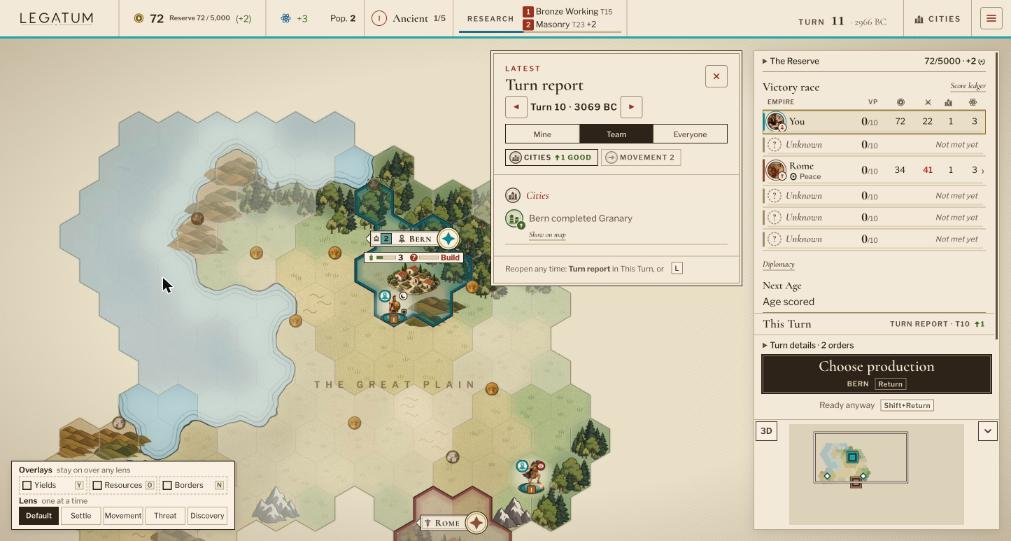
We played 11 turns of version 0.1.0 at playlegatum.com on November 26, on Hard, the default. It loads in a browser, about 7 MB, to a painted title screen. The README promises 11 peoples, nine eras, 45 technologies, three to six hours per game, and an AI with no bonuses at any difficulty. It also says every browser game is uploaded without player names, and that this “cannot be turned off.”
It plays like Civilization VI with the rough edges sanded down. You get a hex map, a Civ-style tech tree, and an advisor that explains each click. Every empire moves at once, and a turn resolves in seconds. Over our 11 turns it held together and was easy to read, and it felt more finished than a week-old hobby project usually does. Players who went further have reported “Game UI very slow” and, early on November 26, “Archers are immune to any damage”.
We were dealt Switzerland. Its intro card reads “Guard the passes. Keep the accounts.” Its strengths are banking: gold from every city, interest on the treasury, cheap purchases. Its drawback: “A rival that captures one of your cities takes part of your treasury.” Its goal is to keep 5,000 gold in the vault. It is a nation of bankers whose weak point is someone getting into the vault, built by the official guarding the Treasury’s.

On turn 11 we met Rome, next door, with an army of 41 against our 22. A November 22 census had Rome winning just 2.3% of simulated games. The commit log shows Hard Rome was retuned on November 23 and 24: “Hard Rome commits early to an unwalled neighbour,” then “Hard Rome eliminates its first victim.” Our capital had no walls.
The moderator turns itself off around December 9. Batch filers have until December 30. FinCEN says the FBI, CISA and outside examiners are still working out the scope of the intrusion. It has given no date for full service, and no word on whether data was taken. Its deadline relief reaches back to filings due November 18, and filing providers reported batch submissions failing from that day, six days before FinCEN disclosed the intrusion. FinCEN has not said when the intrusion began.
Further Reading
- Treasury CIO Is Vibe Coding a ‘Civilization’ Clone During Treasury Department Hack, 404 Media’s original report on Corcos and Legatum
- FinCEN investigates cybersecurity incident, takes systems offline, CyberScoop on the notice, what is offline and what FinCEN has not said
- Treasury’s FinCEN takes systems offline after cybersecurity incident, The Record, with FinCEN’s statement on the databases
- samcorcos/legatum, the game’s repository, README and commit history
- Close clearly off-topic issues and PRs when they are opened (two weeks), the pull request that added the moderation bot