
Australians paid Apple A$12.9 billion in its 2025 financial year. Apple’s Australian company paid A$188 million in tax. The method is simple. The Australian company pays a sister company overseas for almost everything it sells, or the overseas company makes the sale itself. The money leaves before it can become Australian profit, so the company declares almost no profit in Australia. The overseas company then books the profit in Singapore, Switzerland, the Cayman Islands or the Bahamas, where it pays a fraction of Australia’s 30% company tax.
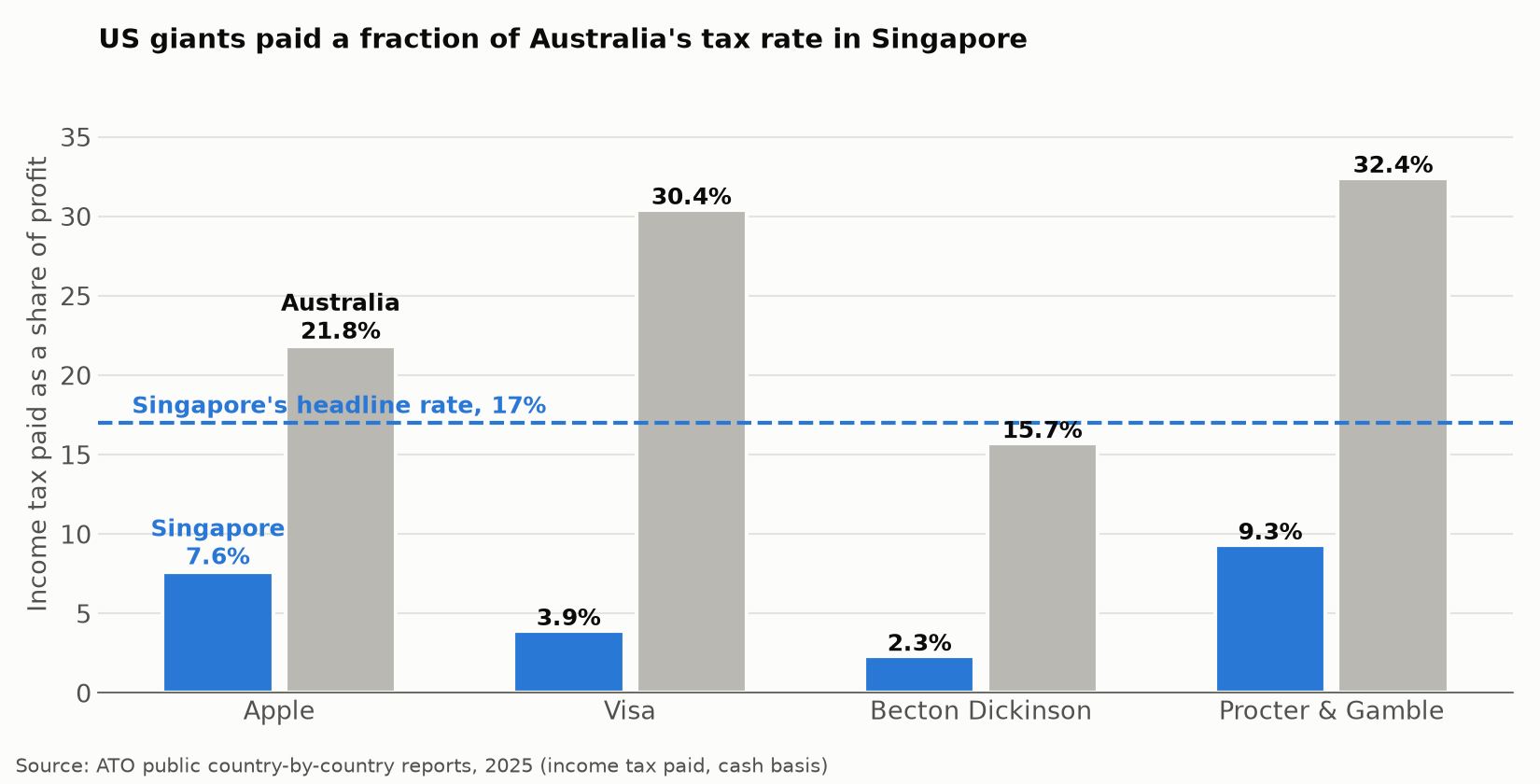
Australia’s first public country-by-country tax reports now show both ends of that trip, company by company. The Australian Taxation Office (ATO) released them on 12 November 2026. Each report gives a group’s revenue, profit, staff and tax in Australia and in 40 other named jurisdictions. Figures below are in US dollars unless marked A$. Tax rates are income tax paid in the year as a share of profit, taken from the reports.
Apple: A$12.9 billion of sales, 4.8 cents of profit per dollar
Apple’s Australian company makes nothing. It buys the iPhones and Macs it sells from other Apple companies, at a price Apple sets for itself. When the ATO closed a five-year audit of Apple Australia in 2017, those purchases cost it about 91 cents of every dollar it took in. For Apple worldwide the figure was 61 cents. The higher the price Apple charges its own Australian company, the less profit is left in Australia. At the 2015 Senate inquiry into corporate tax avoidance, Apple’s Australian head Tony King was asked whether Apple inflated those prices. He said: “Not at all.”
In the new report, Apple Australia declares $406 million of profit on $8.48 billion of revenue. That is 4.8 cents a dollar, and it paid 21.8% of it in tax. The Australian Financial Review reported in 2014 that since 2010 the seller has been Apple South Asia Pte Ltd in Singapore.
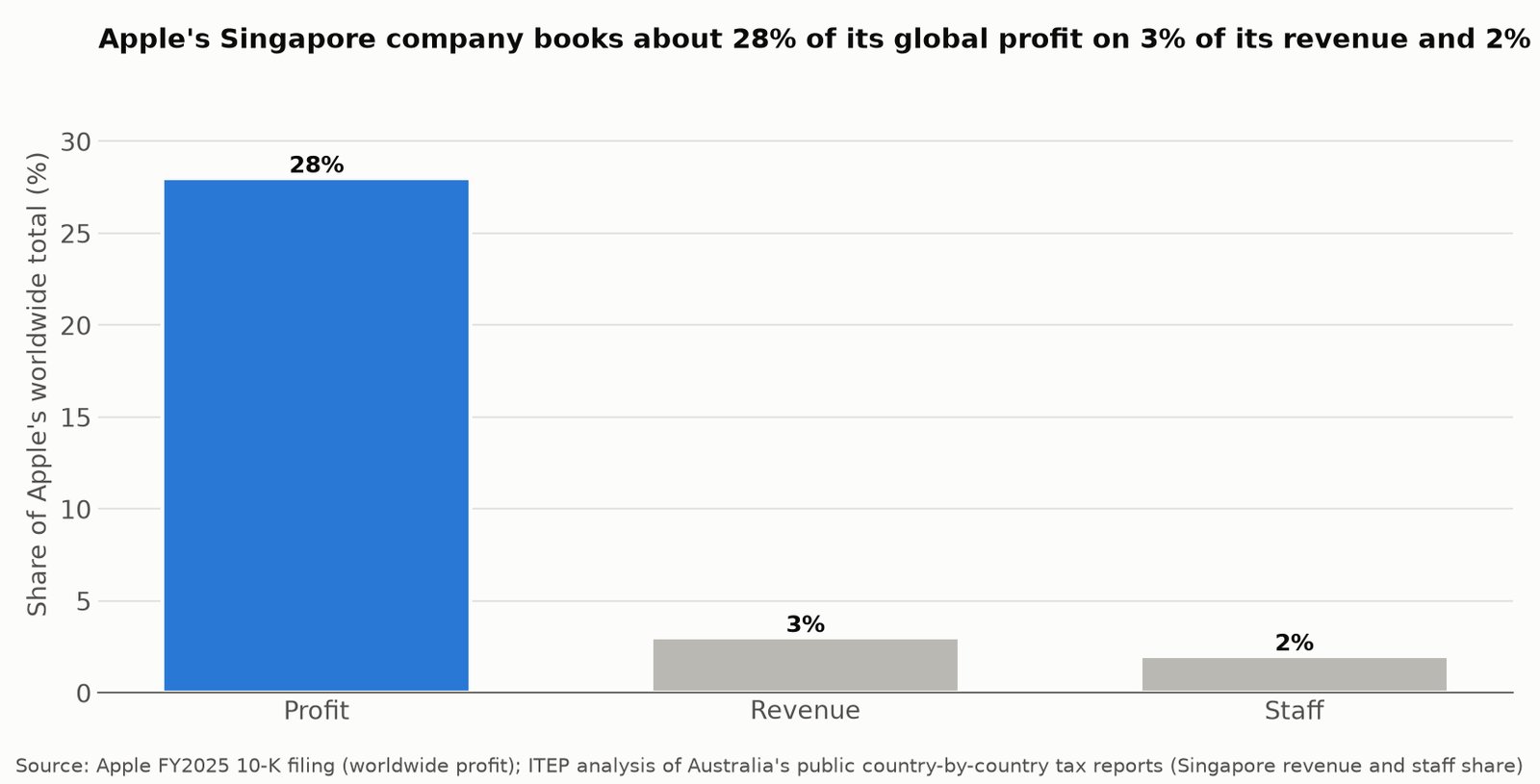
Apple’s Singapore company does not make anything either. Apple’s annual report says a “significant majority” of its manufacturing is done by outsourcing partners, mainly in China, India, Japan, South Korea, Taiwan and Vietnam. Singapore is not on that list. Yet the Singapore company took in $108 billion from other Apple companies and kept $36.6 billion as profit, 30 cents a dollar. That is more than a quarter of Apple’s worldwide profit, booked where it has 2% of its staff. It paid 7.6% tax, under Singapore’s own 17% headline rate. Its 3,870 staff made $9.4 million of profit each. Apple’s 2,916 Australian staff made $139,000 each, 68 times less, as Jason Ward of the Centre for International Corporate Tax Accountability and Research (CICTAR) calculated. The Singapore staff do not build 68 times more iPhones. Singapore is where Apple books the margin.
Visa: Australia’s card fees are booked in Singapore
Every Australian bank that issues Visa cards pays Visa fees to use its network. Those fees do not go to Visa’s Australian company. The company that “contracts in Australia with financial institutions” is Visa Worldwide Pte Ltd in Singapore, the competition regulator found in 2015. Visa’s Australian company is paid a fee for “marketing support, client support, relationship and liaison services”, according to the Singapore company’s 2024 accounts.
So in the new report, Visa Australia declares $91 million of revenue, $82.6 million of it from other Visa companies, and $7.2 million of profit. The Singapore company collected $4.81 billion of fees across Asia-Pacific in 2024, made $3.78 billion before tax, and booked a tax credit of $20.3 million rather than a bill. In the new report, Visa Singapore paid 3.9% on $3.95 billion of profit. Singapore granted Visa’s regional hub a tax incentive that runs to September 2028. In fiscal 2025 the incentive cut Visa’s Singapore tax by $453 million. Each of Visa’s 2,558 Singapore staff produced 63 times the profit of each of its 292 Australian staff.
Microsoft: from Singapore and Bermuda to Ireland
Until 2017, Microsoft did what Visa does. Its global tax chief, Bill Sample, told the 2015 Senate inquiry that about A$2 billion of Australian software and services revenue was booked in Singapore, against a little over A$100 million in Australia. Tax Commissioner Chris Jordan told the same inquiry that much of the Singapore profit was paid out as technology fees and “ends up in Microsoft Bermuda”, which then had no company tax. In 2017 Microsoft settled an ATO audit on confidential terms and switched to Apple’s method: Microsoft Australia now buys the software and resells it.
The purchases are where the money goes. In 2021 Microsoft’s Australian company had more than A$5 billion of revenue and bought more than A$3.4 billion from related companies, CICTAR found from its accounts. It was owned by Microsoft companies in Ireland. In the new report, Microsoft Australia declares $504.5 million of profit on $7.63 billion of revenue, 6.6 cents a dollar, and paid 24.3%. Microsoft’s annual report says its tax rate is lower mainly because of earnings taxed at lower rates through its regional operations centre in Ireland. Ireland produced 81% of Microsoft’s foreign profit before tax in fiscal 2025. The Australian reports cannot show how much of that came from Australians, because Ireland is not one of the 40 jurisdictions they name.
Disney: A$1 billion of revenue, paid out as royalties
Disney’s main Australian company earned A$1.01 billion in the year to September 2025, A$854 million of it from licensing Disney’s films, characters and brands. Royalties paid to Disney’s US parent for the right to use them absorbed most of it. A royalty is a cost to the Australian company, so it comes off its taxable profit. The company declared A$63 million of profit and paid A$16 million in tax.
The royalties are taxed, but not by Australia at 30%. Money paid out as a royalty escapes Australia’s company tax. Australia can take only a withholding tax on it, and under the US–Australia tax treaty that is capped at 5% of the royalty. The cap was cut from 10% in 2003. The rest is taxed in the US, under US rules. Disney’s worldwide group paid 10% of its $12.2 billion of profit in tax in the year, according to its report.
Procter & Gamble: 3.2 cents a dollar in Australia
P&G, the maker of Gillette, Pantene and Oral-B, sold $512 million to Australian customers. Its Australian company is, in its own words, “purely a distributor”: it buys the products from other P&G companies and resells them. It declared $16.3 million of profit, 3.2 cents a dollar. P&G’s regional hubs describe their work in the report as “strategic management and operational oversight” of manufacturing and supply. That is where P&G books its profit. P&G’s Asia-Pacific headquarters in Singapore took in $4.1 billion from other P&G companies, booked $822 million of profit and paid 9.3%. Its Latin American headquarters in Panama booked $217 million, all from other P&G companies, under a regional-headquarters law that gives multinationals tax incentives. It paid 4.0%.
Becton Dickinson: $266 million in a Cayman company with nobody in it
Becton Dickinson, the US maker of syringes, needles and catheters, sold $281 million to Australian customers. Its Australian company describes itself in the report as “sales, marketing, or distribution”. It declared $20.6 million of profit and paid 15.7%. The profit is booked elsewhere. BD’s Singapore company, which BD says holds and manages intellectual property, booked $2.06 billion of profit. Most of its revenue (91%) came from other BD companies, and it paid 2.3%. Its 1,480 staff made 26 times the profit of BD’s Australian staff, each.
Three Cayman Islands companies show what the system is for. They have no staff and no buildings or equipment, and BD lists their activity as “internal group finance”. They collected $266.3 million from other BD companies, kept almost all of it as profit and paid no tax. BD’s US annual report shows an $11 million loss in the United States and $1.89 billion of profit abroad. The report never mentions the Cayman Islands, the Institute on Taxation and Economic Policy (ITEP) noted.
Sazerac: one cent a dollar in Australia, 91% of the profit in Lucerne
Sazerac, the private US distiller behind Buffalo Trace and Pappy Van Winkle, sold $117 million of spirits to Australian customers. In the report its Australian company is labelled “distributor” and its Swiss company “principal”, the company that owns the goods and carries the business risk. The distributor declared $1.2 million of profit, one cent a dollar. The Swiss principal has 76 staff and no outside customers. All of its revenue came from other Sazerac companies. It booked $469 million of profit, 91% of the group’s total, and paid 1.4%. Each Swiss employee made $6.2 million of profit; each Australian employee made $15,000. The Swiss company was registered in Lucerne in December 2023 as a “global competence centre” for the group.
Franklin Templeton: nine staff in Nassau, $103 million, no tax
Franklin Templeton, the fund manager, has 144 staff in Australia and declared $25.8 million of profit there. Its Bahamas company, Templeton Global Advisors, has nine staff. It managed $25.8 billion as of September 2025 and charges a fee on every dollar of it. It booked $103 million of profit, $11.4 million per employee, and paid no tax, because the Bahamas has no corporate income tax.
What the reports cannot show yet
Ireland, Luxembourg and the Netherlands are not among the 40 named jurisdictions, so profit booked there disappears into a rest-of-world line. The first release mainly covers groups whose financial year ends on 30 June or in September. Companies that close their books on 31 December include Alphabet, Meta, Amazon, Netflix and Uber. Their reports are expected in May 2027.
Assistant Minister Andrew Leigh announced the release: “Multinational profits can travel halfway around the world without a suitcase.” The reports now show where the profit went, and how little tax it paid when it got there.
How you can do the same
Say you run a small business in Australia and like the look of a 7.6% tax rate. Here is the method, step by step, and where it stops working for you.
- Register a company in Singapore, Switzerland or the Cayman Islands. Anyone can. But Australia’s controlled foreign company rules apply to Australian residents who control a foreign company, and can tax its income in your hands as if you had earned it yourself. Apple Australia does not own Apple’s Singapore company. Apple Inc. in California does, so those rules never reach it.
- Make it the legal hub of your business. Under the ATO’s residency ruling, a company registered overseas is an Australian tax resident if its central management and control, the place where the big decisions are made, is in Australia. Run your Singapore company from your kitchen table in Ballarat and it pays Australian tax. Apple’s Singapore company has 3,870 staff.
- Have it charge your Australian business for everything you sell. Under Australia’s transfer pricing rules, prices between related companies must match what unrelated businesses would charge, and the ATO can rewrite them if they don’t. The giants pay advisers to defend their prices, and some agree them with the tax office in advance. Cisco has such an arrangement with both the ATO and the US Internal Revenue Service. Atlassian is negotiating a new one.
- Declare a small profit to keep the ATO happy. You already pay tax on whatever profit is left: 25% for most companies with turnover under A$50 million, 30% for the rest. The giants don’t win on the rate. They win on how much profit is left to tax. Apple Australia kept 4.8 cents a dollar after paying its sister company.
The giants’ advantage is not a lower Australian tax rate. It is a parent company overseas that owns both ends of the sale and sets the price in between.
Further Reading
- Public country-by-country reporting, the ATO’s full dataset of the 382 reports
- New Australian Data Shed Even More Light on Tax Avoidance by Big Tech and Others, ITEP on Apple, Becton Dickinson and US disclosure
- Australia Releases First Country-by-Country Tax Reports, FACT Coalition on Apple, Visa, Sazerac, Becton Dickinson and Franklin Templeton
- Country-by-country tax reporting: who is dodging what and where, Jason Ward of CICTAR on Apple, Microsoft and Visa
- Apple emerges unscathed from five-year ATO tax audit, iTnews on the 91-cent cost of sales