
L3Harris is the defense contractor that has run key parts of the Federal Aviation Administration’s telecommunications network for more than 20 years. In 2025 it made about $1.6 billion in U.S. profit and paid no federal income tax on it. Three quarters of its revenue comes from the U.S. government, according to both its annual report and ITEP’s analysis. The public pays for most of what L3Harris sells, and in 2025 the Treasury also sent it $355 million in tax refunds.
That network is where the November 13 failure began. The outage grounded every departure in the country for more than four hours, the third nationwide ground stop in FAA history.
How the bill reached zero
L3Harris’s annual report, filed February 12, puts its U.S. pretax income at $1,677 million for 2025. At the 21% corporate rate, that profit would carry roughly $352 million in federal tax. The line for federal tax owed that year reads minus $10 million, a small credit. The Institute on Taxation and Economic Policy (ITEP), a tax research group, arrives at the same zero.
The cash went the same way. L3Harris collected $355 million in federal refunds from amended returns and carryback claims, which apply credits or losses to earlier years’ taxes. It then spent $191 million buying transferable tax credits, credits that other companies earned and sold on. Net of what it spent on those credits, L3Harris came out $164 million ahead on federal tax for the year.
ITEP’s headline blames last year’s One Big Beautiful Bill Act for the zero. Its own text, and L3Harris’s filing, show the company was already at zero in 2024, before that law existed:
| 2024 | 2025 | |
|---|---|---|
| U.S. pretax income | $1,406M | $1,677M |
| Federal income tax owed that year | −$166M | −$10M |
The 2025 credit is smaller than the 2024 one, so the new law did not create the zero. The breaks that show up in both years do that work, and these reduce tax outright instead of postponing it:
- R&D tax credits: $226 million in 2025
- Foreign-derived intangible income deduction (a lower rate on profits from sales to foreign buyers): $35 million
- Manufacturing tax credits: $22 million
In 2024, tax audit settlements also helped. In 2025, the refunds did.
The 2025 law added a write-off on top of those breaks, and this one is about timing. The 2017 tax law made companies spread research costs over five years starting in 2022. Under that rule L3Harris deducted less up front and paid tax sooner, including $328 million of current federal tax in 2023. The 2025 law, signed July 4, permanently restored the immediate deduction and let companies claim the costs they had been spreading out. ITEP calculates the write-off was worth $449 million to L3Harris in 2025. The 10-K shows the same amount as the fall in its record of tax paid early on research it could not yet deduct, from $1,694 million to $1,245 million. Part of the $449 million is L3Harris getting back tax it had already paid early.
The write-off was not paired with a research boom. Much of L3Harris’s R&D is paid for by customers, principally under U.S. government contracts. The research it funded itself rose from $515 million to $536 million, an increase of $21 million.
L3Harris’s own accounts tell a different story. In the figures companies report to shareholders, the 10-K shows total 2025 income tax expense of $326 million, a 16.9% rate, up from $85 million (5.3%) in 2024. That total includes $166 million of deferred federal tax, booked now but owed in future years, and the write-off is what moved tax into that line. The company also says the new law raised its rate by 1.8 points; the same law cut the value of the R&D credit. That is a paper charge. The federal cash in 2025 still went to L3Harris.
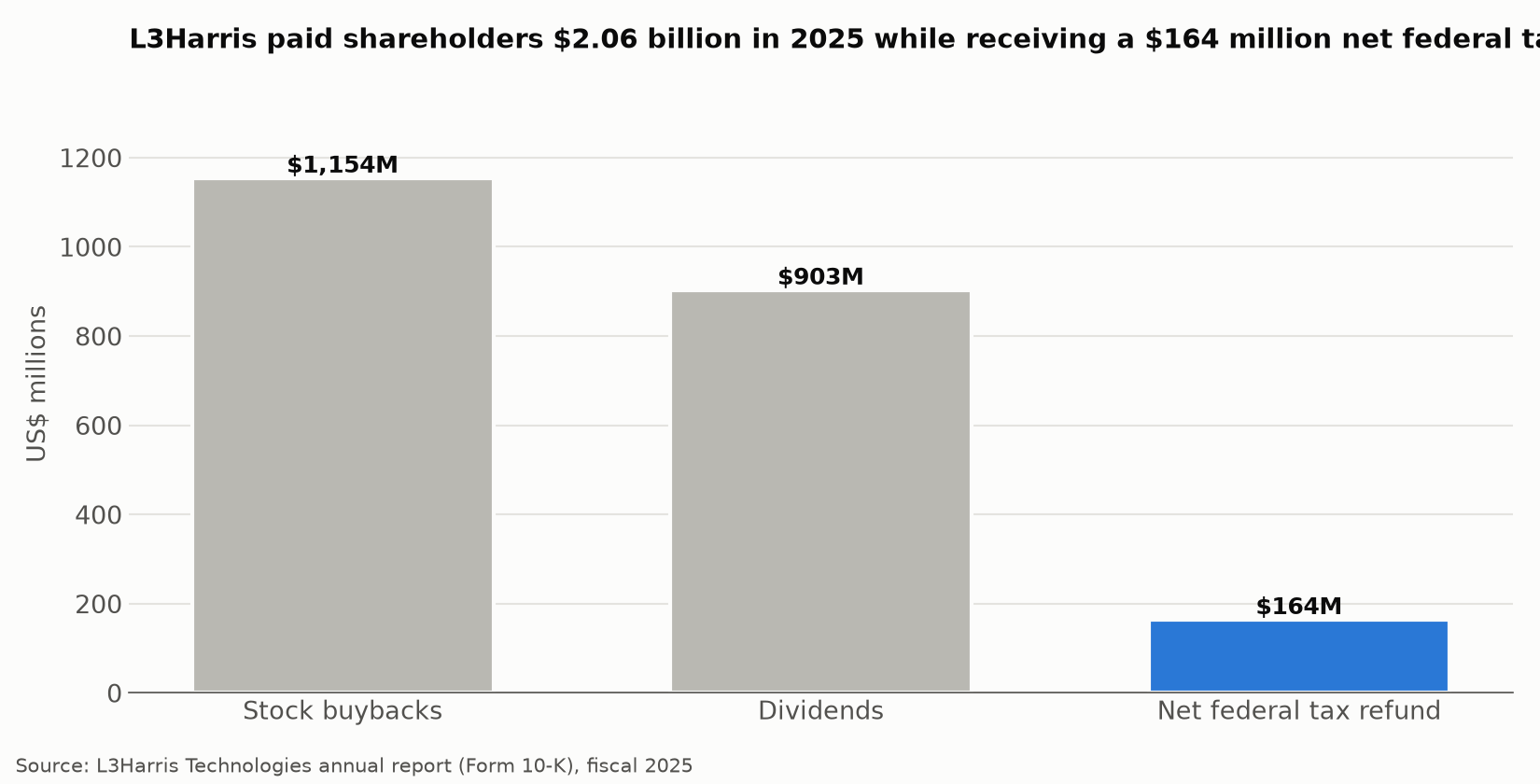
The company’s own spending went elsewhere. In 2025 L3Harris paid shareholders about $2.06 billion: $1,154 million in stock buybacks and $903 million in dividends.
It has plenty of company. ITEP counts L3Harris as one of 114 Fortune 1000 corporations that paid no federal income tax on substantial U.S. profits in 2025. The same zero turns up abroad, among the billion-dollar companies paying no income tax in Australia.
The network that went down
The FAA Telecommunications Infrastructure carries voice and data between more than 4,400 FAA facilities and supports about 45,000 flights a day, Newsweek reports. L3Harris is partway through moving it from copper lines to fiber. When it failed on November 13, more than a million travelers were affected.
Transportation Secretary Sean Duffy blamed old hardware:
“Today’s nationwide ground stop happened because our air traffic control system is operating on DECADES-OLD analog equipment that simply cannot compete with the demands of the 21st century.”, Sean Duffy, on X
By the next day, Duffy told reporters that investigators were looking at a router installed during the fiber conversion, which had been making more than 1,000 connection attempts every few seconds. He said they were checking whether the cause was “user error or installer error from L3Harris, or did they install a faulty router.” The failure under investigation is in new equipment L3Harris installed, not the old analog lines Duffy blamed. Officials found no sign of a cyberattack. L3Harris says it is “supporting the FAA in its investigation” and that more than 70% of the conversion is done.
The bill landed elsewhere. Analysts at Bernstein estimated that American, Delta, United and Southwest alone lose about $345 million in pretax earnings.
This is not the first such failure. After a ground stop at the Dallas airports in September 2025, the FAA said “an oversight by L3 Harris, an FAA contractor, failed to make sure that redundancies in the system functioned properly.” Since the outage, Duffy has said L3Harris is “not doing great work for us.”
None of this has hurt the business. In October L3Harris reported a record backlog of $53.2 billion, meaning orders booked but not yet delivered, and a third-quarter operating margin of 13.0%, up two points on a year earlier.
In March the FAA also gave L3Harris a five-year contract for the services behind its ADS-B aircraft-tracking network. The federal contract tracker HigherGov lists it as worth up to $1.118 billion, awarded sole source on a single bid. And the tax break does not end with 2025: the immediate research write-off is permanent. Only the one-time catch-up on 2022-24 costs is finished.
Further Reading
- L3Harris, the Company Behind Air-Travel Meltdown, Paid No Federal Income Tax on $1.6 Billion in Profits, ITEP’s breakdown of the zero, including the $449 million R&D figure and the 2024 comparison.
- L3Harris Technologies annual report (Form 10-K), fiscal 2025, the primary record; Note 7 covers income taxes, refunds and the breaks.
- Who is L3Harris?, Newsweek on the company’s FAA contracts, the router, and Duffy’s remarks.
- Outdated infrastructure behind Dallas airport ground stops, CBS Texas on the 2025 incident the FAA attributed to an L3Harris oversight.