
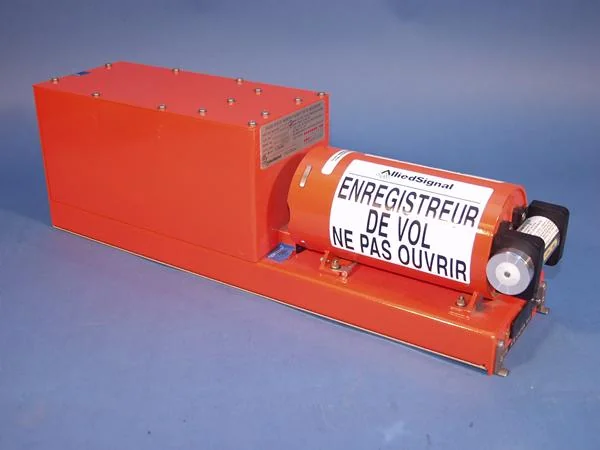
Airplane black boxes, more accurately called flight recorders, are legally required by aviation authorities to be painted a bright high-visibility orange (or occasionally yellow), not black, so that investigators can quickly spot them in wreckage on land or underwater. International standards from bodies like the International Civil Aviation Organization (ICAO), EUROCAE, and the U.S. Federal Aviation Administration specify both the conspicuous color and reflective markings to make the recorder as easy to find as possible after a crash.
Despite the nickname, the word “black” has nothing to do with the color. The name stuck from World War II era electronics and from the systems-engineering idea of a “black box” whose inner workings are hidden. In fact, regulations explicitly call for flight recorders to be bright orange and labeled “FLIGHT RECORDER DO NOT OPEN” in contrasting letters so that recovery teams can identify them at a glance.
What is an airplane black box?
When people talk about an airplane “black box,” they are usually referring to the crash-protected flight recorder carried on commercial aircraft. In modern airliners there are two core devices: the flight data recorder (FDR), which logs hundreds of technical parameters like altitude, speed, control positions, and engine performance, and the cockpit voice recorder (CVR), which captures crew conversations, radio calls, and ambient cockpit sounds for at least two hours of flight time.[Flight recorder, Wikipedia]
Some newer aircraft combine these into a single unit called a combined voice and data recorder or Enhanced Airborne Flight Recorder, but the function is the same: to preserve what the airplane and the crew were doing in the minutes and hours before an accident. According to the International Civil Aviation Organization, these recorders have been mandatory on large commercial airliners in many countries since the 1960s, because they dramatically improve investigators’ ability to understand why a crash occurred.[ICAO accident investigation guidance]
Each recorder sits in a protective crash-survivable case mounted typically near the tail of the aircraft, where structures often remain more intact. Inside that case are solid-state memory modules or, in older units, magnetic tape or wire. These are engineered to survive extreme forces and temperatures that would destroy almost any other onboard equipment.
Why are airplane black boxes orange instead of black?
The bright orange color is purely about visibility and recovery, not symbolism. International technical standards that govern flight recorder design, such as EUROCAE ED-112, require that crash-protected recorder cases be painted a high-visibility orange or yellow and include reflective surfaces so they stand out in debris fields or murky water.[Flight recorder specifications] In practice, almost all modern commercial aircraft recorders are coated in a intense, fluorescent orange that many manufacturers market as “high-visibility orange” or “safety orange.”
The recorders must be housed in boxes that are bright orange in color to make them more visually conspicuous in the debris after an accident.
This requirement exists because, after a crash, the first technical priority is often to locate the recorders. Wreckage may be scattered over kilometers of forest, ocean, or rugged terrain. Painting the units black, gray, or any low-contrast color would make them very hard to see. Bright orange cuts through background clutter, especially when paired with reflective tape and bold white lettering.
Color is only part of the location strategy. Each unit also carries an underwater locator beacon, a small acoustic transmitter that starts emitting an ultrasonic “ping” as soon as it contacts water. According to the U.S. National Transportation Safety Board and European regulators, these beacons are designed to operate for at least 30 days and at depths of up to around 6,000 meters, giving search teams a sonic homing signal when visual search is impossible.[NTSB report, Flight 447]
Where did the term “black box” come from?
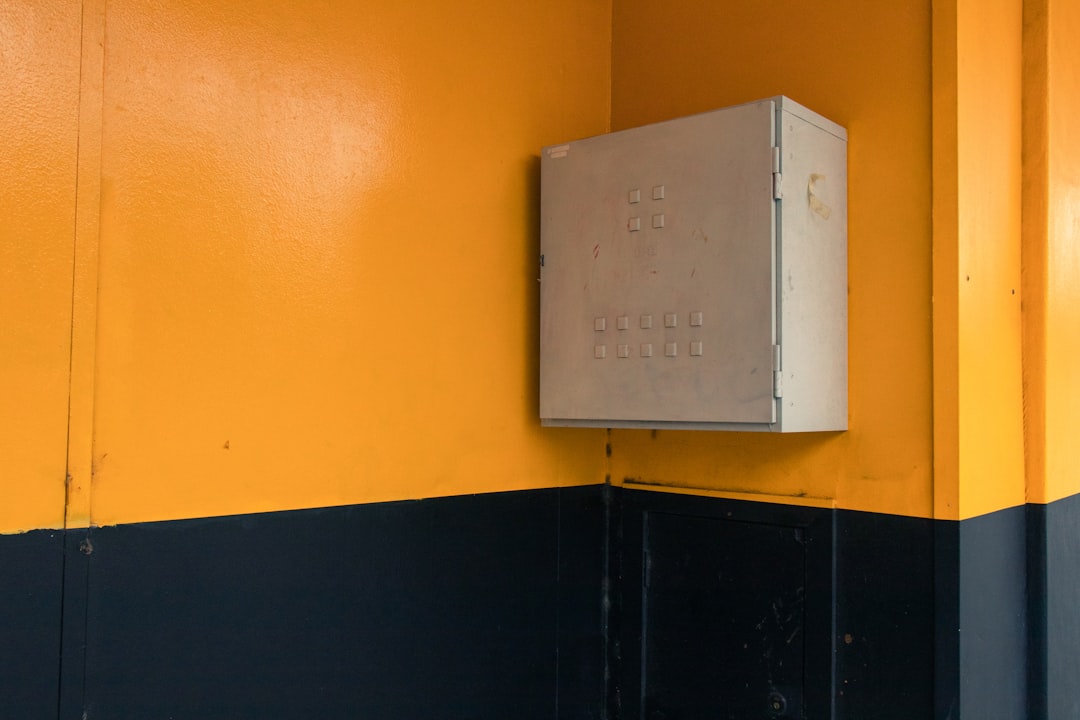
The nickname “black box” predates modern orange flight recorders, and it has two main historical roots. One is wartime aviation: during World War II, British and Allied aircraft carried increasingly sophisticated and secret electronic devices for radar and navigation. These units were often placed in non-reflective black enclosures to hide their details and make them harder to identify, and technicians colloquially called them “black boxes.” An early public reference appears in a 1945 article in the magazine Flight about adapting wartime radar to civilian use, which mentions the stowage of “black boxes” in airliners.[Flight recorder terminology]
By 1967, when flight recorders were mandated by leading aviation countries, the expression “black box” was already in general public use, even though the devices themselves were fluorescent flame-orange in colour.
The other root is the broader engineering and science concept of a black box system. In systems theory and cybernetics, a black box is a device or process that you study only through its inputs and outputs, not by inspecting its internal mechanism. Pioneers like W. Ross Ashby and Norbert Wiener used the term in the 1940s and 1950s to describe everything from electronic circuits to animal behavior.[Black box, Wikipedia] In that sense, a flight recorder is not literally a black box, because the whole point is to open it and examine the stored data, but the metaphor resonated with both engineers and the public.
So when modern crash-protected flight recorders were proposed in the 1950s by inventors like Australian scientist David Warren and U.S. engineer James Ryan, the phrase “black box” was already familiar shorthand among aviation specialists. By the late 1960s, as regulators made such recorders mandatory, newspapers and television news adopted the term for audiences, and it has stuck ever since, even as the casings turned bright orange.
How do flight recorders work and survive crashes?
Understanding why regulations treat airplane black boxes so differently from other onboard electronics helps explain their color, construction, and placement. A modern flight recorder has three main parts: the input electronics that receive data from the aircraft’s sensors and avionics networks, solid-state memory modules that store that data or audio in fault-tolerant formats, and the crash-survivable memory unit that physically protects everything during an accident.
For the flight data recorder, the aircraft funnels information from dozens to hundreds of parameters into a standardized digital data stream. U.S. regulations now require that large commercial jets record at least 88 key parameters, up from 29 prior to 2002, and many airlines voluntarily record far more so they can monitor operations and maintenance trends.[FAA FDR guidance] Typical examples include control surface positions, autopilot modes, engine thrust, flap configuration, and vertical acceleration. Most of these are sampled multiple times per second.
The cockpit voice recorder, by contrast, continuously captures four separate audio channels in the cockpit, for example the captain’s and first officer’s headsets, the cockpit area microphone, and possibly an observer’s station. Older regulations required only 30 minutes of audio, but in the United States and Europe that minimum has been extended to two hours, and the European Union now mandates 25 hours for new aircraft so that more of a flight can be reviewed.[EASA rule on 25-hour CVRs]
To survive, the crash-survivable memory unit is built to meet strict standards like EUROCAE ED-112. These require that a recorder withstand an impact of about 3,400 g (thousands of times Earth’s gravity) over milliseconds, prolonged fire at temperatures over 1,000 degrees Celsius, deep-sea pressure, and long immersion in aviation fuel and salt water. Manufacturers achieve this with multiple layers: corrosion-resistant metal shells, high-temperature insulation, and mechanical designs that cushion the memory modules against shock.
Why not make the whole plane out of what the orange box is made of?
You sometimes hear a joke: if the black box survives the crash, why not build the entire aircraft out of the same material? In reality, flight recorders are allowed to be extremely heavy, rigid, and small because their only job is to protect data. An airliner must be light enough to fly efficiently, flexible enough to handle turbulence and pressurization cycles, and economical to build and maintain. Scaling up black-box-style construction to an entire airplane would create a vehicle so heavy and stiff that it could not fly within any reasonable performance or cost envelope.
Regulators treat recorders as a special case: they can be massively overbuilt, located in the strongest part of the airframe (often the tail cone), and painted in conspicuous orange without worrying about aerodynamics or aesthetics. Wings, fuselage skins, and control surfaces, by contrast, are optimized for lift-to-drag ratio, fatigue life, and fuel economy. They already incorporate significant safety margins, but they are not designed to be indestructible in the way a recorder casing is.
This difference in design priorities is why you see such a contrast: a compact, bright orange box engineered to endure impacts and fires that no human could survive, attached to a much larger flying structure that must balance safety against many other constraints.
What does the future of airplane black boxes look like?
Although the basic idea of a crash-survivable, bright orange recorder has not changed, several trends are reshaping how flight data is captured and retrieved. After high-profile accidents over oceans, such as Air France Flight 447 in 2009 and Malaysia Airlines Flight 370 in 2014, investigators and regulators have pushed for improvements in live data streaming, longer-duration cockpit voice recordings, and even deployable recorders that eject from the aircraft before impact.[IEEE Spectrum, Beyond the Black Box]
Concepts under discussion include recorders that automatically detach and float, equipped with satellite beacons so searchers can locate them quickly even if the main wreckage is deep underwater, and systems that continuously transmit critical parameters to the ground so that some information is preserved even if the recorder is never recovered. Military aircraft have used deployable recorders since the 1990s, and civil aviation bodies like the International Civil Aviation Organization have been studying whether similar systems make sense for airliners.
What will not change any time soon is the basic regulatory logic: regardless of how data is captured, accident investigators need a reliable, crash-survivable, and easy-to-find source of information. That is why, for the foreseeable future, there will still be at least one bright orange “black box” bolted into the tail of every large commercial airliner.