
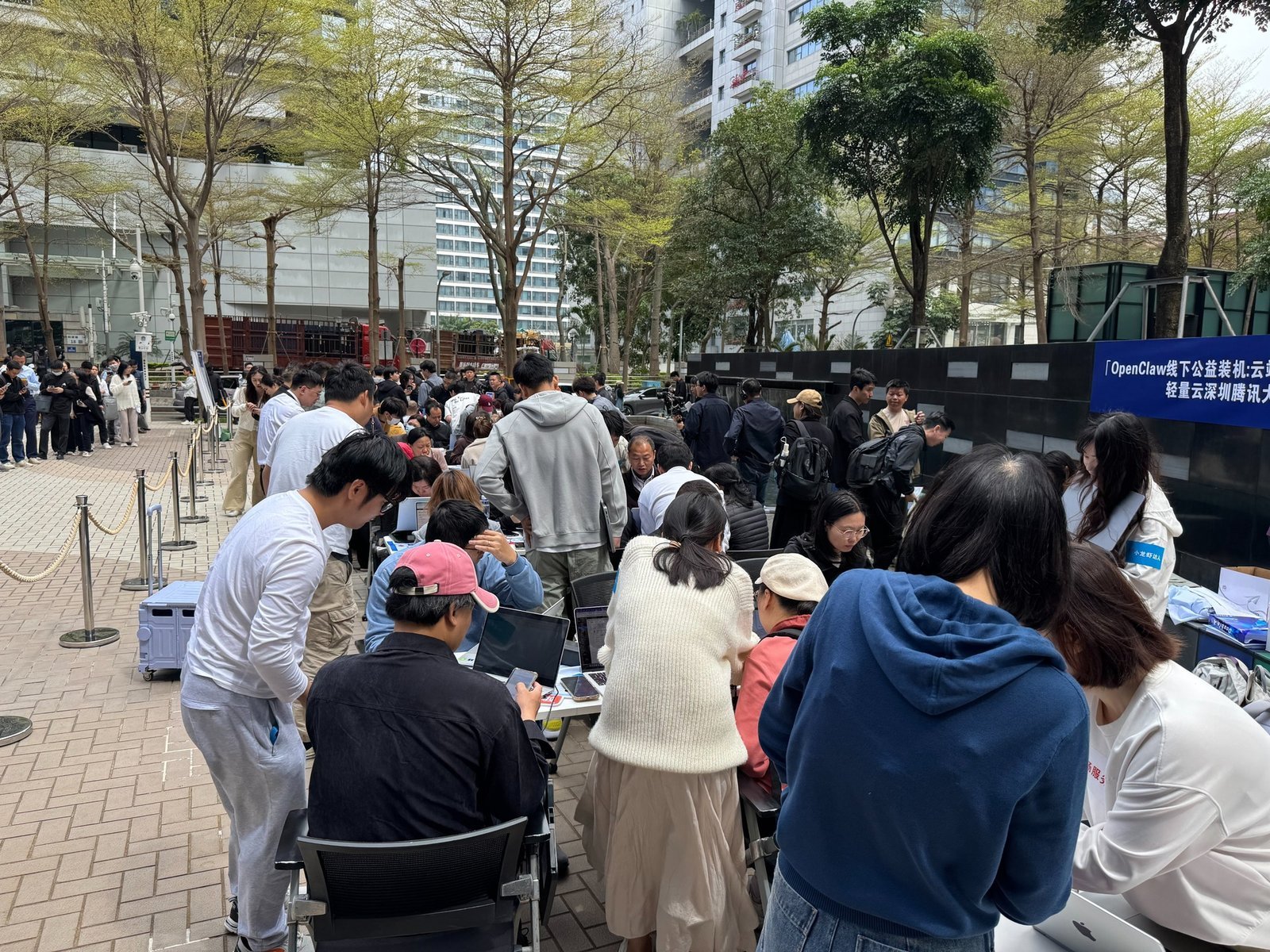
On a Thursday in March, Tencent set up some tents outside its Shenzhen headquarters and offered free OpenClaw installs. By 11 a.m., hundreds of appointment slots were gone, and almost 1,000 people, from fourth‑graders to a near‑70‑year‑old heritage expert, had shown up for a five‑minute deployment. If you want to understand AI adoption in China, start here.
This wasn’t a “developer conference.” It was a public service desk for spinning up an AI agent stack.
The argument I want to make: this is not just cultural enthusiasm or China being “into tech.” It’s the visible tip of a deliberately engineered system for deployment velocity, and that system creates a very different competitive and security profile than the West’s slow, safety‑first AI rollout.
TL;DR
- Shenzhen’s OpenClaw day shows China has turned AI installs into a walk‑up utility, not a startup side project.
- One‑click cloud templates, a paid installer market, and local subsidies form a loop that manufactures deployment velocity.
- That loop accelerates learning and market power, but also centralizes security and governance risk in ways that will matter globally.
Shenzhen’s OpenClaw turnout: proof that AI adoption in China has shifted
Start with the numbers.
Caixin and Shenzhen News both report roughly 1,000 attendees at Tencent’s March 6 OpenClaw event, held on the plaza of Tencent’s Shenzhen tower. Hundreds of appointment numbers were handed out and used up in about an hour. Each installation? Around five minutes per person, handled by Tencent Cloud’s Lighthouse engineers.
The crowd mix is the bigger tell: not just coders, but:
- a nearly 70‑year‑old intangible‑heritage expert
- a retired aerospace engineer in his 60s
- a Shenzhen fourth‑grader
- people who’d traveled in from Hong Kong and Hangzhou
That’s not “early adopters.” That’s “people you’d normally see at a bank branch.”
The format is familiar if you’ve watched Chinese tech before. This looks less like an Apple keynote and more like a WeChat Pay street campaign circa 2015, the company shows up physically and onboards the next million users in a weekend.
The important shift: this time, they’re not installing an app. They’re installing an agent framework that can call tools, ingest data, and sit exposed on a network.
That’s AI as infrastructure, deployed from a folding table.
How templates, paid installers and subsidies manufacture deployment velocity
If you read Tencent Cloud’s documentation, you realize why this can scale. The company has turned OpenClaw into a Lighthouse template: pick SKU, click deploy, wait ~30 minutes for the full stack. No hand‑editing Docker files. No “now compile this from source.”
The in‑person event just compressed this even further. Engineers prepped the configs; walk‑ups got hand‑held through domain binding, access keys, and a working instance in minutes.
Around this you now see three reinforcing mechanisms:
- One‑click cloud templates
Every major cloud, Tencent, Alibaba, Baidu, has rushed out some flavor of “OpenClaw-in-a-box.” This matters because friction is the actual policy lever: when deployment is literally a button labeled “go,” the decision boundary moves from “can we?” to “why not?”
- An on‑demand installer service market
Tencent’s own write‑up casually notes that on‑site OpenClaw installers are charging ~500 RMB per visit. Caixin finds listings going up to 1,000 RMB. You now have a micro‑industry of people whose job is “show up at your office or school, and you have agents by lunch.”
That’s Uber for MLOps.
- Local government subsidies and support
Longgang district’s draft “OpenClaw & OPC” measures propose:
- free OpenClaw deployment services in designated “Lobster Service Areas”
- subsidies up to 2 million RMB for qualifying projects
- awards up to 1 million RMB for code contributions and community building
In other words: the city will both pay you to deploy and deploy it for you for free.
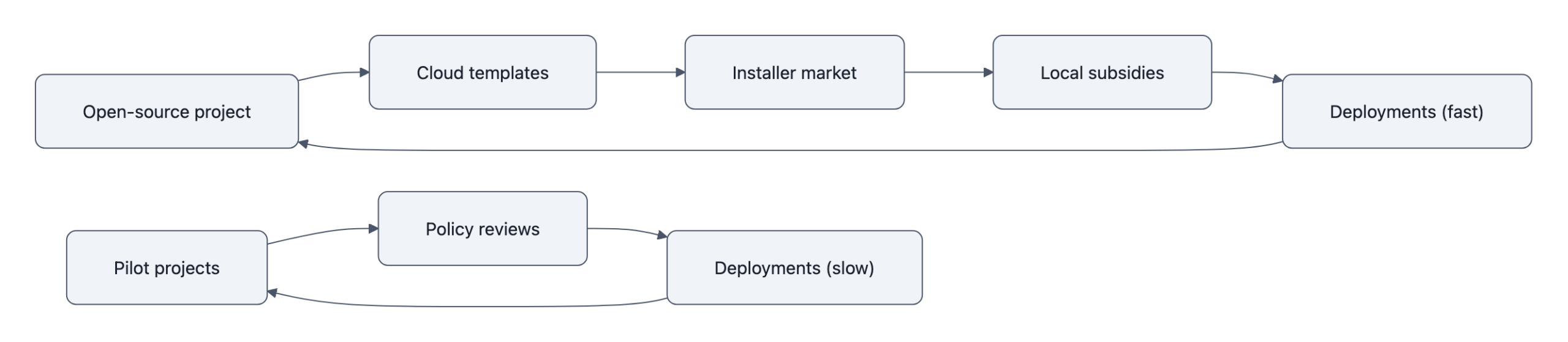
Put these together and AI adoption in China stops being about individual companies deciding to “experiment with LLMs.” It becomes a pipe:
- OSS project goes viral
- Cloud vendors ship turnkey templates
- Installer market appears within weeks
- Local governments sweeten the unit economics
Run that loop enough times and deployment velocity becomes a structural feature of the economy, not a quirk of one product.
Speed vs. safety: MIIT warnings and concentrated security trade‑offs
There’s a cost to turning AI installs into a mall kiosk.
On February 5, before the Shenzhen event, China’s Ministry of Industry and Information Technology publicly warned that default or misconfigured OpenClaw setups “could pose significant security risks” when exposed to the public internet. The advisory calls for:
- thorough audits of network exposure
- strong identity authentication
- hardened access controls
Read between the lines: they had already seen enough bad deployments to worry.
This is exactly the failure mode we wrote about in our piece on security failures: once configuration is industrialized, misconfiguration scales just as fast. Default passwords at the Louvre are embarrassing; default‑open AI agents with tool access are exploitable infrastructure.
China’s approach doesn’t ignore this; it centralizes it.
- Technical patterns are standardized through templates.
- Human operators are funneled through the same training and marketplace.
- Local governments are tying their brand to specific stacks (OpenClaw, OPC).
So when something goes wrong, it won’t be one hospital’s hobby project. It’ll be a category, “that Longgang OpenClaw profile” or “the Lighthouse default template”, with thousands of identical instances.
Regulators seem prepared to live with that. You allow the experiment to run at scale, watch what breaks, then patch centrally.
Western AI governance is doing the opposite. Slow pilots, tight policy, lots of “model cards” and risk assessments before rollout. Fewer catastrophic misconfigurations per product, but far less surface area for learning how agents fail in the wild.
Both choices are rational. But they produce very different worlds.
Why this model of AI adoption in China matters globally
First, product competition.
A team in Shenzhen can wake up to a new agent capability on Monday, push a Lighthouse template on Wednesday, ride an installer mini‑boom over the weekend, and have 10,000 real users by the end of the month. Feedback from that usage folds into v2.
If you’re building a competing workflow tool in San Francisco, where your pilots are trapped behind procurement and policy reviews, you’re not just behind on features. You’re behind on learning cycles.
That’s why this OpenClaw story belongs in the same conversation as “AI deflation” and productivity from our earlier piece on AI adoption in China. The more of the economy you can wire to agents quickly, the sooner you start seeing price pressure and business‑model shifts that slower markets won’t be ready for.
Second, policy benchmarking.
If you’re a regulator in Europe or the US, Shenzhen’s Longgang draft is a preview of the policy competition you’re about to be in:
- They are literally offering free deployment zones for a named OSS agent.
- They are subsidizing specific code contributions.
- They are, implicitly, saying: “We’re okay absorbing some security incidents to get a head start on capability and community.”
That puts Western policymakers in a bind:
- Match the deployment incentives, accept more risk, and try to catch up on usage data.
- Or double down on safety, accept slower innovation, and bet that your governance premium becomes a comparative advantage.
Third, corporate strategy.
If you’re running an AI product team outside China, “we’ll wait until the tech matures” is no longer neutral. It’s a decision to surrender learning loops to jurisdictions that move faster.
The near‑term, concrete prediction I’d make:
- Within 18 months, you’ll see at least one global consumer or SMB product where the best user stories are coming from China purely because of this deployment loop, think small‑factory agents, school‑district copilots, or municipality‑level workflow bots that simply don’t exist elsewhere at comparable scale.
By the time that happens, copying the feature won’t be enough. You’ll be trying to copy five years of user behavior and edge‑case data that your governance model never generated.
That’s the real strategic cost of Shenzhen’s folding tables.
Key Takeaways
- The Shenzhen OpenClaw event shows AI adoption in China has crossed from “developer toy” to “public utility” with five‑minute installs for 1,000 everyday users.
- Tencent’s Lighthouse templates, a 500‑RMB installer market, and Longgang subsidies form a repeatable loop that manufactures deployment velocity.
- MIIT’s security warning signals that misconfiguration risk is already real, but China is choosing to centralize and manage that risk rather than slow down.
- This structural model will give Chinese firms faster learning cycles and earlier AI‑driven deflation in some sectors, pressuring slower Western markets.
- Policymakers and product leaders outside China now face a binary choice: bend toward similar deployment speed, or turn “safety and control” into a deliberate competitive differentiator.
Further Reading
- Caixin, Tencent hosts OpenClaw free-install event in Shenzhen (Mar 7, 2026), On‑the‑ground reporting on the Tencent plaza event, turnout and install process.
- Shenzhen News, Local report on Tencent OpenClaw installation event (Mar 6, 2026), Local coverage of queues, appointment numbers and participant stories.
- Tencent Cloud, Lighthouse OpenClaw deployment template and workflow, Technical guide to the one‑click template and notes on the emerging installer market.
- Reuters, China warns of security risks linked to OpenClaw (Feb 5, 2026), Summary of MIIT’s advisory on OpenClaw security risks and recommended controls.
- Shenzhen Longgang Government, Draft support measures for OpenClaw ecosystem (Mar 7, 2026), Official draft policy outlining subsidies, free deployment services, and ecosystem incentives.
In a decade, people will remember “OpenClaw in Shenzhen” the way they remember “WeChat QR codes on every street corner”, not as a one‑off stunt, but as the moment infrastructure quietly snapped into place and the rest of the world realized the game was being played at a different speed.