
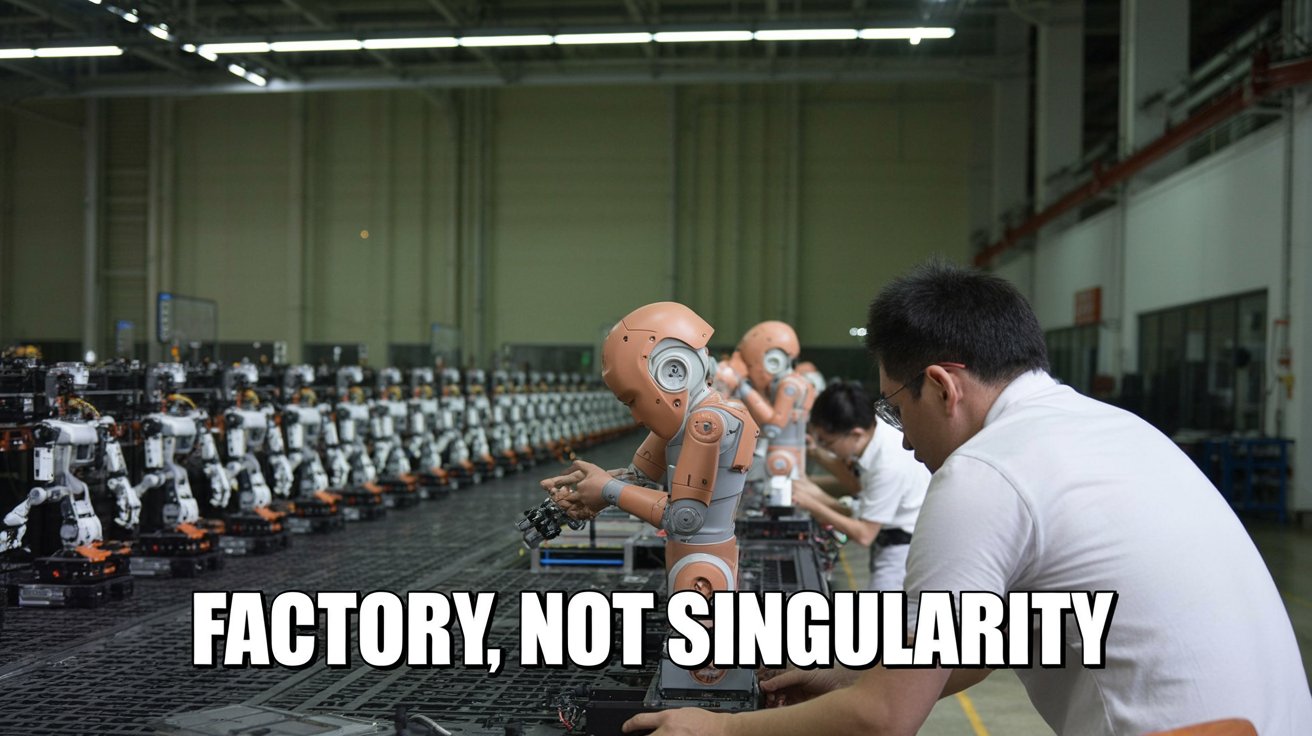
In late March, Chinese state TV quietly aired a segment from Foshan, Guangdong: an automated line that, according to CCTV, can turn out one humanoid robot every 30 minutes, with a China humanoid robot production capacity of 10,000 units a year. No sci‑fi soundtrack, no marching robot army, just a factory shot like any other.
TL;DR
- Foshan’s “10,000 humanoid robots per year” line is best read as nameplate capacity, not current output, but it shows China is industrialising humanoids, not just prototyping them.
- Once you can stamp out bodies on an automated line, the bottleneck shifts from hardware scarcity to software, deployment and regulation, more like smartphones than moon landers.
- That shift matters for economics and geopolitics: mass production accelerates iteration, drives prices down, and makes decisions about where and how these robots are used the real front line.
China humanoid robot production claims, what the state media actually said
The core facts are simple. Regional coverage citing CCTV reports that a new automated assembly line in Foshan “began assembling units on 29 March” and has an annual capacity of about 10,000 humanoid robots, described as “an average of one humanoid robot every 30 minutes.” The line is said to use 24 “digitalised, precision” assembly processes, followed by 77 separate testing procedures to ensure safety and reliability. It is also described as flexible, able to reconfigure workstations and run mixed‑model production on the same line.
Independent outlets such as the South China Morning Post have separately reported that Chinese firms like Unitree and AgiBot are moving into mass production of humanoids, with several makers planning runs of over 1,000 units a year in 2025. But the 10,000‑unit Foshan figure, and the “one every 30 minutes” phrasing, trace back to Chinese state and regional media.
There is, so far, no matching Reuters or AP dispatch with audited numbers or a named customer list. The announcement should be treated as a government‑aligned signal rather than an independently verified production report, but the signal itself is telling.
Why 10,000/year and “one every 30 minutes” are not the same thing
The Foshan coverage blends two different ideas that sound like the same claim: line throughput and annual capacity.
On the one hand, CCTV describes a line that can “roll out one robot every 30 minutes on average.” On the other, state‑aligned reports give a 10,000‑unit annual capacity. These numbers are not internally consistent if taken literally.
A simple back‑of‑the‑envelope shows why:
| Claim | Implied output (24/7) | Implied output (2 shifts, 5d) |
|---|---|---|
| 1 robot every 30 minutes | ~17,520 robots / year | ~4,160 robots / year |
| Nameplate: 10,000 robots/yr | 10,000 robots / year | 10,000 robots / year |
If the line truly ran 24/7 at “one every 30 minutes,” you would reach roughly 17,500 units a year, not 10,000. If you assume a more realistic schedule, say two eight‑hour shifts, five days a week, the 30‑minute figure yields closer to 4,000 units.
The most plausible interpretation is the one familiar from car plants and chip fabs:
- “One every 30 minutes” describes line design throughput under ideal, continuous operation.
- “10,000 a year” is a nameplate capacity rounded to a politically tidy number, and may already assume downtime, ramp‑up, and retooling.
State media have used similar phrasing before for other robotics projects, as Xinhua and China.org.cn coverage shows. The exact arithmetic matters less than the pattern: capacity is being talked about in industrial quantities, not lab runs.
In other words, Foshan is not promising 10,000 robots marching out the door this year. It is advertising a factory that, once demand, software and supply chains catch up, can treat humanoids as just another product on an automated line.
Industrial‑scale production is the signal, not an instant capability leap
A humanoid robot that walks out of Foshan today is not qualitatively different from the prototypes shown at trade fairs last year. The underlying limits, balance, dexterous manipulation, power density, reliable autonomy, are still there. As one Reddit commenter put it bluntly, “It doesn’t matter if they can produce 10k humanoid robots or a million humanoid robots if the humanoid robots are not good enough at completing tasks.”
Yet the strategic shift is real, because it changes what kind of problem humanoids are.
Until now, most humanoid projects have been constrained by hardware scarcity. A lab might have half a dozen units. A start‑up might hand‑assemble a few dozen. Each new mechanical design required bespoke manufacturing and expensive rework. That keeps iteration cycles long and field testing sparse.
Once a country has humanoid robot factories treating these platforms like cars or washing machines, with automated assembly, standardised testing, and mixed‑model flexibility, the bottleneck moves:
- From “Can we build it at all?”
- To “Can we make it useful enough to justify filling this capacity?”
That shift turns a humanoid from an exotic R&D artifact into something closer to a smartphone: a standardised physical shell whose value is determined by software, integration, and supporting services and integrations.
China has already followed this pattern with other technologies. As analysis of AI adoption in China has shown, once there is a hardware or infrastructure base, GPUs, data centres, city‑scale cameras, usage can scale faster than many outside observers expect, because experimentation moves from labs into thousands of real‑world deployments.
What this means in practice, industry, labour and geopolitical consequences
If, and it is an if, lines like Foshan’s actually ramp to thousands of units, four practical changes follow.
1. Iteration speed jumps.
A company with 20 humanoids learns slowly. A company with 2,000 scattered across warehouses, elder‑care facilities and construction sites generates a constant stream of failure modes and edge cases. Software teams can push weekly updates, compare performance across hundreds of near‑identical bodies, and A/B test behaviours. That is how self‑driving software went from campus demos to city pilots; the gating factor was fleets, not algorithms.
2. Unit costs fall, making “mediocre but cheap” viable.
Early humanoids will be limited. But history suggests that mediocre and plentiful often beats excellent and rare. A robot that can safely do 30% of a warehouse worker’s tasks but costs $20,000 and is available in bulk might still be attractive in a country facing demographic pressure. China’s leadership explicitly frames robotics as a response to an ageing workforce in outlets such as China Daily, just as it framed industrial robots as a response to rising wages a decade ago.
That interacts uncomfortably with global debates about AI and unemployment. In many Western economies, distrust of employers and governments slows the deployment of job‑displacing tech. In China’s more state‑directed model, distrust does not disappear, but it plays out differently; Foshan’s announcement reads less like a question and more like a fait accompli.
3. Deployment, not invention, becomes the competitive arena.
If hardware scarcity recedes, the real advantage lies in the messy work of integration: training data from local factories, safety standards that allow or forbid certain uses, insurance and liability rules. A province willing to accept more on‑site experimentation with humanoids, in logistics hubs, ports, or hazardous industrial sites, will learn faster than one that confines them to showrooms.
This creates a new axis of geopolitical competition. The question shifts from “Who builds the most advanced prototype?” to “Who builds the largest, most battle‑tested installed base?” That is the pattern already visible in, for example, China’s dominance in electric vehicle supply chains: not all domestic EVs are best‑in‑class, but the production base and learning loop are formidable.
4. Military and dual‑use risks become less hypothetical.
None of the Foshan coverage talks about defence, and there is no evidence that the unnamed company behind the line is building battlefield robots. But any industrialised platform with legs, arms, and payload capacity is a dual‑use technology by definition. Once hundreds or thousands of units exist, experimenting with security, logistics, or disaster‑response roles becomes far easier, for any country that can buy or copy the design.
The uncomfortable truth is that industrialised humanoids compress timelines. Even if the robots themselves are clumsy today, the infrastructure to build many more of them is what matters. The day a more capable design arrives, it will not face a standing start in manufacturing.
Key Takeaways
- Foshan’s line is best read as capacity signalling: China is building the ability to mass‑produce humanoids, not claiming that 10,000 fully useful robots exist today.
- The shift from handcrafted prototypes to automated humanoid robot factories moves the bottleneck from mechanical engineering to software, deployment, and regulation.
- Even limited humanoids become interesting when cheap and numerous, especially in a country managing demographic decline and willing to push deployment.
- Industrialisation of humanoids accelerates learning loops and creates dual‑use potential long before robots are broadly capable general workers.
- The real race is no longer about a single breakthrough robot, but about who builds the largest, best‑tested installed base on top of standardised hardware.
Further Reading
- Foshan launches China’s first automated humanoid robot line, Regional coverage citing CCTV with the 10,000/year capacity and “one every 30 minutes” claim, plus process and testing details.
- China’s humanoid robot sector enters mass production, Unitree, AgiBot among the pack, South China Morning Post analysis of Chinese humanoid makers scaling up production.
- China reports on robotics and automated production, Xinhua/China.org.cn coverage showing similar state media phrasing on throughput and automation.
- China Daily features on humanoid/robot industry and production facilities, National paper framing robotics as a strategic manufacturing and demographic tool.
- AI adoption in China: Shenzhen’s OpenCLaw and rapid uptake, NovaKnown analysis of how deployment and experimentation, not just invention, drive China’s AI trajectory.
The Foshan line is not a countdown to sentient androids; it is something less dramatic and more consequential. It is a sign that, for at least one major power, humanoid robots are moving from the lab bench to the factory floor, and from a hardware problem to everything that comes after.