
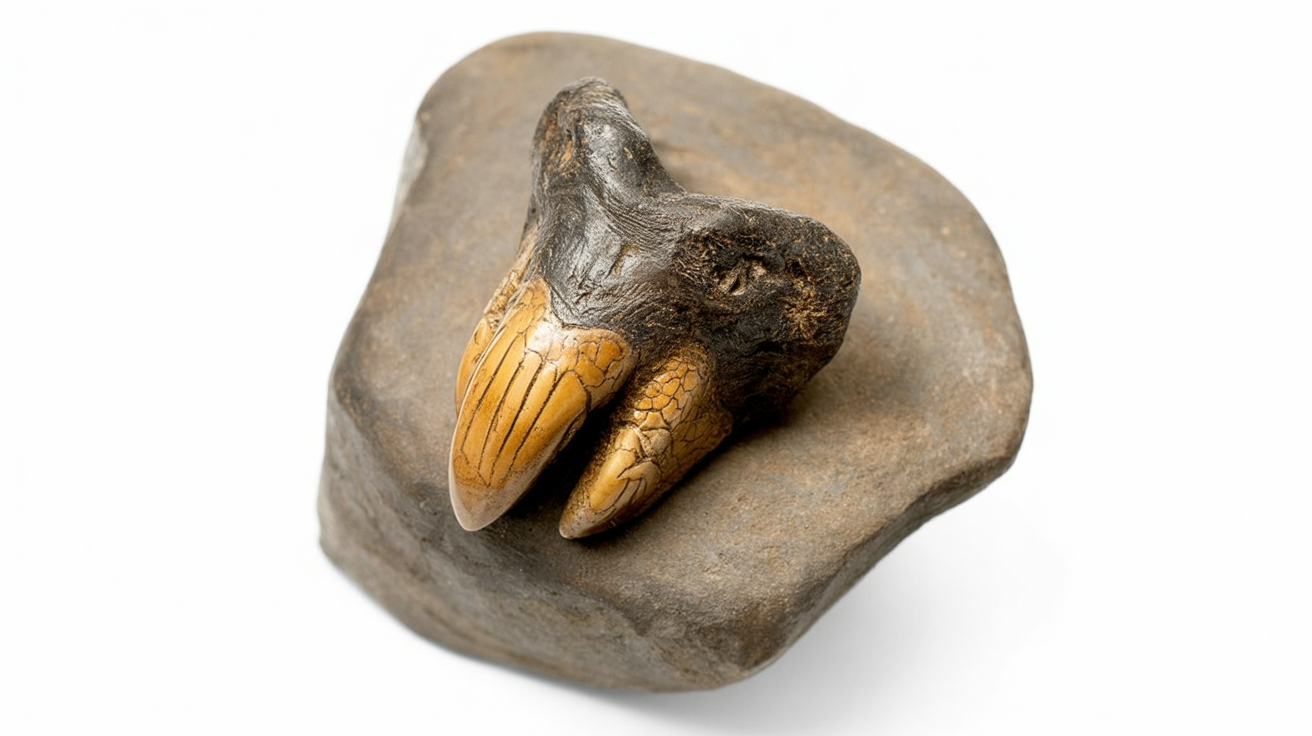
A Nature paper published on 13 May reports that researchers recovered enamel proteins from six Chinese Homo erectus fossils, adding rare molecular evidence to a lineage that has mostly had to be placed by bone shape and geography alone.
The fossils, from Zhoukoudian, Hexian and Sunjiadong, and dated to about 0.4 million years ago, all carried two shared amino-acid variants in the enamel protein ameloblastin, giving late Middle Pleistocene H. erectus in East Asia a clearer, and less tidy, place in the human family tree.
That matters because Homo erectus is one of the longest-lived and widest-ranging hominin lineages, but molecular evidence from it has been almost nonexistent. The paper notes that the only earlier protein data came from a 1.77-million-year-old tooth from Dmanisi in Georgia, and those sequences lacked the kind of informative variation needed to distinguish lineages. We covered that broader molecular push recently in our report on Homo erectus fossil proteins.
The new study analyzed enamel proteins from five male and one female specimens from the three Chinese sites. Enamel tends to preserve longer than ancient DNA, which is why palaeoproteomics keeps turning up in places where genomes do not: it is a thinner record, but sometimes it is the only record left.
One of the two shared variants, A253G in AMBN, was previously unknown and has not been identified in other tested human lineages, including Denisovans, Neanderthals, modern humans, Homo antecessor and the Dmanisi H. erectus sample. The other, AMBN(M273V), had previously been identified in Denisovans.
In the paper, the authors infer from that second variant that some Denisovan genome segments previously attributed to a super-archaic source may in fact have come from populations related to these late Chinese H. erectus. In plain terms, the claim is not that anyone found H. erectus DNA, but that a protein marker seen in both groups fits an older story in which Denisovans inherited genetic material from a much earlier East Asian population.
“The regions in the Denisovan genome attributed to super-archaic introgression … are likely to have originated from H. erectus,” the authors write, adding that late Middle Pleistocene H. erectus may have coexisted with Denisovans in parts of East Asia.
Elizabeth Pennisi reported in Nature News that this is the first molecular evidence suggesting interaction between H. erectus and Denisovans. That is the structural significance here: not a neat new branch on the family tree, but a fresh argument that East Asian hominin history involved overlap and admixture rather than a clean replacement sequence.
The caveat is that the evidence comes from proteins, not genomes, and from just two shared amino-acid variants. As John Timmer noted in Ars Technica, that makes the result informative but limited; it supports population-level inferences rather than documenting a direct mating event. An independent expert quoted by Nature News, palaeoanthropologist María Martinón-Torres of University College London, who was not involved in the study, said the work shows how unsettled these classifications remain and raises the question of what researchers even mean by Homo erectus as a category.
The paper was published in Nature on 13 May 2026. Its DOI is 10.1038/s41586-026-10478-8.
Key Takeaways
- A Nature study analyzed enamel proteins from six Chinese Homo erectus fossils dated to about 400,000 years ago.
- The fossils came from Zhoukoudian, Hexian and Sunjiadong, and included five males and one female.
- All six specimens shared two ameloblastin amino-acid variants.
- One variant, A253G in
AMBN, was previously unknown in other tested human lineages. - Another variant,
AMBN(M273V), was previously seen in Denisovans, supporting an inferred link between Denisovan super-archaic ancestry and H. erectus.
Further Reading
- Enamel proteins from six Homo erectus specimens across China, Primary Nature research article reporting enamel protein analysis of six Chinese H. erectus fossils.
- Did Homo erectus and Denisovans mate? Tooth proteins hint at ancient trysts, Nature News explainer on the study and its implications.
- Palaeontology: Ancient teeth hint at interactions between archaic humans, Nature Portfolio press summary of the findings.
- Ancient teeth hint at canoodling between early human relatives, AP report summarizing the study for general readers.
- Protein in Homo erectus teeth suggests Denisovans gave us some of their DNA, Ars Technica explanation of the protein evidence and its limits.
TOPIC VOCABULARY (from the research brief, may inform your keyword choice, but the article body is authoritative):
Homo erectus, enamel proteins, paleoproteomics, Denisovans, Middle Pleistocene