
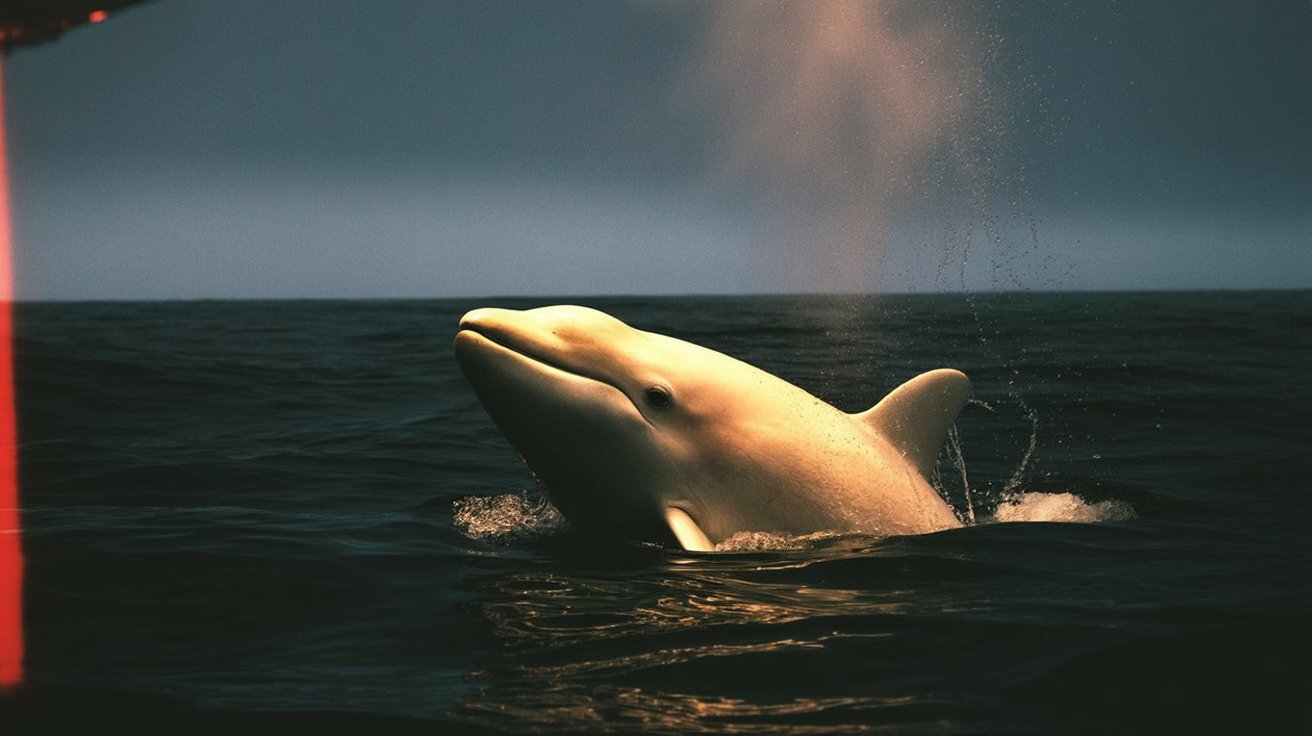
White orcas are real, but most white killer whales are not confirmed albinos. The key distinction is that albinism means a near-total absence of melanin across the body, while many pale or white-looking whales are better explained by other pigmentation changes such as leucism or reduced contrast in normally black-and-white skin patterns, as marine mammal experts note in explainers on whale coloration and albinism from Baleines en direct and NOAA-linked research on killer whale morphology and pigmentation differences.
Orcas are normally black and white, with species-level patterning described by NOAA Fisheries. So when one turns up looking mostly white, it is unusual. But unusual is not the same thing as diagnosed. That matters here.
Are white orcas real?
Yes. A widely reported adult all-white killer whale was photographed near Russia’s Kamchatka Peninsula in 2010, and scientists quoted at the time said the animal appeared genuinely white while also stressing that the cause was still uncertain. NOAA has also documented unusual killer whales off Cape Horn, Chile, including animals with strikingly atypical appearance.
That is the practical answer readers usually want: yes, white-looking orcas exist in the real world, not just in rumor or edited photos.
But the evidence does not justify treating every white or pale orca as automatically albino. The Smithsonian report on that Russian sighting explicitly noted scientists’ uncertainty about whether the whale was albino. That is the right level of confidence.
Why some orcas look white
The short version is that white appearance can come from more than one biological route.
Baleines en direct explains that true albinism is caused by genetic changes that disrupt melanin production. In mammals, melanin is the pigment that normally colors skin and eyes. If melanin is missing almost entirely, an animal can appear white or pinkish, and the eyes often look red or very pale because the pigment that would normally darken them is absent.
But white-looking whales can also result from other pigment disorders. The same explainer distinguishes albinism from conditions such as leucism, in which pigmentation is reduced but not eliminated. That difference sounds technical. It is not. It is the difference between “the pigment system is broadly off” and “the pigment system is missing.”
Killer whales also have natural variation in markings across ecotypes and populations, with NOAA-backed morphology work describing pigmentation differences among killer whale forms. That does not mean normal orcas are secretly white. It means the species already has visible pattern variation before you get to rare pigment abnormalities.
How to tell albinism from normal white coloration
The best clue is the eyes. According to Baleines en direct, animals with true albinism usually have very pale, pink, or reddish eyes because melanin is absent there too. A whale that looks white but still has dark or normally pigmented eyes is less likely to be truly albino.
Other useful signals run in parallel:
- Albinism usually means near-total melanin loss across skin, eyes, and sometimes hair-bearing tissues in other mammals, as summarized by Baleines en direct.
- Leucism or partial pigment loss can leave an animal pale or patchy while preserving some darker pigmentation, including in the eyes, according to Baleines en direct.
- Normal killer whale coloration still includes white underside and eye-patch regions, as shown on the NOAA Fisheries species page.
In other words, an orca can be “very white” for different reasons. The label depends on which pigment systems are affected, not just on what a photo looks like from a boat.
That is why many famous white-orca sightings stay in the category of unusual pigmentation. Without close clinical observation, eye-color confirmation, or, ideally, genetic evidence, calling the animal albino is more confidence than the evidence supports. A white body alone is not a diagnosis.
Key Takeaways
- White orcas are real, with documented sightings including a widely reported all-white adult near Russia in 2010.
- Most white killer whales are not automatically confirmed albinos, because white appearance can come from albinism, leucism, or other pigmentation changes described by Baleines en direct.
- True albinism affects melanin broadly, including the eyes, which are often very pale or pinkish in albino animals, according to Baleines en direct.
- Killer whales already show pattern variation across ecotypes and populations, including documented pigmentation differences in NOAA-backed morphology research.
- A white body is not enough to diagnose albinism without stronger visual or genetic evidence.
Further Reading
- Killer Whale | NOAA Fisheries, NOAA overview of killer whale biology and appearance.
- Killer Whale: Science | NOAA Fisheries, NOAA science page on killer whale populations and ecology.
- Scientists Find Mystery Killer Whales off Cape Horn, Chile | NOAA Fisheries, NOAA report on unusual Southern Ocean killer whales.
- Rare Sighting of All-White Orca Whale | Smithsonian Magazine, Coverage of a documented all-white orca and scientists’ uncertainty about its cause.
- Do albino whales exist? | Baleines en direct, Clear explainer on albinism versus other white color patterns in whales.
References
- NOAA Fisheries, Killer Whale
- NOAA Fisheries, Killer Whale: Science
- NOAA Fisheries, Scientists Find Mystery Killer Whales off Cape Horn, Chile
- Smithsonian Magazine, Rare Sighting of All-White Orca Whale
- Baleines en direct, Do albino whales exist?
- NOAA Repository, Quantifying variation in killer whale morphology using elliptical Fourier analysis
Last reviewed: 2026-06