
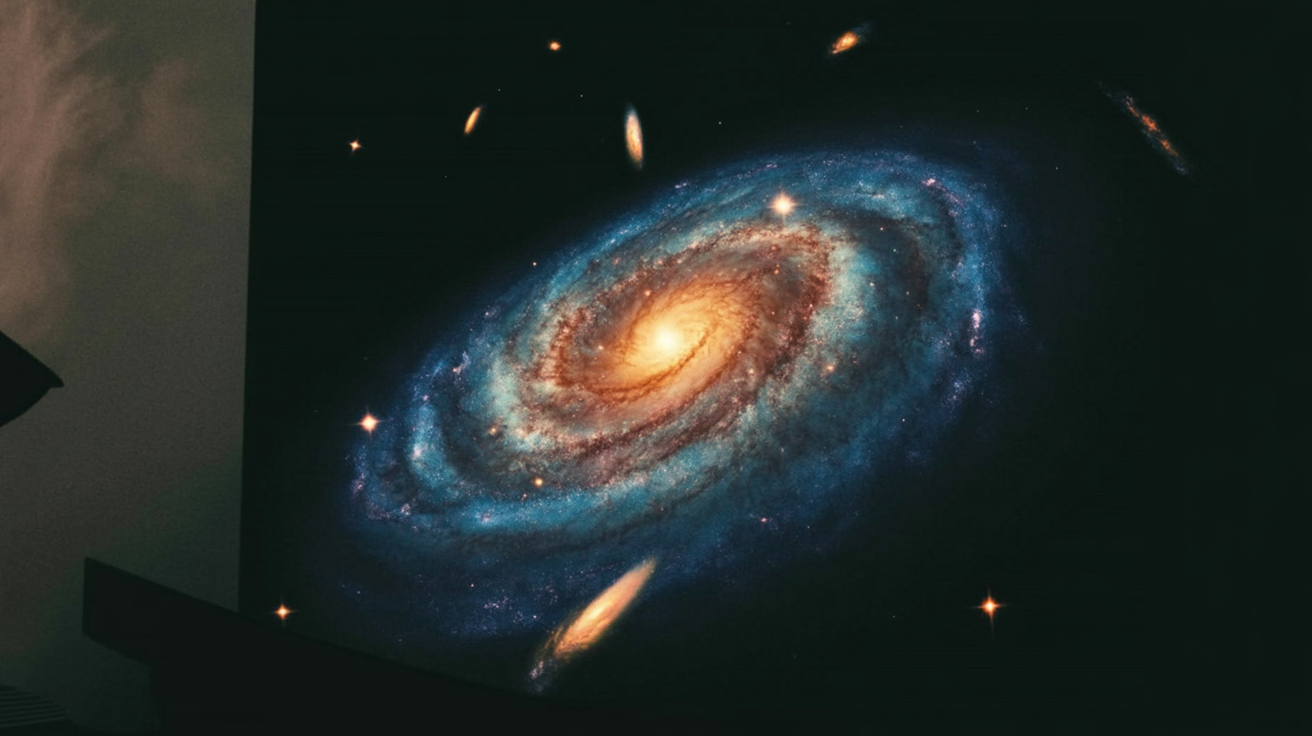
Direct collapse to a black hole is a formation pathway in which a pristine gas cloud avoids breaking into normal stars and instead collapses almost straight into a massive black hole seed. The key trick is that Lyman-Werner radiation can suppress molecular hydrogen, removing the cloud’s main coolant and keeping it hot enough to fall inward rather than fragment.
This matters because the early universe appears to have produced supermassive black holes very quickly, and ordinary stellar-remnant seeds can struggle to grow that fast under standard limits on accretion.
What direct collapse means
In the usual picture, dense gas cools, fragments, and forms stars. Some of those stars later die and leave behind black holes. Direct collapse is the different route: a metal-free gas cloud in an early dark-matter halo stays simple, hot, and dense enough that it does not make a normal first generation of stars, and instead heads toward a much larger seed from the start Nature Astronomy, 2017.
The phrase can sound more abrupt than the physics really is. In simulations, the gas typically collapses into a central object such as a protostellar core or supermassive star, which then becomes a black hole. But the important point is the same: the cloud skips the standard small-star route and produces a seed that is already large.
According to the 2019 Nature study, rapidly growing, metal-free pre-galactic gas clouds can collapse at rates of about at least 0.1 solar masses per year. At that pace, a cloud feeding for 1 million years would supply about 100,000 solar masses of material. That is the appeal in one number: you are not starting from a typical stellar black hole of a few tens of solar masses.
The conditions the gas has to meet
The first condition is chemical simplicity. The cloud has to be metal-free or nearly so, because heavier elements provide extra cooling channels. Cooling sounds harmless. Here, it is the enemy. If the gas cools too well, it breaks into many clumps and makes stars instead of one dominant collapsing object.
The second condition is weak molecular-hydrogen cooling. In primordial gas, H2 is the main low-temperature coolant. If enough H2 forms, the cloud can cool to a few hundred kelvin, fragment, and produce Population III stars, the first generation of stars formed from pristine material. Direct collapse needs that route shut down.
That is where Lyman-Werner radiation comes in. This ultraviolet radiation, generally from nearby star-forming galaxies, dissociates molecular hydrogen and suppresses its formation. With H2 cooling reduced, the gas stays much warmer, around the atomic-cooling regime, and collapses more smoothly instead of shattering into many small star-forming pockets Nature Astronomy, 2017.
The third condition is environment. The halo has to be massive enough for atomic hydrogen cooling to operate, while also sitting close enough to a neighboring galaxy to receive a strong Lyman-Werner flux, but not so close that it gets polluted with metals too early. It is a fussy setup. The universe does not hand these out casually.
The 2017 Nature Astronomy paper describes this as a close-proximity scenario involving an embryonic protogalaxy and a neighboring source of radiation. The neighboring system helps by sterilizing the gas cloud’s H2 chemistry. It can also hurt by sending metals or other feedback into the same region. So the window is narrow: enough ultraviolet light to block normal star formation, but not so much contamination that the cloud stops being primordial.
A compact way to think about the required conditions is:
- pristine or nearly pristine gas
- a halo hot enough for atomic cooling
- strong Lyman-Werner radiation
- and limited metal pollution from nearby star formation Nature Astronomy, 2017
Why astronomers think it matters
Astronomers think direct collapse matters because some quasars appeared very early and already hosted enormous black holes. NASA notes that supermassive black holes sit at the centers of large galaxies, but explaining the most ancient examples is harder: they had less cosmic time available to grow.
If the first seeds were only the remnants of ordinary massive stars, growth can be tight on the clock. A direct-collapse seed starts much larger, which eases the timing problem. That does not make direct collapse proven. It makes it useful. It is one of the few pathways that naturally gives the universe a head start.
The 2019 Nature paper strengthens that case by showing, in simulation, that rapidly accreting metal-free clouds can form a central object that grows into a supermassive star and then a massive black hole seed. The 2017 Nature Astronomy paper argues that nearby protogalaxies can create the radiation conditions needed for this route. Put together, the studies sketch both the why and the how.
There is still a catch. Direct collapse is hard to observe directly because black holes are difficult to see unless they interact with nearby matter, and the crucial phase happens in the distant early universe. That is why candidate observations matter so much. NASA’s Webb team reported a possible direct-collapse black hole candidate in 2025, which is exactly the sort of object astronomers have been hunting for, though “possible” is doing real work there.
So the blunt answer is this: direct collapse matters because it offers a credible way to make big black hole seeds fast enough to explain early supermassive black holes. It is not the only proposed pathway, but it is one of the cleanest ways to skip the slow part.
Key Takeaways
- Direct collapse is the idea that a pristine gas cloud can avoid normal star formation and collapse into a massive black hole seed Nature Astronomy, 2017.
- Lyman-Werner radiation helps enable direct collapse by suppressing molecular hydrogen, the main coolant in primordial gas.
- Metal-free gas is important because metals let gas cool and fragment more easily into stars.
- The pathway likely runs through a protostellar core or supermassive star, not a literal one-step jump from cloud to black hole.
- Astronomers care because larger initial seeds make it easier to explain supermassive black holes in the early universe.
Further Reading
- Black Holes, NASA’s overview of what black holes are and why supermassive ones matter.
- What Are Black Holes?, NASA explainer on black hole classes and formation channels.
- Rapid formation of massive black holes in close proximity to embryonic protogalaxies, Nature Astronomy paper on the radiation and environmental conditions behind direct collapse.
- Formation of massive black holes in rapidly growing pre-galactic gas clouds, Nature paper on the collapse pathway through a protostellar core and supermassive star.
- NASA’s Webb Finds Possible ‘Direct Collapse’ Black Hole, NASA blog on a recent observational candidate.
References
- NASA Science, Black Holes
- NASA, What Are Black Holes?
- Wise et al., 2019, Formation of massive black holes in rapidly growing pre-galactic gas clouds
- Agarwal et al., 2017, Rapid formation of massive black holes in close proximity to embryonic protogalaxies
Last reviewed: 2026-06